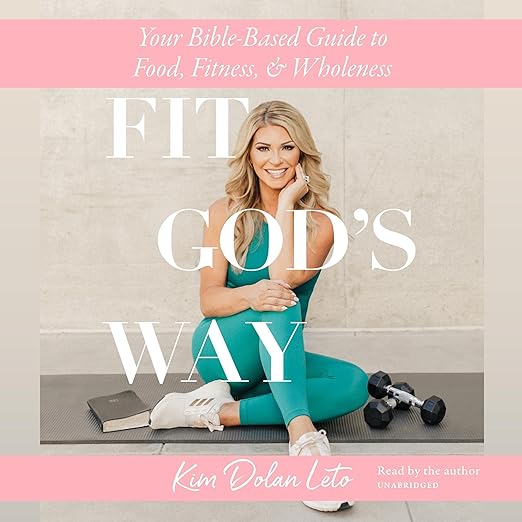
Quick Take
- Narration: Kim Dolan Leto narrates her own book with warm conviction and the unhurried confidence of someone who has given these talks many times before, the self-narration is essential to the material’s emotional resonance.
- Themes: Faith-integrated fitness, spiritual self-concept over worldly comparison, breaking the Monday-diet-restart cycle
- Mood: Warmly devotional and purposefully motivating, closer to a women’s faith retreat than a fitness manual
- Verdict: A genuinely distinct entry in the Christian fitness space that earns its audience through scriptural depth rather than surface inspiration, though listeners outside its faith tradition will find the framework inaccessible.
There is a particular kind of audiobook that only fully works when the author reads it herself, and Fit God’s Way is one of them. I listened to the opening chapter on a Saturday morning, half expecting the familiar wellness-meets-faith hybrid that often dilutes both. What I found instead was someone who has clearly spent years inside this material, thinking about it, testing it, revising it against her own experience as an ESPN Fitness America Champion who is also a committed Christian. Kim Dolan Leto’s voice carries the particular authority of lived integration rather than intellectual synthesis.
The book’s central argument is structural: the fitness industry’s model of willpower-dependent behavior change is fundamentally incompatible with sustained transformation, and the replacement for weak willpower is the Holy Spirit’s gift of self-control. This is not a metaphor. Leto means it literally, and she builds her seven-habit system around scriptural foundations rather than behavioral psychology. That distinction matters more than it might first appear.
Why the Scripture-First Framework Is Not Decoration
Reviewer Brynne Elise noted that inviting God into every aspect of the health journey is what makes the message unique and powerful, and she is identifying something real. Most faith-adjacent fitness books use scripture as inspirational seasoning on top of a program that would otherwise look identical to its secular equivalents. Leto inverts this. She starts with theology and derives the fitness methodology from it. Self-control is a fruit of the Spirit described in Galatians. Confidence comes from being seen through God’s eyes rather than through a scale. Motivation is rooted in purpose and calling rather than aesthetics.
This architecture has a practical consequence that reviewer James picked up on: the book is full of actionable takeaways, scripture references, and prayers that reinforce each chapter’s message. Listening to this rather than reading it means you absorb the rhythm of those prayers in Leto’s voice, which is where self-narration earns its keep. A professional voice actor reading these sections would inevitably introduce a layer of performance distance that would undercut the intimacy.
The Seven Habits and What They Actually Cover
The seven habits of Christ-centered fitness that structure the book range from the expected, nutrition and exercise, to the more distinctive, managing social media comparison and building a personalized daily system. The social media chapter is among the book’s sharpest contributions. Leto is direct about the way curated fitness imagery creates a thought cycle of not good enough that is antithetical to Christian anthropology, and she names this as a spiritual problem rather than simply a psychological one. For her target audience, that reframing carries significant weight.
The exercise and nutrition guidance is less distinctive, offering sensible but familiar principles rather than a specific protocol. This is appropriate for a book that positions itself as a system-builder rather than a program, and it is an honest choice that reviewer lissa Shep flagged when she noted wanting more in-depth specifics after Leto’s earlier book. The seven-hour runtime is well-calibrated: substantial enough to deliver a complete framework, short enough to avoid padding.
The Audience This Book Is Written For
Fit God’s Way is written for Christian women, and it does not hedge that specificity. The scripture is not optional background material. The prayers at the end of each chapter are not aesthetic choices. The entire framework assumes a relationship with God that the listener is trying to align more fully with her body and health practices. Listeners outside that tradition will find the book structurally unfollowable because the motivational architecture depends on shared beliefs.
Within that audience, however, Leto delivers something more rigorous and more specific than most faith-fitness titles manage. The 4.8 rating across 345 reviews reflects a readership that found what it came looking for and found it done well.
Who Should Listen and Who Should Skip
Christian women who have cycled through secular fitness programs without lasting results and suspect the missing variable is spiritual will get substantial value here. The self-narration is non-optional: if this title becomes available with an alternative narrator, hold out for Leto’s version. Skip it if your health and fitness goals do not intersect with faith practice, not because the content is poorly done but because the framework requires shared premises to function.
Frequently Asked Questions
Is Kim Dolan Leto’s narration of her own book notably different from what a professional narrator would deliver?
Yes, meaningfully so. The prayers and scripture-based sections carry a devotional quality in her own voice that would be difficult for a professional actor to replicate without making it feel performed. The warmth is genuine rather than crafted.
Does the book include specific exercise and meal plans, or is it primarily philosophical and spiritual?
The book is primarily a framework and mindset system. It offers clear guidance on developing seven habits, but it does not include detailed meal plans or training programs. Listeners wanting a prescriptive protocol should supplement it with a separate plan.
How does Fit God’s Way compare to other Christian fitness titles like Made to Crave?
Leto’s book is more practically structured than Lysa TerKeurst’s Made to Crave, with a clear habit-building system rather than a memoir-inflected devotional journey. Both are scripturally grounded, but Fit God’s Way is more explicitly a program with accountability built in.
Is this audiobook appropriate for men as well as women, despite being marketed to Christian women?
The content is not inherently exclusionary, but the book addresses its reader as a woman consistently throughout. Reviewer James provided a five-star review, suggesting men find value in it, but the framing and examples are clearly oriented toward a female audience.