Quick Take
- Narration: David Ackroyd handles the dual-protagonist structure cleanly, keeping Peter and Thea’s voices distinct without overplaying either.
- Themes: Arctic adventure, hidden worlds, parallel mysteries
- Mood: Quietly mysterious and building, with a satisfying late-act convergence
- Verdict: A strong debut from Stead that middle-grade listeners will find genuinely surprising, even if it starts more slowly than her later work.
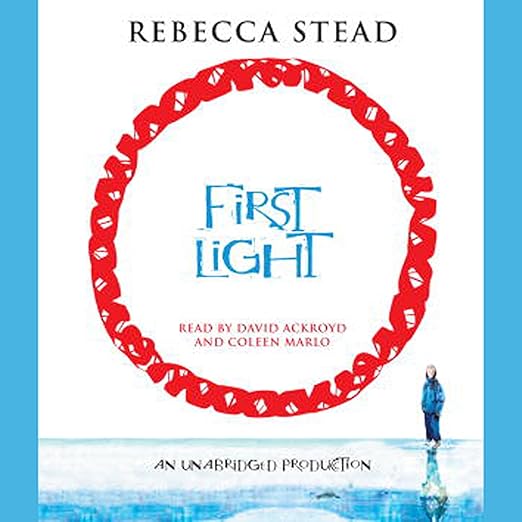
I finished Rebecca Stead’s debut novel on a quiet Saturday morning when rain had made any outdoor plans irrelevant. There is something fitting about listening to a book set partly on the Greenland ice cap while the windows fog up and the world outside turns gray and wet. First Light runs just over seven hours, narrated by David Ackroyd, and I found myself stretched out longer than I’d planned, unwilling to stop before Peter and Thea’s stories converged. For a children’s audiobook, it held my attention with a consistency I wasn’t fully expecting from a debut.
Rebecca Stead has since become something of a known quantity in middle-grade fiction, When You Reach Me won the Newbery Medal and earned a devoted readership. But this earlier novel, which she wrote before that success, carries the same structural intelligence and the same gift for dual-narrative tension. Knowing what Stead would go on to accomplish makes First Light retrospectively interesting as a debut, and in audio form, Ackroyd does the material justice.
Our Take on First Light
The dual structure is the engine of this book, and Stead runs it well. Peter’s storyline is grounded in the recognizable, a kid joining his father’s scientific expedition in Greenland, experiencing a strange and unsettling series of visions on the ice. Thea’s story is far stranger: a community of people who have lived for generations inside the arctic ice, hidden from the surface world after being suspected of witchcraft. These two storylines run in parallel until Stead brings them together in a convergence that reviewers have correctly noted is genuinely surprising. One young reader described it as thinking you have everything figured out until you realize you are, in their words, terribly wrong. That’s exactly right.
Why Listen to First Light
David Ackroyd’s narration is well-suited to material that requires tonal flexibility. He moves cleanly between Peter’s contemporary American register and Thea’s more formal, slightly otherworldly voice without making either feel theatrical. For a children’s audiobook, that distinction matters: younger listeners need differentiation that is clear but not condescending, and Ackroyd threads that needle. The book also weaves in real science, Peter’s father studies global warming in Greenland, and Stead incorporates that context without making it feel like a lesson. The arctic setting is rendered with enough specificity to feel real: dogsled travel, the particular quality of the ice, the scale of the landscape.
What to Watch For in First Light
The book’s weaknesses are largely structural and mostly minor. Some listeners who came to Stead through When You Reach Me note that this debut is somewhat less polished in its pacing, particularly in the early chapters before the two storylines have fully distinguished themselves. The mystery of Thea’s underground world takes some time to come into focus, and younger readers who want immediate action may find the opening slower than they’d prefer. The book is also definitively a middle-grade novel, its emotional register is calibrated for readers around ages 10 to 14. Adults who listen alongside children will likely enjoy it, but it isn’t cross-demographic in the way that some children’s literature manages to be.
Who Should Listen to First Light
The natural audience is children aged 9 to 13 who enjoy mystery and adventure with a genuine speculative premise. Parents reading aloud or listening alongside younger children will find it accessible and engaging, and Ackroyd’s narration is pleasant enough to sustain adult attention over the seven-hour runtime. Fans of Stead who know her through When You Reach Me will want this as a companion piece, it shows where the structural instincts that won the Newbery were first developing. Skip it only if you’re looking for something with a faster early pace or more overt action.
One final note for parents and educators: the Greenland setting is not just atmospheric. Stead uses it to introduce the realities of climate research in a way that is accurate without being agenda-driven, and the specific details of life on the ice cap, the dogsled travel, the scientific camp routines, the disorienting scale of the landscape, give the book an educational texture that makes it genuinely useful in classroom contexts alongside its narrative pleasures. That combination of adventure, speculative premise, and scientific authenticity is rarer in middle-grade fiction than it should be.
Frequently Asked Questions
Is First Light appropriate to listen to with younger children, say ages 7 or 8?
The book is aimed at middle-grade readers around ages 10 to 14. There are no scary or graphic elements, but the dual narrative structure and mystery elements work best with slightly older listeners who can hold two storylines in their heads simultaneously. A patient 8-year-old who enjoys longer chapter books could manage it.
Does David Ackroyd differentiate the voices of Peter and Thea clearly enough?
Yes. Ackroyd does solid work distinguishing the two protagonists, Thea’s more formal register is distinct from Peter’s contemporary American voice. The differentiation is clear without being overdone.
How does First Light compare to When You Reach Me for someone who loved that book?
First Light is less polished and somewhat slower to establish its central mystery, but it shares the same structural intelligence and the same commitment to a genuine convergence twist. Think of it as Stead working out the instincts she would later perfect, worth reading, but the Newbery winner is the stronger book.
Is the global warming theme handled in a heavy-handed way?
No. Peter’s father is an ice researcher and the Greenland setting is grounded in that context, but Stead is primarily interested in story rather than message. The science adds authenticity to the setting rather than driving the narrative with an agenda.