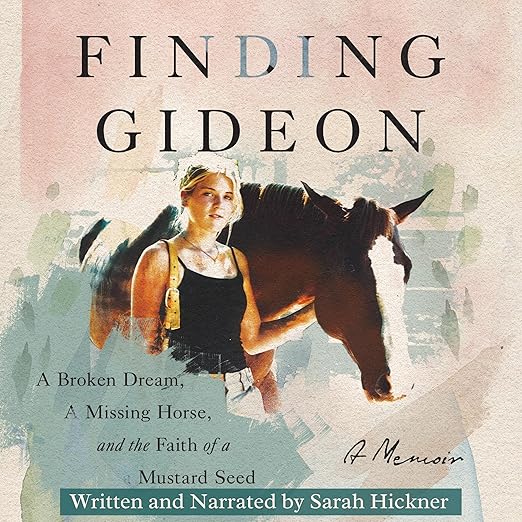
Quick Take
- Narration: Sarah Hickner reads her own memoir with the unguarded quality of someone telling you the story across a kitchen table; authenticity compensates for polish.
- Themes: Chasing a dream against the odds, faith under pressure, the bond between horse and rider
- Mood: Earnest and emotionally open, with real grit underneath the warmth
- Verdict: A self-narrated memoir that earns its reputation through honest storytelling and a central horse-racing arc that genuinely keeps you listening.
I picked up Finding Gideon because a reader told me it had made her cry on a plane and she wanted me to understand why. She is a former eventer who does not cry easily. I was curious. I started the audiobook on a Thursday morning walk and finished it the following Saturday, which for a nearly ten-hour listen represents something close to compulsion.
Sarah Hickner narrates her own story, which begins with a fifth-grade girl reading Thoroughbred series novels and arrives at a junior-year-of-college decision to leave home and apprentice as a jockey exercise rider in Louisville. The horse at the center of all of it is Gideon, a Thoroughbred who disappears from her life at the moment when everything else is also crumbling. What holds the memoir together is Hickner’s willingness to describe failure without prettifying it.
Our Take on Finding Gideon
The Readers Favorite Gold Medal and the 2023 Pencraft Awards recognition are not the usual marketing decoration; the book has earned its praise. Hickner writes and speaks with a quality that reviewers have described as making “small moments become significant,” and I think that is precise. The section where she is riding young Thoroughbreds at dawn and impressing trainers with her bravery, only to watch the dream start coming apart piece by piece, is constructed with the kind of narrative control that makes you forget this is a memoir and not a novel.
The faith element is present throughout, and Hickner is transparent about it. She is wrestling with a God who, as she frames it, gives and takes away, and she does not resolve that wrestling with easy answers. Readers who share her Christian framework will find resonance; readers who do not will find the faith sequences honest enough to be readable without feeling like a sermon.
Why Listen to Finding Gideon
The self-narration is the right choice for this book even if it sacrifices professional smoothness. Hickner’s voice carries the memory of the events rather than a performance of them. You hear the places where she is still figuring out what something meant, and that unresolved quality is part of what gives the memoir its texture. One reviewer described it as “the perfect escape on a beach vacation,” and while I understand that framing, I think it undersells how genuinely difficult some of the material is. This is not a comfortable book; it is a compelling one.
The racing sequences, particularly those involving the physical reality of galloping exercise horses in the pre-dawn dark, are some of the most vivid equestrian writing I have encountered in memoir form. If you have spent time at a track, even as a spectator, you will recognize the sensory detail. If you have not, you will still feel it.
What to Watch For in Finding Gideon
Listeners who come looking for a straightforward racing memoir in the Seabiscuit tradition should know that Finding Gideon is more interior than that comparison suggests. The racing is the setting, not the story. The story is what a young woman is willing to endure in order to do the thing she has always known she needed to do. The comparisons to Wild Hearts Can't Be Broken in the synopsis are closer to the mark. This is a coming-of-age story that happens to be set on a backstretch.
Who Should Listen to Finding Gideon
Readers who love horse racing memoirs, coming-of-age stories with real stakes, or faith narratives that do not shy away from doubt will all find something here. It also works for listeners who enjoy the quality of a self-narrated audiobook, where the author’s voice and the story’s emotions are inseparable. Skip it if you need a polished professional narrator, or if you are looking for racing history and industry context rather than personal narrative. Those who are indifferent to or impatient with faith content may want to sample the first chapter first.
Frequently Asked Questions
Is Finding Gideon a traditional horse racing memoir or more of a personal spiritual narrative?
It is primarily a personal memoir that uses the horse racing world as its setting. Faith, identity, and perseverance are more central than racing history or industry detail. The book has been compared to Wild Hearts Can’t Be Broken more than to Seabiscuit.
Does Sarah Hickner’s self-narration work for the full ten-hour runtime?
Most reviewers find it does, largely because the unpolished authenticity fits the material. Her voice carries genuine memory rather than performance. Listeners who strongly prefer professional narrators may find the occasional roughness distracting, but it is not an obstacle to enjoying the story.
What actually happens to Gideon? Does the memoir have a resolution regarding the horse?
The synopsis is deliberately vague, and the book is worth experiencing without spoilers. What I can say is that the question of Gideon’s fate is eventually answered, and the resolution shapes the memoir’s emotional arc in ways you may not anticipate.
Is Finding Gideon suitable for teen readers who love horses?
Yes, with one note: the book contains themes of loss, faith struggle, and young adult romantic elements. There is nothing inappropriate, but the emotional depth is probably best suited to readers fifteen and older. Teens who have read the Thoroughbred series Hickner mentions in the memoir are a natural audience.