In Brief
- Read by: Kiiri Sandy delivers the Gottmans' research with warmth and authority, keeping the clinical material from feeling cold or lecture-like.
- At its heart: Conflict as intimacy, the five critical mistakes couples make, Gottman method communication repair.
- Vibe: Practical and encouraging, grounded in real case studies.
- Short version: Couples who avoid hard conversations and couples who have them badly will both find specific, research-backed tools here.
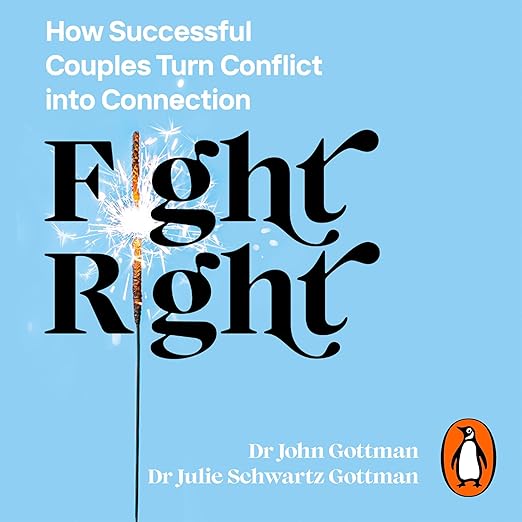
The Gottmans have spent decades studying what separates couples who survive conflict from those who are destroyed by it, and the audiobook edition of Fight Right by Dr. John Gottman and Dr. Julie Schwartz Gottman, narrated by Kiiri Sandy, distills that research into something immediately usable. This is not a book about keeping the peace. It is a book about fighting better, and the distinction matters. The premise is direct: conflict is not a sign that a relationship is failing. It is the material through which lasting connection is either built or corroded, depending entirely on how couples handle it.
Five Mistakes That Recur Across Every Culture
The central argument rests on a research foundation that the Gottmans have been refining since the 1970s, and the audiobook format makes their case feel conversational rather than academic. Sandy's narration carries the right register for this material. She is measured without being flat, and she handles the book's case studies with the kind of attentiveness that the couples described deserve. The Gottmans are not gentle with their diagnosis of how people fight wrong. They identify five critical mistakes that recur across couples regardless of background or relationship length, and they name these patterns specifically enough that most listeners will recognize themselves in at least one of them within the first few chapters.
What distinguishes Fight Right from the broader field of couples communication literature is the international study woven through the later chapters. The Gottmans use data from couples across multiple cultures to argue that the dynamics driving conflict, including contempt, stonewalling, and what they call flooding, are not cultural artifacts but near-universal patterns. That argument is convincing, and the clinical case studies that accompany it prevent the data from feeling abstract. These are real couples, genuinely struggling, and the book is frank about how difficult recovery actually is.
Sandy Avoids Both Preachy and Cheerful Traps
Sandy's narration makes a real difference to this material. Couples communication books carry an inherent risk: if the tone turns preachy or overly cheerful, the listener disengages. Sandy avoids both traps. She reads the Gottmans' more provocative claims, including their insistence that suppressing conflict is as damaging as explosive fighting, with enough seriousness that the arguments land without feeling combative. The audiobook runs just over ten hours, which gives the Gottmans space to move through their framework at a pace that allows each principle to settle before the next arrives. Reviewers have noted that the book works not just for romantic partners but for professional relationships, and that crossover value is genuine. The principles around emotional flooding and repair attempts translate across contexts with surprising fidelity.
One of the more striking sections involves the Gottmans' account of couples who arrived at their research lab in genuine crisis, couples who had, in their own words, lost their way completely, and were still able to rebuild. The book does not offer a softened version of what that recovery looks like. The tools described are concrete and require practice, which means listeners looking for overnight transformation will be disappointed. But listeners willing to apply the material incrementally will find it unusually specific. The exercises embedded in the later chapters work better heard than read, because Sandy's pacing gives them room to breathe without the compulsive re-reading that print tends to invite.
Dense Terminology Gives Way to Case Studies
The book's structure is not without tension. The Gottmans' framework is coherent and well-supported, but the early chapters can feel dense with terminology before the case studies arrive to ground the concepts. Listeners who prefer narrative-first approaches may need to push through the opening sections before the book finds its rhythm. The five critical mistakes are introduced fairly early, but the resolution strategies take longer to develop, which means the first quarter of the audiobook is heavier on diagnosis than on remedy. That is by design, but worth knowing in advance.
The Gottmans address what they call the Four Horsemen of relationship conflict, contempt, criticism, defensiveness, and stonewalling, which listeners familiar with their prior work will recognize from books like The Seven Principles for Making Marriage Work. For longtime readers, that section will feel like a refresher. For those coming to the Gottmans fresh, it is probably the most concentrated piece of practical advice in the entire audiobook, and Sandy handles the precision of that section with appropriate care, never rushing the list of correctives that follows each named pattern.
When Every Argument Hits the Same Wall
Couples who recognize that their arguments tend to escalate the same way every time, hitting the same walls without resolution, will find Fight Right directly useful. It is also well-suited to individuals who want to understand their own conflict patterns before or between relationships. The material is frank enough to work without a partner listening alongside, though the exercises benefit from being practiced together. Anyone who has read the Gottmans before and wants a focused update on their research, particularly the new international study that runs through the later chapters, will find the audiobook format makes familiar ideas feel freshly weighted. Skip it if you are looking for a short intervention or a book that prioritizes comfort over clarity. The Gottmans are encouraging, but they are not going to tell you that any of this is easy.
The audiobook's ten-hour length is an asset for this particular material. Relationship dynamics are not fixed by a single insight; they shift through repeated application of new behaviors, and the Gottmans build toward that kind of incremental change across the book's full arc. Sandy's pacing respects that process. Listeners who want a single chapter of techniques can find shorter alternatives, but the extended run of Fight Right is what allows the Gottmans to demonstrate, through case study after case study, that the patterns they describe are not edge cases. They are the norm, and the audio format makes the cumulative weight of that evidence land differently than the same content read in isolation.