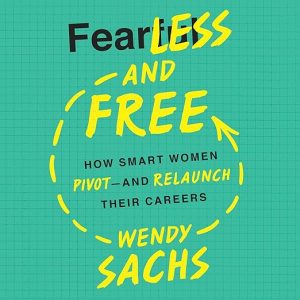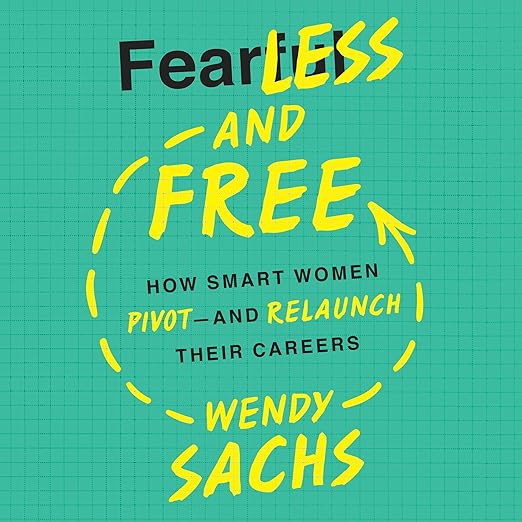
Fearless and Free asks a specific question: if women adopted the startup mindset, the act-fast, learn-from-failure, pivot-quickly ethos that Silicon Valley has built its mythology around, what would change in their careers? Wendy Sachs wrote this audiobook as a journalist and communications professional who interviewed a wide range of women who had faced exactly the roadblocks the book describes, and narrator Joyce Bean brings that journalistic directness to the seven-hour-fourteen-minute listening experience. The result is less a manifesto than a structured case study collection wrapped around a clear framework for career reinvention, grounded in the experiences of real women across industries and age ranges.
Sachs's structural instinct is sound. She knows that readers will respond to specific women's experiences more readily than to abstract argument, so the book moves through its framework via people rather than principles. Jill Abramson, former executive editor of the New York Times, appears as one voice among many rather than as the book's symbolic center, which keeps the advice from feeling aspirationally irrelevant to readers who aren't already operating at that level. Aminatou Sow of the Tech LadyMafia and other voices from adjacent industries give the book breadth without diluting the through-line argument about what holds women back and what changes when they stop waiting for certainty before acting.
The book's central diagnosis is its most valuable contribution: the pattern of waiting for complete certainty before acting is identified not as a personal failing but as a structural response to professional environments that have historically punished women differently than men for identical risks. The startup model, as Sachs reads it, offers a counter-protocol. Fail fast, learn, pivot. This is not presented as a perfect framework or as a solution to systemic inequality. The structural realities are acknowledged. But Sachs's argument is that within those constraints, the entrepreneurial orientation offers more options than the cautious one, and the evidence she marshals for this claim comes from women who have tested it rather than from consultants theorizing about it.
The actionable structure of the audiobook is worth noting in detail. Sachs includes specific, named strategies throughout: engineering serendipity, branding without bragging, building momentum through small decisive actions, competing with digital natives by playing to different strengths, and selling your story rather than waiting to be discovered. These are concrete enough to be immediately applicable. At least one reviewer noted having purchased both the audio and print versions, which is a useful data point about the density and utility of the content. The audio version is valuable for initial encounter and motivation; the print version for marking specific passages for implementation.
A Triumphant Narrator Would Undermine This Argument
Joyce Bean's narration is a genuine asset to this material. The book moves between Sachs's analytical framing and the stories of the women she interviewed, and Bean navigates these shifts smoothly. She has a quality of engaged warmth that makes the more vulnerable sections of the book, the honest admissions of fear and failure that Sachs draws out of her interview subjects, feel genuine rather than motivational-speaker polished. This matters for a book that is explicitly trying to destigmatize the experience of professional stuckness and career fear. A narrator who sounds triumphant throughout would undermine the very argument the text is making. Bean's warmth is not uncomplicated cheer; it is the warmth of someone who takes the material seriously while remaining encouraging in her delivery.
The seven-hour runtime gives Sachs space to develop each strategic principle with enough examples that the advice feels tested rather than asserted. Shorter career books often sacrifice the depth of case study that makes advice generalizable across different industries and situations. Fearless and Free uses its length to accumulate evidence from enough different contexts that the core argument holds regardless of whether your specific situation resembles any of the individual examples.
Mechanically Gender-Neutral Advice Framed for Women
The book's primary audience is women who are already experiencing career stagnation or transition anxiety and who are looking for both permission and practical tools to act differently. Readers who approach it expecting a structural critique of the professional inequalities that make risk-taking harder for women than for men will find the book somewhat light on that dimension. Sachs acknowledges these structural realities but her orientation is toward what individuals can do within them rather than toward how the structures themselves should change. This is a pragmatic rather than a political book, and that's worth knowing in advance if your primary interest is systemic analysis.
One reviewer noted that the book's ideas are not exclusively applicable to women, despite its framing, and this is accurate. The core argument about entrepreneurial mindset and risk tolerance is mechanically gender-neutral even if the specific obstacles Sachs describes are not. Male listeners who pick up this audiobook for practical career pivot strategies will find the content useful, though the framing remains consistently addressed to women throughout.
Readers May Resist the Book's Central Metaphor
Women in their thirties and forties who are feeling professionally stuck, who have reached a ceiling in a shrinking industry, or who are considering a significant career pivot will find this audiobook directly useful. Entrepreneurially inclined women who want concrete examples of how other women have navigated risk and reinvention, rather than generic inspiration, will appreciate the specific case studies and named strategies. Listeners who want a structural or systemic critique of professional gender inequality should supplement this with other reading; Sachs works in the space of individual agency rather than institutional change. Anyone who finds the Silicon Valley startup mythology exasperating may resist the book's central metaphor, though the practical advice it produces stands regardless of how you feel about the analogy itself.
The Short Version
- Voice: Joyce Bean delivers a professional, warm performance that suits Wendy Sachs's conversational and encouraging tone without becoming saccharine.
- Big ideas: Career reinvention, risk tolerance, entrepreneurial mindset for women
- Atmosphere: Energizing and direct
- Worth it?: Sachs builds a practical case for treating career fear as information rather than a stop sign, backed by real women's stories across industries and decades.
How does Joyce Bean's narration affect the audiobook experience?
Bean is well-matched to Sachs's conversational, encouraging tone. She handles the transitions between analytical framing and personal story material smoothly, and her warmth in the vulnerability sections keeps the listening experience from feeling like a pep talk rather than a genuine engagement with the challenges Sachs describes.
Is the Fearless and Free audiobook useful for men or is it exclusively for women?
The content is addressed to women throughout, and the specific obstacles Sachs discusses are shaped by professional dynamics that women navigate differently than men. However, the core framework around entrepreneurial mindset, risk tolerance, and career reinvention is mechanically gender-neutral, and at least some male listeners have found the advice applicable to their own situations.