Quick Take
- Tara Sands brings a convincingly breathless quality to Paige’s dual-world experience, managing the shift between small-town normalcy and sudden celebrity without flattening either register.
- Themes: Sudden fame, the love triangle as identity test, the gap between who you were and who you’re becoming
- Mood: Breezy and propulsive with genuine romantic stakes
- Verdict: A well-constructed YA romance that works better as audio than the premise suggests, anchored by a protagonist whose disorientation feels real enough to keep the story honest.
I picked up Famous in Love on a Friday evening when I needed something to listen to that wasn’t going to demand anything difficult of me, and I finished it by Saturday afternoon. That’s the right information about what this book is and does. Rebecca Serle writes YA romance with a structural confidence that makes the familiar tropes feel earned rather than mechanical, and Famous in Love is one of her earlier examples of that craft at work before her career pivoted to adult fiction with titles like One Italian Summer.
The premise is the fantasy version of a casting call story: seventeen-year-old Paige Townsen gets discovered during an open call and cast as the lead in the film adaptation of a blockbuster book series. Within a month she’s on a film set in Maui alongside Rainer Devon, who is everything a teen magazine would call him. Then Jordan Wilder joins the production and everything Paige thought she had sorted out becomes considerably less sorted. The love triangle is not incidental to the story; it is the story, and Serle is smart enough to make both romantic options genuinely attractive rather than using one as obvious misdirection.
Paige as a Protagonist Who Doesn’t Know Who She Is
What distinguishes Famous in Love from purely entertainment-driven YA romance is the specific quality of Paige’s disorientation. She isn’t naive about Hollywood because she’s been sheltered. She’s disoriented because stardom, when it arrives without preparation, genuinely destabilizes identity. The Paige who was anonymous in her hometown is not obviously compatible with the Paige who suddenly has professional obligations, public scrutiny, and two compelling people competing for her attention. Serle doesn’t resolve this tension easily, which gives the story more traction than the premise initially implies.
Tara Sands narrates with a quality that suits this material well: engaged without being breathless, romantic without being cloying. She handles the sections set on the Maui film set with enough awe to make Paige’s experience feel immediate, and the passages where Paige’s loneliness surfaces come through without overwhelming the story’s fundamentally optimistic register. One reviewer describes devouring the book in under a day and being unable to wait to continue the series, which is the correct outcome for a first installment that works.
The Rainer and Jordan Problem
Any love triangle lives or dies on the quality of both options, and Serle gives Rainer and Jordan meaningfully different kinds of appeal. Rainer is the expected: polished, famous, attentive, the version of romantic interest that comes pre-approved by public consensus. Jordan is more complicated: troubled, intense, connected to Paige’s developing character in ways that are harder to explain and easier to feel. The film-within-the-book structure, in which Paige is playing a character caught in a similar triangle, creates a doubling that the story uses more cleverly than the life-imitates-art device usually allows.
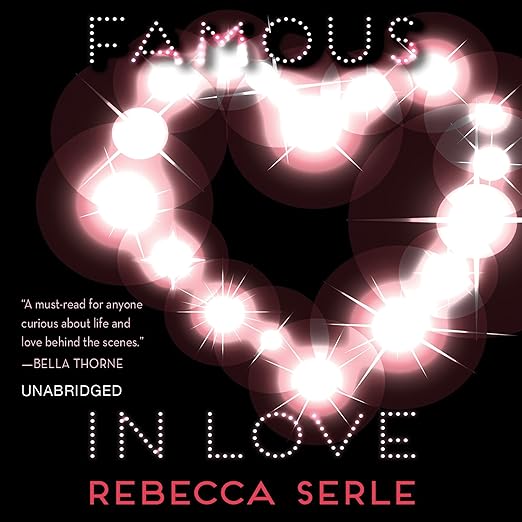
The Bella Thorne endorsement on the cover, and the subsequent Freeform television adaptation, tell you something useful about the book’s intended audience and the speed at which it was absorbed by that audience. Famous in Love landed at exactly the right cultural moment and reached readers who hadn’t been looking for it but found it immediately compatible with their preferences. That’s not a dismissal of its quality. It’s a description of what well-timed commercial fiction does when it works.
What the Audio Format Adds
YA romance is a genre that benefits substantially from audio narration because the first-person voice, which is the dominant mode of the genre, requires a performer who can make interiority feel confessional rather than expository. Tara Sands consistently achieves that quality. Paige’s internal negotiations between what she wants and what she knows she should want are the real drama of the book, and Sands renders them with enough specificity that the love triangle never reduces to a simple choice between obvious options.
Who Should Listen
Listeners who enjoy YA romance and haven’t found Serle’s work yet will find this a satisfying introduction. Readers who already love her adult novels and want to trace the development of her romantic sensibility will find Famous in Love revealing about how she constructs emotional stakes. Those who need more plot complication than a romantic triangle against a glamorous backdrop will want to look elsewhere in her catalog.
Frequently Asked Questions
Is Famous in Love a standalone or does it require reading the sequel?
Famous in Love is the first book in a two-book series. It has its own story arc and ends at a satisfying stopping point, but the full resolution of the love triangle plays out across both volumes. Listeners should know going in that the series continues.
How does the audio version compare to the Freeform television adaptation for fans of the show?
The book preceded the TV adaptation and was the source material for it. Some characters and plot details differ between the two, as is standard with adaptations. Fans of the show may find the book’s focus more internal and less plot-driven than the series, which expanded the narrative considerably.
Does Tara Sands voice Paige’s on-screen character separately from her real-life scenes?
The book is written entirely from Paige’s perspective rather than including scenes from inside the film she’s making, so Sands doesn’t manage a character-within-a-character structure. The parallel between Paige’s real triangle and her on-screen role is thematic rather than formally staged.
Is this book appropriate for younger YA readers, say 12 or 13, or is it aimed at older teens?
The romance content is PG-level and appropriate for readers in the 12-16 range. There’s nothing requiring a content warning for younger teen listeners, and Serle’s writing is accessible enough for middle school readers while being engaging to high schoolers as well.