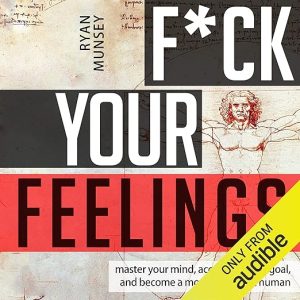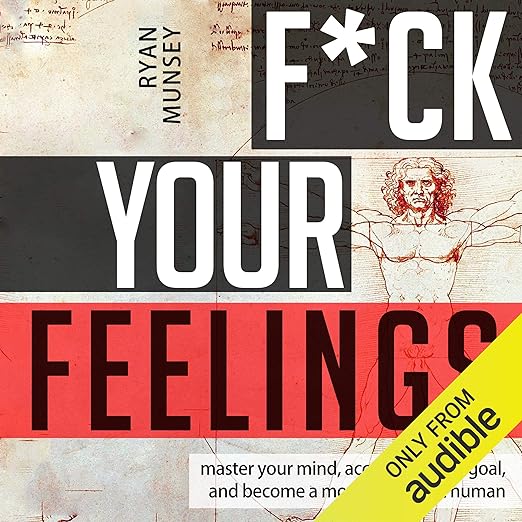
Titles this blunt do half the marketing and all of the filtering. Ryan Munsey's book announces in four censored characters that it has no plans to be gentle with you, and the nine hours and fifteen minutes of audiobook underneath are read by its author, which makes the provocation a decision taken twice, once at the keyboard and once at the microphone. What surprised me is how orderly the argument turns out to be once the cover stops shouting.
Where This One Lands
The most consequential sentence on this page is a footnote. A January 2020 five-star, which calls the book a human performance manual and reports reading it twice and recommending it to a dozen people, closes by mentioning that it wrote the identical review under the other title of this same book, Master Your Mind. So one text is being sold under two covers, accumulating two review pools, two averages and two rating counts. A buyer comparing editions is comparing a book against itself, and nothing on this listing says so.
Censorship of the title has its own consequences. The book cannot be typed the way it is spoken, which complicates every search a listener might run for it, and it puts the most aggressive gesture in the whole package in front of you before a single sentence of the actual argument. That is deliberate, and it works, but it also means a lot of people will decide about this book without ever learning what it claims.
Its actual claim is fairly ordinary once unwrapped. Most decisions are made by feeling rather than by reasoning, feelings are physiological events rather than moral ones, and the physiology can be trained. Munsey builds that out through emotional control fundamentals, an argument about play and safety and the vagus nerve, a section on dopamine and the things that hook it, and a running insistence that consistency is a skill rather than a personality trait.
Somebody who used it to get out of a hole wrote the pool's strongest endorsement in May 2022, describing a book that helped beat depression and improved life both personally and professionally. The mechanism that response names is specific and it matters: the book connected scientific theory to daily practice, so that controlling feelings and making better decisions stopped being an instruction and became a procedure. That is the difference between a motivational book and a useful one.
Munsey reads the whole thing, and across three hundred and seventy ratings not one written response says a word about how it sounds. That absence is louder here than it would be elsewhere, because in a book whose entire method is confrontation, delivery is the argument. A tough-love manual delivered flatly is a lecture; delivered by the person who believes it, at the volume the title promises, it is coaching. Which of those you are buying is the single thing the page never establishes, and it is the thing a sample will settle in ninety seconds.
Weak Spots in F--k Your Feelings
Recipe is the word an October 2022 five-star chose, and it is a warning dressed as praise. That entry describes following the steps and then referring back to the book, and looks forward to putting a named framework into practice. Referring back is exactly what a linear recording is worst at. Nothing on this page offers an index, a worksheet or any kind of chapter map, so a listener who wants to redo step four has to go hunting by ear through hours of continuous audio.
Statistics in the description arrive without sources and should be treated accordingly. Ninety-five percent of decisions are said to be based on feelings. An insight is promised that will separate you from ninety-two percent of the population. Those are the numbers of a sales page rather than of a citation, and the copy's other promises follow the same shape: the one four-letter word that guarantees failure, the everything-is-everything moment, the single controllable property that decides whether you are a dreamer or a doer.
Register is the last thing to check yourself against. The description names its audience as business owners, entrepreneurs and people working on their fitness, and adds a qualifier that does the real work: anyone with a goal who is not terrified of tough love. If being spoken to that way makes you dig in rather than move, this format will not soften it. The voice is the author's, and the author is not in a conciliatory mood.
Recommended For
An April 2025 five-star found a use the marketing never anticipated, saying that despite the title the content is clear and direct, and that the material on training the brain helped in caring for a daughter with special needs. A book packaged as gym-floor aggression turning out to be useful in a caregiving context tells you the underlying psychology is sturdier than the cover suggests, and it is the single most disarming thing anyone has written about it.
You will get something out of it if you respond to being challenged rather than encouraged, if you want the physiology behind self-regulation rather than affirmations, or if you have already worked through the gentler end of this shelf and want somebody to stop being polite. Leave it alone if you need citations you can check, if profanity as a structural device wears on you at length, or if you would use this as a reference book, in which case the printed edition under either of its two titles will serve you better.
Strong House Press released this in October 2018, and the audience it has collected since is substantial by any measure. It has also gathered a second identity, and the page carries no trace of it.
In Brief
- Voice: Ryan Munsey reads his own provocation, so the swearing is a choice made twice, on the page and then out loud.
- Big ideas: Emotional self-regulation, discomfort as training, dopamine and attention, consistency as a skill
- Atmosphere: Confrontational and briskly practical
- Worth it?: Sturdier psychology than the cover implies, on a listing that never admits the book has a second title.
Questions Listeners Ask
Is the audiobook usable without the printed edition?
Partly. The description builds the book as a sequence: fundamentals to apply, tactics to learn, a twenty-minute routine to run. Listening carries the argument perfectly well. Coming back to one specific instruction a week later is the part the format makes awkward, since the record offers no index and no downloadable summary.
Who is this audiobook actually aimed at?
The description is unusually direct about it: business owners, entrepreneurs, people trying to get in shape, and in its own phrasing anybody chasing something who will not be scared off by blunt talk. It also rules itself out of three categories, naming get rich quick schemes, business plans and anything it considers touchy-feely.