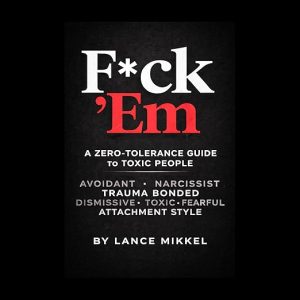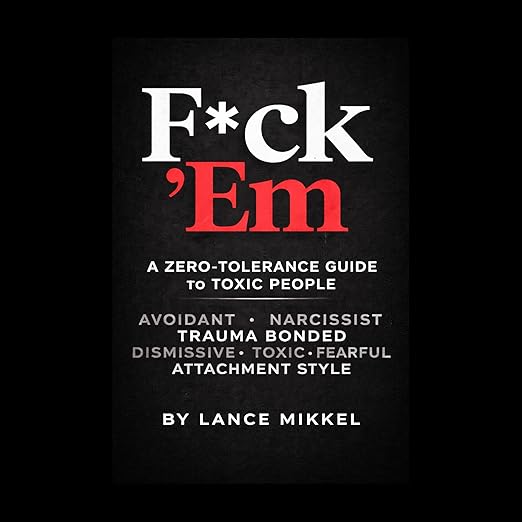
Let me be clear about what this audiobook is and is not. At seventy-four minutes, F*ck 'Em: A Zero-Tolerance Guide to Toxic People is less a book than an extended argument delivered at the speed of someone who has already worked through the evidence and arrived at a verdict. Lance Mikkel is not interested in balanced presentation. He is interested in getting you to a particular decision, specifically, the decision to stop negotiating with people who are using your empathy as a resource rather than responding to it as a human trait. Whether that bluntness is a feature or a limitation depends entirely on where you are when you sit down to listen.
I listened to this on a rainy Tuesday morning after a conversation with a friend who had been cycling through the same toxic relationship pattern for the third time in as many years. I thought of it as field research. What I found was more organized than I expected from the marketing framing. Mikkel structures his argument clearly: he identifies the categories of emotionally irresponsible behavior, avoidants, narcissists, manipulators, perpetual victims, explains why excuses function as their primary weapon, and articulates why empathy without boundaries is self-destructive rather than virtuous. None of this is original to Mikkel, but he synthesizes it with directness and genuine conviction, and the synthesis is efficient in a way that longer books on toxic relationships sometimes are not.
Naming What You Already Knew Was True
The most useful thing this audiobook does is not provide new information. It provides a permission structure. Reviewers repeatedly describe finishing it and feeling clarity, strength, and relief, not because they learned something they did not know, but because they heard their own situation named and validated without hedging. One listener wrote that it changed her frame of thinking within hours of purchase. Another described it as the first time she truly felt her worth without guilt about enforcing her own limits. A third finished it in one sitting and described it as the best thing that ever happened to her in terms of moving forward from an incredibly toxic relationship. These are not responses to intellectual novelty. They are responses to being told clearly that what you already know is correct, and that acting on it is not cruelty but self-preservation. For listeners who have spent months or years in the negotiating position, that clarity is genuinely valuable.
Mikkel Reframes Excuses as Manipulation Tools
The section on excuses as manipulation tactics is the sharpest part of the book. Mikkel's point is that excuses are not explanations but tools, they are used to redirect attention from behavior to context, shifting the frame from what this person did to why you should understand why they did it. This reframing, he argues, is the mechanism by which manipulative people sustain their position: as long as you are evaluating the excuse, you are not evaluating the pattern. That insight is clear, well-argued, and immediately applicable. The related observation that empathy without enforcement enables exactly the behavior it is trying to address is also genuinely useful and stated with the kind of directness that allows listeners to apply it without doing additional interpretive work. One reviewer particularly appreciated that the book focuses on walking away rather than accommodating or reforming the other person, a stance that distinguishes it from some of the more hope-inflected material in this genre.
The audiobook's positioning, published in February 2026 and narrated by its author, is consistent with a broader wave of short-form self-help content that has moved from social media into audio. Mikkel's online presence is significant, and several reviewers found him through that presence before picking up the book. This context matters because the book functions as a kind of extended episode of the worldview he has already communicated to his audience. For listeners who come to it cold, the ideas are complete enough to stand on their own. For those already familiar with Mikkel's online perspective, the audiobook offers depth and personal narrative that shorter content cannot accommodate.
Too Short for Abusive or Enmeshed Dynamics
Seventy-four minutes is a thin canvas for the full psychology of toxic relationship dynamics, and the book does not pretend otherwise. Mikkel frames the audiobook as a mindset shift rather than a comprehensive treatment, but listeners who come hoping for detailed tactical guidance on specific relationship types will find the coverage uneven. The avoidant and narcissistic personality types get reasonable attention; other patterns are addressed more briefly. The book does not engage sufficiently with the psychological complexity of why leaving is so difficult in ways that feel adequate for listeners dealing with abusive or deeply enmeshed dynamics rather than merely draining ones. For those situations, the book is a useful companion to professional support, not a substitute for it.
Ready to Leave but Still Finding Excuses
Listen if you are at the stage in a toxic relationship where you already know it needs to end but keep finding reasons not to act. This audiobook will give you language and permission in a format short enough to listen to in one sitting when you need it most. Also useful for anyone processing a recent exit from a toxic dynamic and looking for reinforcement of the decision they have already made. Skip it if you are looking for nuanced psychological analysis of manipulation and trauma bonding, the book is too short and too directive for that purpose. Approach it as a motivational intervention rather than a clinical framework, which is exactly what it clearly intends to be, and it will likely deliver exactly what you need.
Before You Listen
At just over an hour, does F*ck 'Em cover enough ground to be genuinely useful?
For its stated purpose, giving people who already recognize a toxic dynamic the permission and language to act, yes. For listeners seeking comprehensive coverage of toxic relationship psychology, the length is a genuine limitation.
Does Lance Mikkel's self-narration work for this material, or would it benefit from professional production?
The self-narration is integral to the book's effect. The directness and urgency of Mikkel's delivery are inseparable from the argument he is making, and a professional narrator would create a layer of distance that would undermine the book's specific power.
Is this audiobook appropriate for someone currently in an abusive relationship, or is it better suited for less severe situations?
The book is primarily calibrated for emotionally draining and manipulative relationships rather than physically dangerous ones. For listeners in abusive situations, the zero-tolerance framing can be validating, but professional support and safety planning are essential, this audiobook is not a substitute.
How does F*ck 'Em compare to longer self-help audiobooks on toxic relationships and boundaries?
It is shorter, more directive, and less interested in nuance than books like Not Nice by Dr. Aziz Gazipura or Why Does He Do That by Lundy Bancroft, which cover related territory with more depth. F*ck 'Em is best understood as a motivational intervention rather than a comprehensive resource.