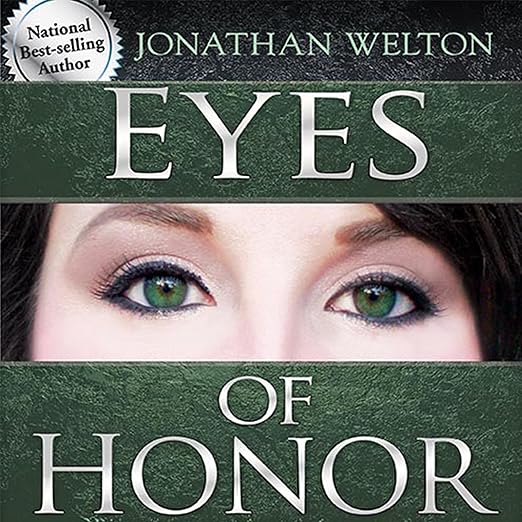
I do not typically review books in the Christian living subgenre, partly because it is a crowded field and partly because the quality varies enormously. Eyes of Honor reached my queue because it kept surfacing in recommendation threads for books that approach the topic of sexual purity differently from the standard accountability-and-willpower framework. That framing was accurate enough to warrant closer attention, so I spent a Sunday afternoon with Jonathan Welton's seven-hour narration and came away with a fairly clear sense of both what the book does well and where it limits itself.
Welton's premise is built around identity rather than behavior. The distinction matters more than it might initially appear. Most books that address sexual temptation or pornography use in a Christian context operate on a behavioral model: identify the trigger, interrupt the pattern, build new habits, recruit accountability partners. Welton argues that this model treats the symptom rather than the root, and that the root is a misunderstanding of who the believer actually is in Christ. If you genuinely internalize your new identity, he contends, the behavioral problems begin to resolve themselves because you are no longer fighting from a posture of shame and deficit but from one of completeness and freedom.
This is not a novel theological claim, but Welton develops it with more specificity and practical texture than most writers who invoke the same framework. The sections on learning to view the opposite sex through eyes of honor rather than through objectification or avoidance are grounded in specific scriptural language while also being psychologically coherent in ways that feel earned rather than imposed. He is clear that he struggled with the material he is teaching for years before finding what he describes as the answer in Scripture, and that biography of failure before insight gives the teaching a quality of hard-won conviction that pure theological instruction rarely achieves.
Reviewers describe the book as leaving them feeling empowered rather than condemned, which is a meaningful distinction in a genre that can lean heavily on guilt and shame as motivating forces. One reviewer, identifying as a wife rather than the book's intended male audience, found it genuinely useful and recommended it beyond the demographic it was written for. Another described it as the best book they had encountered on grace, identity, and addiction, placing it in a category with other identity-focused resources for men's ministry. The consistent thread across the reviews is that something in Welton's framing clicked where other approaches had not.
Strongest on Identity, Overreaching on Counseling
Eyes of Honor is most effective in its theological and identity-formation content. It is less effective when it ventures into commentary on counseling and twelve-step recovery approaches, which Welton critiques based on his personal negative experience with them. One reviewer noted that his criticism of professional counseling as an option felt overstated, and that the experience of finding a poor fit with a particular counselor is not the same as the approach itself being ineffective. This is a fair pushback. The book's credibility rests on personal testimony, and testimony-based arguments have limits when they become categorical claims about systemic alternatives.
For readers who share Welton's theological framework, this limitation will feel minor relative to the value of the core teaching. For readers who come from traditions that integrate counseling and spiritual direction more fully, it may produce some friction. The book was written for a specific audience with specific theological commitments, and within that audience it operates with considerable effectiveness. The scriptural backing throughout is substantial, and the practical exercises that appear in the later chapters give readers concrete tools rather than leaving the identity claim as an abstraction to be accepted on faith alone.
Welton's Pastoral Pacing Sounds Like a Sermon
Welton narrates his own work, which is almost always the right call for this kind of pastoral teaching. The voice carries the vulnerability of the autobiography and the conviction of the teacher, and neither quality would transfer cleanly to a professional narrator reading the same words. The seven-hour runtime is manageable, and the pacing moves at the measured cadence of a pastor who is used to holding a congregation's attention rather than a speaker racing to cover material.
The production quality is professional without being over-polished, which suits the material. Eyes of Honor does not read or sound like a conference-circuit self-help product. It reads like a pastor who found something that worked and is trying to hand it to the people in his care. Whether that voice resonates depends almost entirely on whether you share the theological context the book assumes. If you do, the seven hours will feel short. If the framework is foreign to you, the material will be more difficult to locate yourself inside of, and a different approach to the underlying questions would serve you better.
Christian Men Who Tried Behavioral Approaches
Eyes of Honor was written for Christian men who have tried the behavioral approaches to sexual purity and found them insufficient. It was also written for anyone in ministry who works with men on these issues and wants a theologically grounded, grace-forward framework to offer. Reviewers from both demographics describe it as among the best available resources on the subject. The book is appropriate for women readers and is appreciated by some spouses and partners who want to understand the framing their partners are working with, though Welton is honest that it was not written with a female audience in mind.
If you are not working within a Christian theological frame, the book will not translate. Its arguments are scriptural rather than secular-psychological, and the identity claim at the center requires a specific set of theological commitments to function as Welton intends. For the audience it was written for, it is a serious and useful piece of work that earns its strong reception across a decade of consistently positive reader responses.
Common Questions
Is Eyes of Honor appropriate for teenagers, or is it written for adult men?
Several reviewers describe using it in student ministry contexts, and Welton's accessible pastoral style makes it readable for mature teenagers. The content deals with sexual temptation and shame, so parental discretion applies for younger audiences.
Does the book work for women, or is it specifically written for men?
Welton writes primarily for men and some of the framing is gendered toward male experience. Several female reviewers, including wives and mothers, found the book genuinely useful for understanding the framework their husbands or sons were working with, and some found the identity-formation content applicable to their own situations.
Welton criticizes counseling and twelve-step approaches in the book. Does that make it inappropriate for someone currently in those programs?
At least one reviewer pushes back on this aspect of the book, noting that Welton's criticism seems based on a poor personal experience rather than the approaches themselves. You can engage with the identity-formation content productively while disagreeing with his critique of therapeutic alternatives.
Do you need to be familiar with Jonathan Welton's Welton Academy or his other teaching to get value from this book?
No prior familiarity is necessary. Eyes of Honor works as a standalone text and does not require background in Welton's broader ministry or supernatural school curriculum to follow the argument.