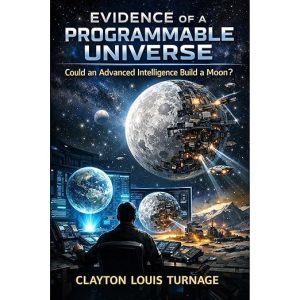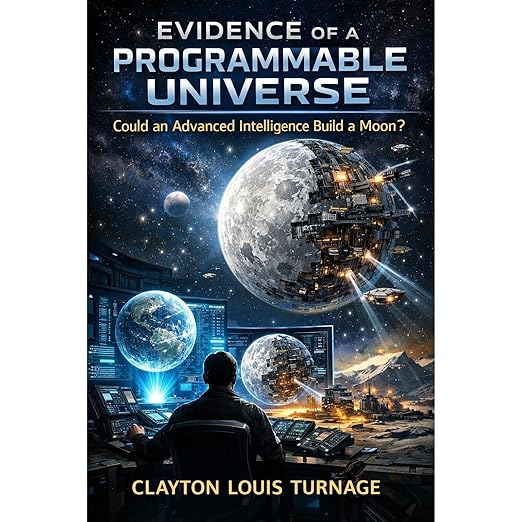
Clayton Louis Turnage opens with a geometric fact that is genuinely strange: Earth's Moon appears almost exactly the same angular size as the Sun in our sky, which is why total solar eclipses are total at all. This audiobook, the fifth entry in Turnage's Conscious Computational Cosmology series, takes that strangeness as its central evidence, asking whether the Moon's suite of anomalous properties, its disproportionate size relative to its host planet, its role in stabilizing Earth's climate, its uncanny positional precision from our vantage point, constitute a signal of design. Virtual Voice narrates, which at 1 hour and 29 minutes means the question is raised, turned carefully in the light, and then the listener is left to pursue it further on their own time.
The premise belongs to a tradition of speculative cosmology that sits at the intersection of physics, astronomy, and philosophy of science. Turnage is not arguing for any particular creator; he is arguing for the possibility of intentional cosmic engineering as a category worth taking seriously. The vehicle is what he calls Conscious Computational Cosmology, a framework built around the idea that if reality is fundamentally informational, then sufficiently advanced intelligences might be able to construct physical systems the way programmers construct software. It is an ambitious premise for a short-format entry in a series, and the density of argument per minute reflects that ambition.
The argument proceeds through three registers. First, Turnage presents the observational oddities of the Moon with reasonable care, citing its stabilizing function for Earth's axial tilt, which most planetary scientists would confirm as significant for the development of complex life. Second, he surveys the theoretical landscape of megastructure engineering, from Freeman Dyson's original sphere concept through more recent work on programmable matter and nanotechnology, establishing that the gap between current technology and planet-building is enormous but not categorically unbridgeable. Third, and most speculatively, he connects these threads through the lens of simulation theory and informational cosmology, arguing that a universe built from computation is a universe that can, in principle, be modified.
The Virtual Voice narration delivers this material in a clean, neutral register that suits exposition but flattens anything that should feel wondrous. The transitions between observational fact, theoretical physics, and speculative extrapolation happen quickly, which at this runtime is unavoidable. Listeners who engage with the ideas actively, pausing to follow a thread of implication, will get considerably more from this audiobook than those expecting a passive experience. The density is the point, not a production limitation.
For a series that deals in large speculative claims, the discipline Turnage brings to the threshold question, at what point does coincidence become anomaly worth explaining, is the detail that distinguishes this from looser speculation. The Virtual Voice narration cannot supply wonder, but the argument can supply its own.
Ninety Minutes With No Room for Breath
The value of this audiobook is proportional to how willing the listener is to take speculative cosmology on its own terms. Turnage is not writing peer-reviewed physics; he is conducting the kind of structured thought experiment that has historically preceded genuine scientific inquiry. The question of whether the Moon's properties are coincidental or constitute some form of design is not new, but Turnage's framing through computational theory gives it a contemporary angle that distinguishes this entry in the CCC series from older anthropic-principle arguments.
At under 90 minutes, this is a dense listen without padding, anecdote-driven chapter-openings, or narrative warmup. The argument begins on the first track and does not pause for breath. For listeners already familiar with the cosmological fine-tuning debate or with the simulation hypothesis literature, this will feel appropriately concentrated. For listeners coming in fresh, the density may feel abrupt, and there is a reasonable case for treating this as a starting point for further reading rather than a comprehensive treatment on its own terms.
Self-Assembling Materials Bridge Two Big Ideas
The most intellectually substantive section of this audiobook is the bridge Turnage builds between megastructure engineering and programmable matter. He draws a line from current research in self-assembling materials and nanotechnology through to the theoretical conditions under which a civilization could construct celestial bodies from the substrate up. The argument here is speculative but internally consistent, and it is more careful than the more headline-friendly moon-as-artifact framing that opens the book might suggest to a skeptical listener.
Also worth tracking is Turnage's use of the term coincidence. He is precise about distinguishing between single coincidences, which any scientist would explain as noise, and clusters of coincidences, which may constitute a different epistemic category. Whether one finds his threshold for anomaly persuasive will determine how the final section of the audiobook lands. This is the fulcrum on which the entire argument turns, and the Virtual Voice narration delivers it with appropriate structural emphasis even if it cannot provide interpretive coloring.
Rigor Without Requiring Peer-Reviewed Proof
Listeners who enjoy speculative science writing in the vein of Paul Davies or Michio Kaku, writers who take frontier questions seriously without abandoning rigor entirely, will find this a provocative 90-minute investment. It functions as a well-organized entry point into the computational cosmology conversation for anyone encountering it for the first time, while offering series regulars a focused argument on one specific evidentiary thread. Listeners who require empirical peer-reviewed backing for every claim made in a science audiobook will find the speculative reach uncomfortable. This is explicitly a thought experiment extended into book form, and it works best when approached as such. Those who have not listened to the earlier CCC entries can start here; the central argument is self-contained.
Is this audiobook a standalone entry or do I need to have listened to earlier books in the Conscious Computational Cosmology series?
The book is the fifth in the CCC series but the central argument about the Moon and programmable matter is self-contained. No prior familiarity with the earlier volumes is required to follow the main thesis, though readers of the series will have additional context for Turnage's CCC framework.
Does the Virtual Voice narration affect the quality of this audiobook significantly?
The AI narration is functional and clear, which suits the expository nature of the material. It lacks the sense of wonder that a skilled human narrator might bring to speculative passages about moon geometry and civilization-scale engineering, but the argument itself comes through without distortion.
At under 90 minutes, does this audiobook offer enough depth to be worth the time?
It depends on what you bring to it. As an introduction to computational cosmology and moon anomaly arguments, it is dense and well-organized. As a comprehensive treatment of the subject, it is necessarily limited. Think of it as a structured long-form essay rather than a full-length book treatment.