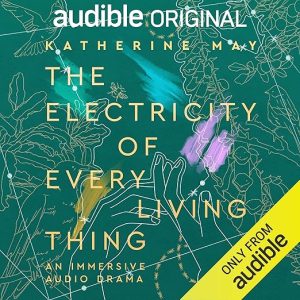
Two entirely different books share this exact title, and the one behind this specific audio production is a startling, sound-designed drama about autism and sensory overwhelm, not James Herriot's beloved Yorkshire vet memoir of the same name. This audiobook adapts Katherine May's memoir The Electricity of Every Living Thing, in which May, at thirty-eight, walks the six-hundred-thirty-mile South West Coast Path and comes to suspect, through a chance radio broadcast, that she is autistic. The genre tags attached to this listing, biographies-memoirs alongside home-garden and sports-outdoors, with keywords like Pets & Animal Care, plainly carry over from Herriot's very different, animal-centered book, a mismatch worth clearing up before anything else.
Whoever expects gentle Yorkshire countryside vignettes about calving cows and difficult farmers will find instead a psychologically intense, formally ambitious production: a full cast of fifteen credited performers, led by Amy McAllister, recreates May's walk and her unfolding self-discovery as an immersive audio drama rather than a single-narrator reading. Directed by Caitriona Shoobridge and adapted by Julie Parsons for Whistledown, with autism consultant Nicola Shaughnessy involved directly in the production, this is an Audible Original built specifically for the audio medium rather than simply narrated into it.
The specific phrasing in the source material, describing this as a different way of experiencing an audio drama, is worth taking at face value rather than as ordinary marketing language; the production team is explicit that they built something meant to be encountered differently than either a standard audiobook or a standard radio play, closer to a guided sensory experience of May's own condition.
What Stands Out
The format itself is the strongest argument for listening rather than reading. The production notes explicitly recommend trying the piece both on speakers and on headphones, stating plainly that each way of listening provides a different experience, a level of formal attention to how sound reaches a listener that a standard narrated audiobook rarely offers. For a story specifically about sensory processing and overwhelm, that structural choice is not a gimmick; it's the same subject matter enacted at the level of production design.
May's central discovery, that a lifetime of feeling exhausted by ordinary social expectations might trace back to undiagnosed autism identified only in her late thirties, gives the piece real weight beyond the physical journey. The walk becomes a dual narrative: the literal coastline mileage, and the parallel process of understanding a mind that has spent decades being read as merely difficult or oversensitive rather than differently wired. Listeners who have watched their own late-diagnosis story play out, or who love someone going through one, will likely find specific moments landing hard.
A fifteen-person cast for a single memoir adaptation signals real production ambition, and the specific choice to dramatize interior psychological material (sensory meltdowns, masking, the exhausting arithmetic of appearing normal) through multiple voices and produced sound rather than one narrator's inflection, is a genuinely different craft challenge than most audiobooks attempt. This sits closer to prestige radio drama than to conventional memoir narration, and it rewards listeners willing to meet it on those terms.
Immersive audio drama is a growing but still relatively rare category, closer in spirit to prestige radio plays or a production like GraphicAudio's dramatized fantasy releases than to a standard narrated audiobook, and Every Living Thing represents a particularly ambitious example: a fifteen-person cast, dedicated sound design, and explicit formal instructions about how best to listen all suggest a production team treating audio itself as an expressive medium rather than a delivery mechanism for text.
May's walk sits within a well-established tradition of long-distance walking memoirs used as a framework for psychological reckoning, the territory Cheryl Strayed covered in Wild and Raynor Winn covered in The Salt Path. What distinguishes May's version is the specific destination of her self-discovery: where those books use the walk to process grief or crisis, May's journey becomes the occasion for a diagnosis that recontextualizes her entire life up to that point, not just the period covered by the walk itself.
This being produced specifically as an Audible Original UK release, rather than a standard third-party audiobook publisher's production, is worth noting for what it signals about resourcing and ambition: original-content divisions typically greenlight fewer, more carefully developed projects than a standard commercial audiobook slate, which tracks with the unusually large fifteen-person cast and dedicated consultant role this production carries.
Things to Know Before Starting Every Living Thing
The content warnings attached to this listing are extensive and specific: bullying, depression, self-harm, eating disorders, meltdowns, clinical medical language, and negative attitudes toward neurodivergent people, plus scenes designed to convey sensory acuity that the production itself flags as potentially triggering. This is not incidental difficult content; it is structurally central to what the piece is trying to do, and listeners should treat the warnings as load-bearing information rather than boilerplate.
No listener reviews are attached to this specific title yet, worth knowing going in; unlike most audiobooks on this scale, no accumulated word-of-mouth exists to weigh against the official description here, only the production's own extensive framing material to go on for now. A cautious listener might sample the opening minutes before committing to the full seven-hour runtime, especially given the sensory-intensity warnings.
Because the title and byline point so strongly toward Herriot's very different book, this is genuinely easy to buy by accident. Anyone specifically hunting for the real Every Living Thing, Herriot's own final Yorkshire vet memoir closing out the All Creatures Great and Small series, should look for that title under Herriot's name directly rather than this listing, which belongs entirely to May's adaptation despite the shared title.
Whistledown, the production company behind this adaptation, has a track record in UK audio drama and factual programming, worth knowing if the polish and ambition of the production itself is a factor in a listener's decision; this isn't an independent or lightly-resourced adaptation but a produced Audible Original with a credited director, dramatist, and consultant working alongside the performing cast.
Listeners new to the audio drama format generally, rather than traditional single-narrator audiobooks, should know the pacing and structure will feel different: expect scene-based transitions, layered sound rather than pure narration, and a more theatrical rhythm than a conventional memoir reading provides.
Best Suited For
This rewards listeners already familiar with May's earlier, widely-read memoir Wintering, anyone drawn to formally adventurous audio drama over conventional narration, and listeners specifically interested in adult-diagnosed autism and sensory processing told from the inside rather than as clinical case study.
Skip it if you came looking for James Herriot's gentle vet memoirs based on the title alone, or if the extensive content warnings around self-harm, eating disorders, and sensory distress make this the wrong listen for where you are right now; both are legitimate reasons to wait or look elsewhere, and neither reflects badly on the production itself.
Is this Every Living Thing audiobook the same as James Herriot's book of the same name?
No. Despite the shared title and a byline pointing toward Herriot, the actual synopsis and production credits belong entirely to Katherine May's audio drama adaptation of her memoir The Electricity of Every Living Thing.
Should I listen to this audiobook on headphones or speakers?
The production notes state that each way of listening provides a different experience and recommend trying both, given the piece's deliberate focus on sensory immersion.
What content warnings apply to this audiobook?
Bullying, depression, self-harm, eating disorders, meltdowns, clinical medical language, negative attitudes toward neurodivergent people, and intense sensory scenes are all flagged directly by the production.