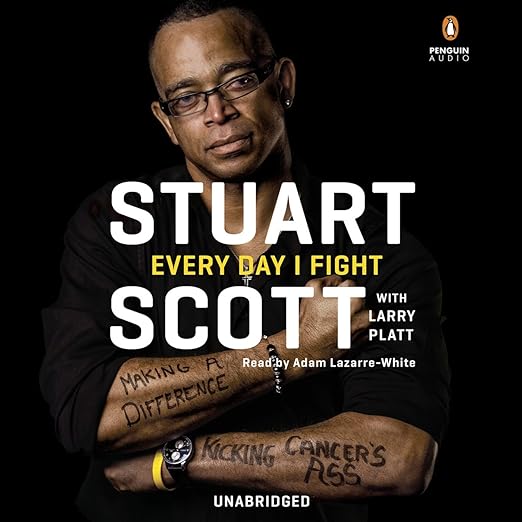
I first encountered Stuart Scott the way most non-sports people did: through clips. The catchphrases, the energy, the particular kind of joy he brought to SportsCenter that felt different from what came before and after. What I did not know, until sitting with Every Day I Fight one quiet Thursday morning on a long commute, was how much was happening beneath that on-air presence. This memoir is not about the catchphrases. It is about what it costs to keep showing up.
Scott completed work on this book shortly before his death on January 4, 2015. That fact matters to how you receive it. Every Day I Fight was written by a man who knew he was dying, who chose to use that time to put his story on record, not as a self-help document or a collection of inspirational bromides, but as an honest account of what it actually felt like. The famous quote that opens the book, "When you die, it does not mean that you lose to cancer. You beat cancer by how you live, why you live, and the manner in which you live", is not rhetorical. It is the argument the entire book is built around, and Scott spends the pages that follow proving he believed it.
Is Every Day I Fight Worth Your Time?
One of the memoir's real gifts is how fully Scott renders his life before the disease. His childhood in North Carolina, his family, the particular grinding effort of his early career as a sportscaster working his way up through markets that didn't know what to do with him, all of this gets real space. The ESPN triumph is not treated as the destination. It's treated as one chapter in a life that was already complicated and fully inhabited before appendiceal cancer arrived in 2007.
This matters because it means the book's second half, which deals with the illness directly, has the weight of a complete human life behind it. The countless surgeries, the chemotherapy, the logistics of getting from hospital to studio and back, these are not abstracted. Scott writes about the physical reality of being sick with the same directness he brought to the broadcast desk. One reviewer, who describes themselves as no sports fan at all, notes that they watched Scott's ESPN work on YouTube after finishing the book just to see the man they'd come to know. That's the effect of memoir that gets the human being right before anything else.
The Best Parts of Every Day I Fight
Every Day I Fight is ultimately a book about fatherhood. Scott is explicit about this: his daughters Sydni and Taelor are not backdrop figures. They are the reason he kept fighting when fighting required more than most people can imagine. The workout routines he maintained through chemotherapy, the way he pushed himself to stay physically present and capable, all of it is filtered through the lens of what kind of example he needed to be for two teenage girls watching their father navigate a terminal diagnosis.
This element of the memoir lands differently depending on where you are in your own life. Reviewers who are parents, or who have watched parents fight illness, describe the book as transformative. Reviewers who came in as sports fans found a dimension of Scott they hadn't seen in two decades of watching him work. What the memoir accomplishes, in either case, is making the man legible. Not heroic in the abstract, but specific and real and trying.
Before You Commit to Every Day I Fight
Narrating someone else's first-person memoir carries a particular responsibility, especially when that person is as recognizable as Stuart Scott. Adam Lazarre-White does not attempt to impersonate Scott's famous delivery. He finds the voice of the writing, more reflective than the broadcast persona, quieter, more willing to sit with difficulty, and renders it with consistency across eight hours. The result feels like receiving a private communication rather than a public performance. That's the right register for this material.
The audio version was published by Penguin Audio and runs just over eight hours, which turns out to be exactly the right length. Long enough to fully develop the life Scott was writing, short enough to feel like a focused account rather than an exhaustive one. There is nothing superfluous here. Scott knew what he was trying to say, and the production honors that clarity.
Should You Listen to Every Day I Fight?
Every Day I Fight works for sports fans because of what it reveals about a figure many of them grew up watching. It works for everyone else because Scott does the harder work of writing a memoir that is about the human experience of illness and love and purpose rather than the celebrity experience of those same things. Listeners who avoid sports entirely have found this book meaningful, which says something important about what Scott actually wrote. If you are not a sports fan, do not let the ESPN context put you off. This is a book about staying alive on purpose, about deciding what your life is for when the time you have is running out, and it does not require any prior familiarity with SportsCenter to hit home.