Quick Take
- Narration: Caitlin Kelly matches Eva’s personality precisely: warm, earnest, and quick to reveal vulnerability without tipping into self-pity. The coastal town atmosphere translates well to her measured pacing.
- Themes: Belonging and self-worth, magic as metaphor for capability, community and mutual aid
- Mood: Cozy and anxious in equal measure, building toward a genuinely satisfying emotional release
- Verdict: A thoughtful, character-driven middle-grade fantasy that earns its emotional climax honestly, with Caitlin Kelly’s narration an ideal match for a protagonist defined by quiet persistence.
I came to Eva Evergreen on a Sunday evening with a cup of tea and the specific exhaustion of a week that had asked more than it gave. I had been in the mood for something that didn’t require me to hold a complicated mythology in my head or remember which political faction had betrayed which other political faction three books ago. This was the right choice. Julie Abe has written a book that does one thing with great care: it builds a protagonist whose emotional logic is entirely coherent, and then puts her in a situation designed to test every part of that logic.
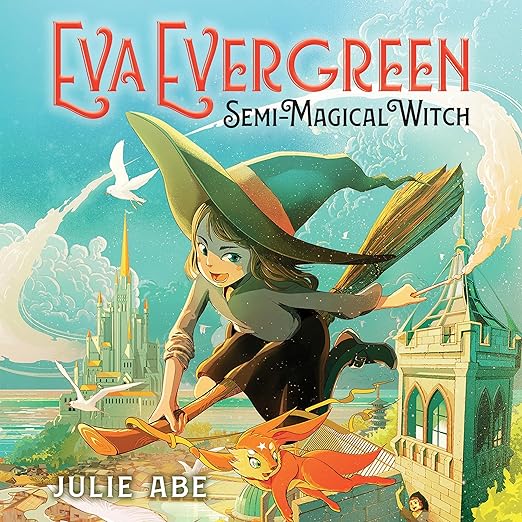
The setup, a young witch with barely enough magic to qualify for her coming-of-age quest, is not novel. Abe is clearly aware of the comparison to Kiki’s Delivery Service embedded in the book’s marketing, and the structural parallels are real: a girl witch, an unfamiliar town, the gap between what she can do and what people expect. But Eva is a different kind of protagonist than Kiki, and Abe’s story takes different turns.
The Repair Shop as Narrative Engine
Eva’s solution to her magical deficiency is the most interesting structural decision in the book. Unable to perform the kinds of dramatic witchcraft that would impress the residents of the coastal town of Auteri, she opens a magical repair shop, offering small fixes using whatever she has. This is a clever inversion of the usual fantasy power arc: instead of learning to do more, Eva learns to do less more precisely. Her semi-magical fixes turn out to address the actual needs of the townspeople rather than the spectacular needs she imagined they wanted.
Abe handles this with real care. Each repair shop encounter is a small character study, and Caitlin Kelly’s narration gives each Auteri resident a distinct voice without turning them into caricature. The accumulation of these encounters is what the book is actually doing: building Eva a community she has earned through attention and effort rather than power. When the magical storm arrives in the final act, the stakes are emotional as much as physical, which is why the climax works.
What the Sleeping Spell Actually Means
Eva’s specific magical limitation, she falls asleep when she overuses what little magic she has, is the most psychologically astute element of Abe’s premise. It functions as a literal consequence of pushing past your limits, and any child who has been told they are trying too hard and burning themselves out will recognize the dynamic. It also creates genuine tension in the climax, where Eva must make deliberate choices about when to spend her limited reserves.
The comparison to Aru Shah and the End of Time, the other book cited in the marketing, is less apt than the Kiki comparison. Roshani Chokshi’s series is faster-paced, higher-stakes mythology with ensemble dynamics. Eva Evergreen is a quieter, more personal book, more interested in one girl’s interior experience than in world-level conflict. That distinction matters when recommending it.
Caitlin Kelly and the Coastal Town Atmosphere
Kelly has narrated multiple middle-grade series and brings a particular quality to this kind of cozy-tense story: she paces slowly enough that the warmth of the Auteri scenes registers, but she doesn’t lose tension during the storm sequences. Her Eva is defined by a consistent emotional register, earnest and slightly anxious without being fragile, which maps well onto Abe’s characterization.
The nine-plus-hour runtime is about right for the story’s scale. This is not a brisk adventure but a slow build, and Kelly’s narration respects that pacing. Listeners who prefer faster-moving middle-grade fantasy may find the first half slow; those who appreciate character-first storytelling will find it exactly calibrated.
Who Should Listen, Who Should Skip
Eva Evergreen is best suited to readers aged 10 to 14 who enjoy character-driven fantasy with an emphasis on community and self-worth over combat and escalating powers. The Kiki’s Delivery Service comparison is the most accurate orientation point. Listeners looking for large-scale worldbuilding or ensemble casts should look elsewhere; this is a book about one girl in one small town, and that focus is its strength. Adults reading with children aged 9 and up will find the emotional material resonant and the repair shop scenes genuinely charming.
Frequently Asked Questions
How closely does Eva Evergreen resemble Kiki’s Delivery Service?
The structural parallel is real: a young witch, a coastal town, the challenge of earning belonging through work rather than innate power. But the emotional emphasis is different. Abe focuses more explicitly on self-worth and community building through the magical repair shop conceit, and the climactic storm gives the story a higher-stakes resolution than Miyazaki’s film.
Does the audiobook work for the cozy tone the book aims for, or does narration flatten it?
Caitlin Kelly is well-matched to the material. Her pacing is deliberate enough to let the warmth of the Auteri scenes register without losing tension during the storm sequences. The nine-plus-hour runtime benefits from her measured delivery rather than suffering from it.
Is this a series or can it be listened to as a standalone?
Eva Evergreen is Book 1 of a two-book series. The story arc in this volume is self-contained with a satisfying ending, but the world and characters continue in Eva Evergreen and the Cursed Witch. New listeners can start here without prior context.
What is the significance of Eva falling asleep when she overuses her magic?
It functions as both a plot mechanic and an emotional metaphor for overextending yourself past your actual capacity. It creates genuine suspense in the climax by forcing Eva to make deliberate choices about when to spend her limited magical reserves, and it resonates with children who experience pressure to exceed what they can actually manage.