Four skill names generated from a two-by-two grid are easy to read and surprisingly hard to hear. Self-Awareness, Self-Management, Social Awareness, Relationship Management: the same handful of words recycle across all four cells, so on a page you take in the whole structure at a glance, and in a four-hour-and-seventeen-minute audiobook you have to assemble it from memory while the strategies keep arriving. That design feature is the most useful thing to think about before choosing this edition, and it is not what any of the reviews will tell you.
Two Adjacent Cells Differ by One Word
Once you see the grid, the book organizes itself. One axis separates what happens inside you from what happens between you and other people. The other separates noticing from doing. Self-Awareness is noticing your own state; Self-Management is doing something about it; Social Awareness is noticing other people; Relationship Management is acting on what you noticed. That is clean instructional design, and it explains both why the framework has outlived its competition and why it is awkward in audio: two adjacent cells can differ by one recycled word.
What I appreciate most is the honesty of the premise. The publisher states the position plainly: EQ 'needs little introduction', and 'knowing what EQ is and knowing how to use it to improve your life are two very different things'. The book is described as having a single purpose, which is increasing your EQ. That is not an argument, it is a program, and treating it as a program sets the right expectations. Nobody here is trying to persuade you that emotions matter at work. The whole enterprise assumes you already agree and moves straight to what to do on a specific occasion.
Parks Signposts Clarity Instead of Warmth
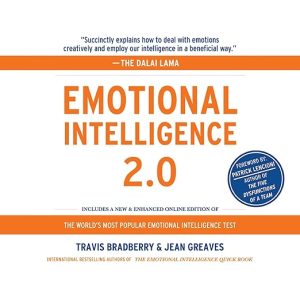
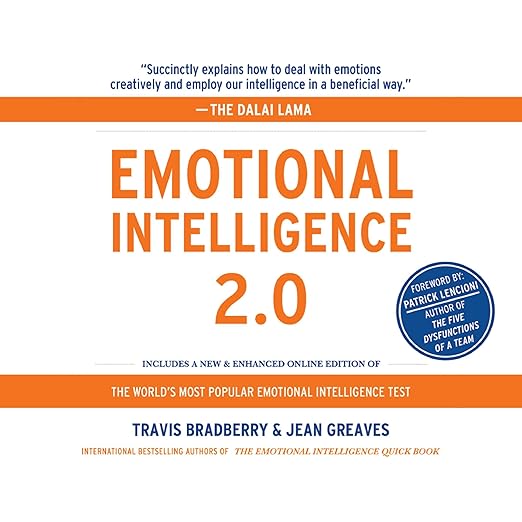
The endorsements are strange in an interesting way. Business books collect blurbs from other business writers, and this one has those, with Stephen R. Covey crediting it with 'abundant, practical findings and insights with emphasis on how to develop EQ' and Patrick Lencioni advising readers to 'read it twice'. But it also carries a line from the Dalai Lama, who says the book 'succinctly explains how to deal with emotions creatively and employ our intelligence in a beneficial way'. A workplace skills manual endorsed from that direction is unusual, and it tells you the material sits closer to general self-regulation than to management technique.
Length is the second genuine advantage. Four hours and seventeen minutes is short enough that finishing is realistic, and the review pool confirms people do. One reader reports getting through it in about a week while busy; another finished in two days and calls it an easy read. Newsweek called it 'A fast read with compelling anecdotes and good context in which to understand and improve'. For a category where most purchases are abandoned around chapter three, a book you can complete on two commutes has a real advantage over a better book you never finish.
Tom Parks holds the reading credit, and what this material asks for is instructional rather than expressive. The text is built from short strategies grouped under four headings whose names deliberately overlap, so the job is signposting: making a section boundary land, keeping a list of tactics from blurring into continuous prose, and holding the four categories apart when the vocabulary itself works against them. Clarity matters far more than warmth in a book built this way.
A Recording Cannot Score Your Own Assessment
The assessment is the thing to check first, and it is genuinely important. One reviewer describes the sequence in detail, writing that they 'completed the EQ test/survey that's included with the book' and received EQ scores from it before working through the material. The whole program is designed around measuring yourself, choosing strategies for your weakest area, and re-measuring later. A recording cannot deliver a scored self-assessment on its own, so confirm before you buy whether your edition provides access to the test. If it does not, you are getting the strategies without the diagnostic that tells you which ones to use.
The naming problem is the second issue, and it compounds over four hours. Because the four categories are assembled from recycled words, a listener without the grid in front of them can genuinely lose track of which one a strategy belongs to, which matters when the entire method depends on applying the right set to the right weakness. My advice is to write the four names down before you start, or to keep a copy of the text nearby. Two minutes of preparation solves a problem that otherwise runs the length of the book.
Notice what the reviews are actually measuring. One writes that the book 'has paid for itself many times over in better communication, calmer decision-making, and stronger team culture'. Another is titled 'Great gift idea!!'. A third opens by recording how fast it was finished. Those are assessments of return on investment and of time cost, not of argument quality, which tells you how this book is used: as a practical purchase with an expected payback, closer to a tool than to a work of nonfiction. That is a fair way to treat it, and it is also why almost nobody discusses the ideas.
Hold the science lightly, too. Covey's blurb asserts that research shows convincingly that EQ matters more than IQ, and claims at that strength have been argued over for as long as the field has existed. The strategies in this book stand up perfectly well as practical technique regardless of how that debate settles. Take them as methods you can test on yourself rather than as findings, and you will get the value without buying the framing wholesale. Fourteen ratings, incidentally, is far too thin a pool to tell you anything, so judge the 4.5 accordingly.
What Lencioni Meant Becomes a Re-Listen
New managers are the clearest audience, particularly anyone who has just acquired responsibility for people and discovered that competence at the work does not transfer to competence at the room. It also suits readers who already accept the concept and want something actionable, since the book skips the persuasion entirely. And it works well as a re-listen, which is presumably what Lencioni meant, because the strategies land differently once you have tried a few and failed at some.
If you want the research behind emotional intelligence, go to the academic literature instead, because this is a manual and makes no pretense otherwise. Readers who enjoy business books as narrative, with case studies and characters, will find the format closer to a reference than a story. And if you cannot get access to the assessment, weigh a print or digital copy seriously, since the measurement step is not decoration on this program. It is the part that tells you where to start.
Before You Listen
Does buying the audiobook give me access to the EQ assessment?
Check before purchase rather than assuming. A reviewer describes completing a test included with the book and receiving scores from it, and the whole method depends on measuring yourself first. Access arrangements differ between formats and editions, and without the diagnostic you get strategies with no guidance on which to prioritize.
What are the four EQ skills, and why are they harder to follow in an audiobook?
Self-Awareness and Self-Management on the inward side, Social Awareness and Relationship Management on the outward one, crossed with a second axis of noticing versus acting. The labels share their words, so a page shows you the pattern instantly while a listener holds four near-identical names in memory. Writing them down first fixes it.
Is four hours long enough for a practical program?
Yes, because the brevity is deliberate. The book skips the case for emotional intelligence and goes straight to technique, so almost nothing is spent on persuasion. Readers on this listing report finishing in days rather than weeks, which for this category counts as a design achievement rather than a shortcut.
Is this worth it if I have already read about emotional intelligence?
It depends what you want next. As an introduction to the concept it will feel redundant, since it assumes you are already convinced. As a structured set of things to actually do, organized so you can target one weak area at a time, it offers something most conceptual treatments never provide.