Quick Take
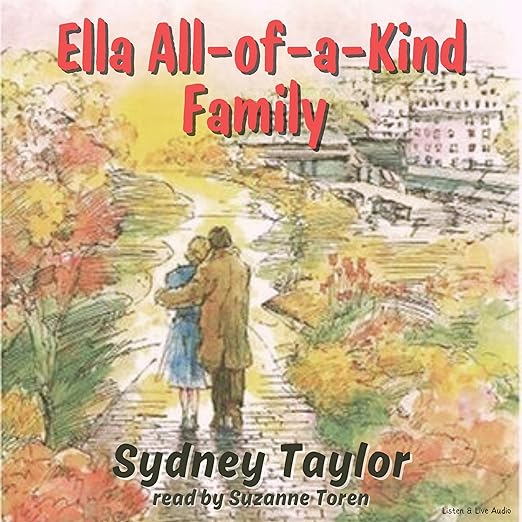
- Narration: Suzanne Toren brings deep theatrical experience to this role, voicing Ella’s ambitions and the family’s warmth with an ease that feels native to the era.
- Themes: Immigration and assimilation, the tension between ambition and duty, coming-of-age in post-WWI New York
- Mood: Nostalgic and warm, with a fizz of theatrical excitement
- Verdict: A satisfying close to a beloved series, and Toren’s performance honors both the history and the heart of Sydney Taylor’s writing.
I came to the All-of-a-Kind Family series late, as an adult reader filling in gaps in my classic children’s lit education, and I finished this final volume on a rainy Saturday afternoon in one sitting. There’s something about Ella’s story specifically that compelled me to keep the headphones in well past the point I’d planned to stop. The series had already given us five sisters growing up on New York’s Lower East Side at the turn of the twentieth century, but this concluding book belongs almost entirely to the eldest, and the question it poses is one that still resonates: when you’re offered a door you’ve always dreamed of, do you walk through it, even if walking through it means leaving someone you love behind?
Sydney Taylor drew on her own girlhood among immigrant Jewish families, and that authenticity saturates the writing. The Lower East Side here is specific and lived-in. The vaudeville world Ella glimpses is both glamorous and precarious. And the return of Jules from World War I gives the romance a quiet gravity that the earlier books couldn’t quite sustain.
What Suzanne Toren Does With Forty Years of Stage Work
Toren is one of those narrators whose resume is so extensive that listening to her feels like being in the hands of a master craftsperson. She has appeared on and off Broadway, recorded hundreds of audiobooks, and been recognized by both the Library of Congress and the Canadian National Institute for the Blind for her Talking Books recordings. None of that feels like a credential flex when she’s actually performing. It feels like a guarantee. Her voice carries the particular quality of someone who understands the difference between reading aloud and performing, and this material demands the latter. Ella’s moments of theatrical ambition need to shimmer; her moments of doubt need to feel genuinely costly. Toren navigates both without ever tipping into sentimentality or pushing the emotional beats harder than the text warrants.
She also has an unusually fine sense of period. The dialogue in Taylor’s prose carries the cadence of early twentieth century immigrant English, and Toren honors it without making it feel like a caricature. The family’s warmth, their Shabbat rituals, their communal apartment life: it all lands because Toren understands that this is social history as much as it is a children’s novel.
The Series Finale and What It Asks of New Listeners
As the fifth book in a series, Ella of All-of-a-Kind Family is not the place to start. The relationship between the five sisters, the family’s particular rhythms, and the significance of Jules’ return all carry weight accumulated across four previous volumes. Listeners new to the series will find this entry slightly thin on its own, because Taylor assumes you already care about these people. That’s worth flagging, but it’s also, in a way, a testament to how genuinely the series builds its world. The payoff here is designed for readers who have traveled the distance.
That said, the 3 hours and 42 minutes runtime is forgiving. This is not a demanding listen. It moves at the pace of a summer afternoon, and the central dilemma, Broadway versus Jules, never feels artificially manufactured. One reviewer described it as a story about women entering the workplace and gaining the vote, and that’s accurate, though Taylor wears her historical consciousness lightly. The suffrage movement and women’s expanded options hover at the edges of Ella’s decision rather than being lectured at the listener.
When Children’s Historical Fiction Works for Adults
The reviews for this audiobook are split between childhood readers returning with their own children and parents who discovered the series through their kids. That dual audience is earned. The All-of-a-Kind Family books belong to a tradition of American children’s historical fiction, alongside books like Laura Ingalls Wilder’s series and the Little Women family, that creates period-specific worlds detailed enough to reward adult attention. Taylor’s depiction of Lower East Side Jewish immigrant life in the early 1900s is genuinely instructive as social history, and it’s rendered with affection rather than sentimentality.
The theater subplot, Ella’s chance at a Broadway career through the attention of a talent scout, gives this concluding volume a particular vibrancy. It allows Taylor to sketch the early vaudeville world without glamorizing it, and it gives Ella a genuine conflict that doesn’t resolve in the way you might predict from a children’s series of this era. The ending is earned rather than tidy.
Who Should Listen and Who Should Wait
Listeners who have followed the series from the beginning will find this a genuinely satisfying conclusion, and Toren’s narration alone justifies the audio format over a silent read. Parents looking for historically rich family listening will want to start with volume one and work their way here. Adults interested in early twentieth century immigrant New York as social history will find the series more rewarding than most dedicated historical titles. Listeners expecting a standalone story with full context provided will want to back up to All-of-a-Kind Family first. If you’re coming to this series new and want to test whether it’s for you, start at the beginning: the 3-hour finale rewards the journey.
Frequently Asked Questions
Do I need to have listened to the earlier All-of-a-Kind Family books before starting this one?
Yes, this is very much a concluding volume and assumes familiarity with all five sisters and with Jules’ prior history with Ella. Starting with the first book in the series gives you the full emotional payoff this finale is built on.
Is Suzanne Toren the same narrator across the entire series, or does this book have a different narrator?
Toren narrates this volume, and she is the narrator associated with the series in audio form. Her theatrical background makes her an excellent fit for a book centered on the world of vaudeville and Broadway.
How does the Broadway versus Jules dilemma actually resolve? Is the ending satisfying?
Without giving away the specific outcome, the ending resolves Ella’s conflict in a way that reviewers consistently describe as charming and earned. It respects both of Ella’s desires rather than dismissing one entirely, which is part of what makes it work.
Is this audiobook appropriate for the 6-10 age range, or does it skew older given the romance and post-WWI setting?
The romantic element involving Jules is handled with complete age-appropriateness. Marriage as a concept is present, but the story’s emotional register is firmly in the younger middle-grade range. The post-WWI setting is more backdrop than theme, and the book should work well for listeners in the 7-10 range.