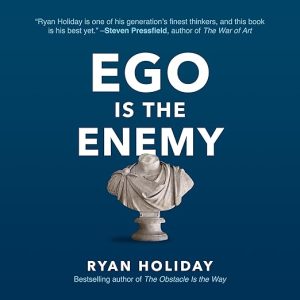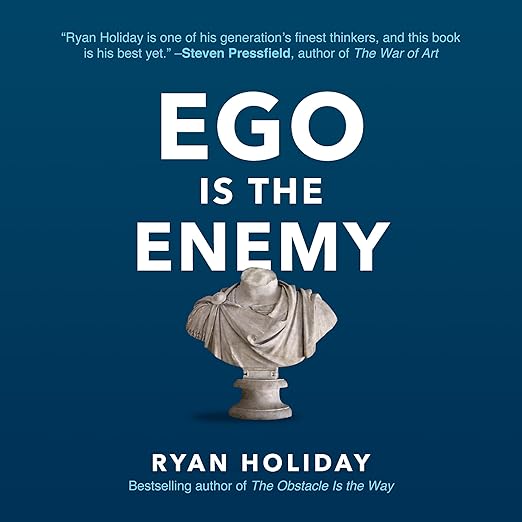
I started Ego Is the Enemy on a morning when I had just made a decision I was privately not sure about and spent considerable energy convincing myself I was certain. Listening to Ryan Holiday explain, in the same composed voice he uses for everything, that this kind of performative certainty is precisely what ego does when it has something to protect was uncomfortable in exactly the way the book intends. That discomfort is the book's most reliable mechanism, and it is not manufactured.
Holiday wrote Ego Is the Enemy two years after The Obstacle Is the Way, and the two books work best as a pair. Where Obstacle addresses how we respond to external resistance, Ego addresses the internal resistance that sabotages us even when the external conditions are favorable. The argument is that ego, the sense of self that prioritizes recognition over substance and comfort over growth, operates in three distinct phases of any endeavor: aspiration, success, and failure. Holiday structures the book accordingly, and each section uses historical examples to show what ego costs at each phase.
The Verdict, Briefly
The book's recurring cast of historical figures is drawn from an interesting mix of domains. General William Tecumseh Sherman, Katharine Graham, and Frank Shamrock appear alongside Benjamin Franklin and Howard Hughes, among others. What they share is not greatness in the conventional sense but rather a particular relationship to their own ambitions: the successful ones managed to subordinate ego to craft. The ones who failed spectacularly often did so precisely when success had inflated their sense of their own invulnerability.
Holiday draws from the prologue that history is made not only by visionary geniuses but by individuals who fought their egos at every turn, who eschewed the spotlight, and who put their higher goals above their desire for recognition. This is the book's organizing principle, and Holiday holds to it consistently across all three sections. The argument is cumulative rather than revolutionary, and its force comes from the accumulation of examples rather than from a single decisive insight.
Why Ego Is the Enemy Works as an Audiobook
At just under seven hours, this is a manageable listen that suits the book's compressed, chapter-by-chapter structure. Holiday's self-narration is measured and without affectation, which is the appropriate register for a book arguing against self-display. He does not perform conviction. He reasons it. The audio format works well for the book's rhythm: each chapter is short and ends on a clear, actionable insight that benefits from a moment of reflection before the next one begins. Listening in shorter sessions of forty-five minutes to an hour is more effective than marathon listening, because the material rewards digestion.
One reviewer with a background in organizational leadership noted that Ego Is the Enemy addresses something that leadership books almost never confront directly: the specific ways that ego compromises effective leadership without the leader recognizing it. That gap in the literature is part of what makes Holiday's contribution here distinct. He is not writing about obvious narcissism. He is writing about the subtler, more socially acceptable versions of ego that professionals carry into every room.
Points to Consider
The book's limitation is also its compression. Holiday makes large arguments through selective examples, and some of the historical figures are handled with enough efficiency that readers who know those figures well may find the portraits slightly flattened. The framework does not accommodate complexity particularly well: ego is treated as consistently and definitionally destructive, which is an interesting philosophical position but not an undisputed one. Holiday is aware that he is arguing a case rather than mapping a terrain, and listeners who want a more nuanced treatment of the relationship between self-regard and achievement will need supplementary reading.
The Turkish-language review visible in the product data is a reminder that this book has a genuinely international readership that extends well beyond the English-language markets Holiday initially addressed. The Stoic framework translates across cultures in ways that more culturally specific self-help does not, which is part of why the series has sustained its readership a decade on.
Should You Listen to Ego Is the Enemy?
Young people in ambitious early careers who have not yet encountered the specific failures that ego produces will find this useful as a preemptive framework. Professionals who have experienced the plateau that often follows early success will find it diagnostic. Anyone who has ever worked for someone whose sense of their own importance actively impaired their judgment will find the managerial sections clarifying. Listeners who want emotional catharsis, personal narrative, or detailed practical guidance rather than a philosophical argument should look elsewhere. Holiday is building a framework, not handing you a checklist.