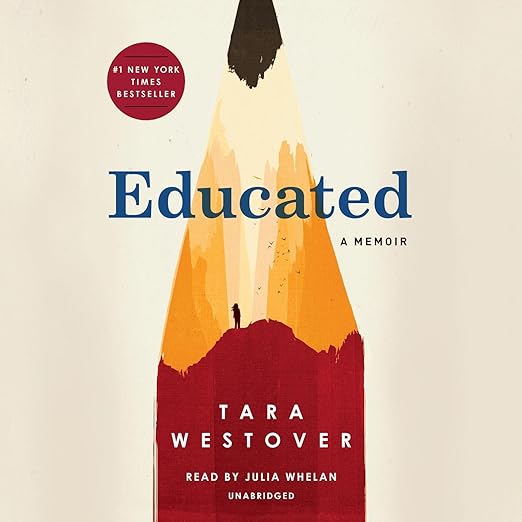
How long does a memoir stay dangerous? The written responses on this listing run from June 2018 to February 2026, the better part of eight years of people arriving at the same story and reacting as though it were brand new. The most recent of them opens with the words "Eye opening". A book about a childhood spent outside every institution the rest of us take for granted has not worn smooth with familiarity, which is rarer than the prize stickers on this audiobook suggest.
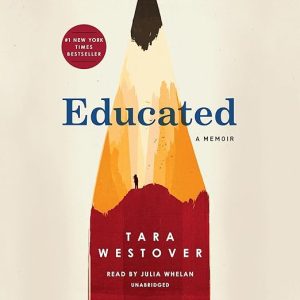
The facts are stark enough in the publisher's own summary. Born to survivalists in the mountains of Idaho, Tara Westover was seventeen the first time she set foot in a classroom. Nobody made sure the children were educated and nobody stepped in when one of her older brothers turned violent. Another brother got himself into college. She decided to try a new kind of life, and the route ran over oceans and across continents, to Harvard and to a PhD from Cambridge University.
Twelve Hours Is the Only Question That Matters
Half the description is a prize list, and I want to be honest about how little that helps you. Ten Best Books of the Year, a place among Barack Obama's favorites, a Kirkus nod as a best nonfiction book of the century, finalist slots, a PEN award, a Los Angeles Times Book Prize. The New York Times supplies the pull quote calling it "an act of courage and self-invention". None of it answers the only question a buyer actually has, which is whether twelve hours inside this family is time you want to spend.
The Word Mormon Appears Nowhere in the Description
The reviews answer it better. marie, writing four months after release, describes a book that "kept me up at night and then well into the following day" and argues it belongs on reading lists for psychology, counseling and family therapy courses. That review also supplies the detail the official copy leaves out: seven children, a patriarch this reader takes to be mentally ill and possibly bipolar, and an extreme interpretation of Mormonism turned into a tool for controlling everyone in the house. The word Mormon appears nowhere in the publisher's description.
Thelma's account is the one I would hand to anybody still deciding. That reader went in "completely blinded", knowing nothing about the book or the story, felt lost through the opening pages, and now counts that ignorance as the best possible way to have arrived. Sadness, rage, and a long stretch of wanting a young woman to speak when she cannot: those are the beats named, and they suggest a book that works on you rather than one you admire from a distance.
Eight Years, 228 Ratings, Zero Words on Whelan
Twelve hours and ten minutes represents a serious commitment, and the first-person register is what makes the format worth making it. This is a woman reconstructing a childhood she was instructed to remember differently, and the reconstruction happens in her own voice on the page. Hearing it spoken aloud collapses the small distance print keeps between a reader and a confession. Memoir is the genre with the most to gain from being read aloud and the most to lose from being read badly, which is why the casting question matters more here than it would on a novel.
The Vogue blurb frames the stakes better than the plot summary does, calling the questions universal ones: how much of ourselves should we give to those we love, and how much must we betray them in order to grow up. Those are questions you have to sit with rather than solve, and a recording controls the pace at which you sit. You cannot speed-read past the part that is getting uncomfortable.
Julia Whelan reads it for Random House Audio, and here I have to be plain with you. Across the five written responses on display, not a single word touches the performance. Eight years of written responses, 228 ratings, and the reading itself goes completely undiscussed, so I am not going to manufacture an impression of it. What the text demands is knowable, though: sustained first person, family dialogue in a very particular register, and passages of violence that need restraint rather than performance. A few minutes of sample will settle the fit faster than any review could.
Tagged Religious, Though No Faith Is Ever Named
Abby supplies the only reservation in the pool and it deserves airtime. That four-star review finds the ending "more rushed than the rest of the story", which is a familiar shape in memoir, where the recent past resists the same shaping as the distant past. If you are the sort of listener who feels shortchanged by a quick landing after a long climb, take the warning seriously. Everything else in that review is admiring.
The subject matter is the larger caution and it is not a small one. Emotional abuse, intimidation, a violent sibling, adults who never step in, and a household organized entirely around one man's certainty. The publisher's summary states the essentials flatly and leaves you to draw the conclusion, which is the right choice. What the book does with that material sits closer to a case study than to a coming-of-age story, and nothing gets softened along the way.
One oddity is worth naming before you commit. The category tag on this listing reads Religious, and the publisher's summary never names a faith at all. It says survivalists, isolation, no schooling, no intervention. The religion is supplied by readers, not by the publisher, and anyone choosing this expecting a book about belief will instead find one about isolation, education and what leaving costs.
Years of Undimmed Reactions Are the Recommendation
First-generation students will recognize more here than they may want to. So will anyone who has had to decide how much of a family they can keep while becoming somebody that family never planned for. The quality that makes the book last is precision: it describes a dynamic most memoirs can only gesture at, naming the exact mechanisms by which a household polices what its members are allowed to know. That precision is also why the reviews keep arriving eight years on rather than tapering off the way praise usually does.
Hold off if you are in the middle of a difficult family situation yourself, because this offers company rather than comfort and it is unsparing about the violence. Hold off too if a hurried final act tends to spoil the whole for you, because the single dissenting voice on this page names precisely that problem. Everyone else should treat the years of undimmed reactions on this listing as the recommendation they clearly are.
Key Details
- Narrator: Julia Whelan for Random House Audio, on a memoir that is one voice remembering from start to finish.
- Subjects: A childhood without school, family loyalty against self-invention, what leaving costs
- Tone: Tense, clear-eyed, quietly devastating
- Bottom line: Still worth the twelve hours, and still hard to sit through in the best way.
Before You Listen
Does anyone say how Julia Whelan's narration of the audiobook holds up?
No, and that is unusual for a title this widely read. Across five written reviews spanning 2018 to 2026, not one mentions the reading. Whelan is credited on a Random House Audio production running twelve hours and ten minutes. Sampling the opening is the only way to test the fit yourself.
How difficult is the family violence in this audiobook?
Difficult enough to plan around. The summary states plainly that no one intervened when an older brother became violent, and reviewers describe emotional abuse, bullying and intimidation running through the household. It is handled as memoir rather than as spectacle, but it accumulates over twelve hours in a way print lets you pace differently.