At a Glance
- Narration: John Bedford Lloyd brings a steady, unshowy authority to Malarkey's testimony that suits the witness-account nature of first-person WWII memoir.
- Themes: Combat survival and camaraderie, the cost of wartime leadership, the ordinary man in extraordinary history
- Mood: Sober, immediate, and deeply human
- Verdict: Easy Company Soldier is the war memoir that Band of Brothers viewers knew existed somewhere, the ground-level account of one man's improbable survival across every major European theater, told without mythologizing.
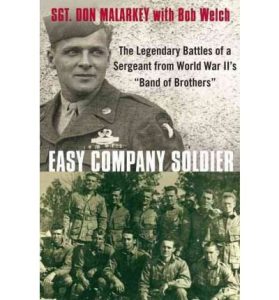
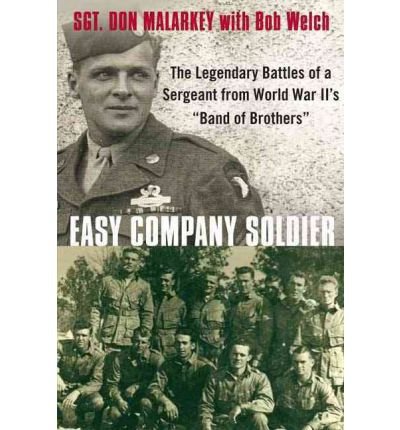
I listened to Easy Company Soldier on a series of long drives through flat, grey November countryside, which turned out to be the right environmental pairing for a book that is fundamentally about endurance in landscapes stripped of comfort. Sgt. Don Malarkey is not a writer by trade, and the memoir does not pretend otherwise. What it is is a witness account of exceptional specificity: one man who beat one-in-six odds at Camp Toccoa, who parachuted into Normandy in the dark hours before D-Day, who fought for twenty-three days straight in Normandy and then kept going, through Holland, through Bastogne, through the Ruhr. By the time the book closes, the cumulative weight of those numbers becomes something close to overwhelming.
The book exists in the shadow of Band of Brothers, which is both an advantage and a complication. Viewers of the HBO series will arrive with images already formed, with some characters already familiar, with a cinematic version of events already occupying the space where imagination should be. Malarkey navigates this by prioritizing the interior over the exterior: his experience of D-Day is not the one the camera showed. It is closer, smaller, more confused, and more frightening. The Bronze Star he received for heroism in those first days of Normandy is mentioned without fanfare because Malarkey is not interested in heroism as a concept. He is interested in what happened and what it cost.
First, the Big Picture
The book's early chapters, covering Malarkey's path from Oregon to Camp Toccoa to England, are essential context for understanding what follows. The selection process for the 506th Parachute Infantry Regiment was genuinely brutal: one in six soldiers earned their Eagle wings. Malarkey was twenty years old. The training sequence establishes the physical and psychological framework that allowed Easy Company to function as a unit rather than a collection of individuals, which is the precondition for everything that follows in the European theater. By the time the paratroopers jump into France, the reader understands what it took to be in that plane.
The loss of his best friend at Bastogne is the emotional center of the memoir, and Malarkey treats it with the restraint of someone who has spent decades living with grief rather than weeks performing it. The nightmarish quality of Bastogne, the cold, the attrition, the particular horror of fighting for a Belgian crossroads in winter, is rendered through personal detail rather than strategic overview. This is the opposite of official history. It is the history that happens to one person and stays with them forever.
Why Listen to Easy Company Soldier
The right narration for a memoir like this is essentially invisible, which is the hardest kind to achieve. John Bedford Lloyd does not impose emotional direction on Malarkey's testimony. He reads with the steady authority of someone who understands that the material generates its own gravity and that the narrator's job is to stay out of the way. This approach works particularly well for the combat sequences, where unnecessary performance would undercut the documentary urgency of what is being described. Lloyd handles the quieter, reflective passages with equal restraint, which maintains the tonal consistency that the memoir's witness-account format requires.
At just over eight hours, the runtime is appropriate for a memoir that spans three years of active combat across four distinct theaters. The book does not overstay. Malarkey knows when he has said what needs to be said, and the narrative closes without forcing a redemptive arc where none would be honest. The kid from Oregon who became a leader of men comes home changed in ways the book does not try to quantify. That honesty is its own kind of valor.
A Few Reservations
Listeners who have watched Band of Brothers and want to understand Malarkey specifically will find this memoir essential reading. He appears in the series as a major character, and hearing his own account of the same events creates a productive tension between the dramatized version and the lived one. Listeners who have no prior exposure to Easy Company should note that the book assumes some familiarity with the basic geography of the Western European theater, though it explains its own terms clearly enough that prior knowledge is useful but not required. This is military memoir that works for the general reader as well as the specialist.
The Right Listener for Easy Company Soldier
Listen if you want a first-person WWII memoir that prioritizes the human experience of combat over strategic overview and refuses to mythologize what it describes. Listen if you are a Band of Brothers viewer who wants the ground-level version of the same events from someone who lived them. Skip if you are looking for a broader historical survey of the European theater rather than a single soldier's account. Skip if accounts of sustained combat and loss in wartime are something you need to approach carefully; the material is not gratuitous but it is honest about what Bastogne and Normandy cost.
What the memoir also captures, and what broader historical surveys cannot replicate, is the physical experience of the European theater. Malarkey remembers cold in the way that someone who has been genuinely cold for weeks at a time remembers it, as a physical fact that reorganizes everything else around it. The descriptions of Bastogne are not strategic assessments. They are sensory accounts of endurance at its limit, and that difference in scale is what makes memoir irreplaceable alongside the larger historical record.
Frequently Asked Questions
Do you need to have watched Band of Brothers to appreciate Easy Company Soldier?
No prior viewing is required, though Band of Brothers viewers will find an interesting counterpoint in Malarkey's first-person account of events depicted in the series. The memoir stands on its own as a complete account of one soldier's journey from Oregon to the end of the European war.
How does Malarkey's memoir handle the loss of his best friend at Bastogne?
With notable restraint. Malarkey does not perform grief or stage the loss for effect. The account of Bastogne and what it took from him is rendered through personal detail and quiet acknowledgment, which makes it more affecting than a more dramatic treatment would be.
Is Easy Company Soldier appropriate for listeners who are not military history specialists?
Yes. The memoir prioritizes the personal and human dimensions of the experience over strategic or tactical analysis. Malarkey explains the context of each campaign clearly enough that readers without deep military history knowledge will follow without difficulty.
What distinguishes John Bedford Lloyd's narration from a more dramatically performed reading of this material?
Lloyd reads with restraint and authority, treating the testimony as a witness account rather than a dramatic performance. This is exactly the right approach for material that generates its own emotional weight, and it keeps the narration from competing with the events being described.