At a Glance
- Narrator: Chloé Cooper Jones narrates her own memoir, and her voice shifting from academic precision to raw disclosure is part of the book's actual argument.
- Subjects: Disability and sacral agenesis, motherhood as reckoning, philosophy of beauty and desirability
- Tone: Intellectually rigorous, unflinching, quietly devastating
- Bottom line: A Pulitzer finalist memoir that rewards listeners willing to sit with philosophy alongside personal disclosure.
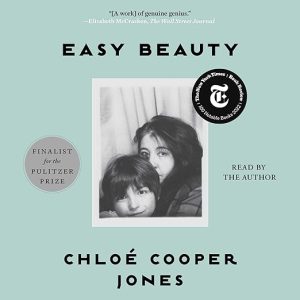
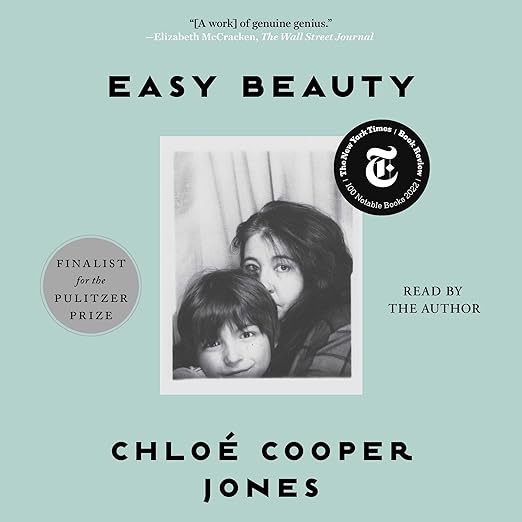
“I am in a bar in Brooklyn, listening to two men, my friends, discuss whether my life is worth living.” That is the actual opening line of Chloé Cooper Jones’s Easy Beauty, and it tells you everything about the audiobook’s approach: unflinching, specific, and delivered by the person who lived it, since Cooper Jones narrates her own memoir.
Easy Beauty is a Pulitzer Prize finalist for memoir, a New York Times Notable Book, Vulture’s number one memoir of the year it published, and a title Oprah Daily included among thirty-three memoirs that changed a generation, and all of that recognition centers on one central fact: Cooper Jones was born with sacral agenesis, a rare congenital condition that affects her stature and gait, and she has spent her life factoring what she calls “pain calculations” into how she moves through the world.
Travel as Fieldwork for an Argument
What makes this memoir more than a disability narrative is its scope. Cooper Jones, a philosophy professor, structures the book as a series of journeys taken specifically to reclaim spaces she’d been denied or had denied herself: sculpture gardens in Rome, a film festival in Utah, a Beyoncé concert in Milan, a tennis tournament in California, and the Killing Fields of Phnom Penh. Becoming a mother, in what the synopsis calls violation of unspoken taboos about disabled bodies, is the hinge that sends her looking, and the book weaves memory and aesthetic philosophy together to question the standards of beauty and desirability she was raised inside, and sometimes helped enforce herself.
Andre Aciman, author of Call Me by Your Name, blurbed the book as “bold, honest, and superbly well-written,” and that combination of bluntness and craft is exactly what carries listeners through material that could easily tip into either self-pity or academic distance. It does neither.
Cooper Jones’s academic credentials aren’t incidental to how this book works: she’s a Whiting Creative Nonfiction Grant recipient as well as a philosophy professor, and that dual background shapes her actual method. Rather than simply recounting what happened at a tennis tournament in California or a film festival in Utah, she uses each specific scene to interrogate a real philosophical question about who gets to be seen as beautiful, capable, or worth watching, then turns that same scrutiny back on her own reactions and complicities. The travel isn’t decorative; it’s fieldwork for an argument she’s building scene by scene. That’s a genuinely different structure than the standard misfortune-to-triumph memoir arc, and it’s part of why critics kept placing this on best-of-year lists across such a wide range of publications, from Vulture to USA Today to the New York Public Library.
Cooper Jones Describes Her Neutral Room
Cooper Jones narrating her own memoir is close to essential here, not just a nice authenticity bonus. Her prose moves fluidly between an academic, philosophical register and raw personal disclosure, and hearing her make that shift in her own voice, in real time, is a different experience than a professional actor reconstructing it after the fact. One listener put it plainly: “I enjoyed the audiobook a lot. It’s so much better hearing the author’s voice and inflections.”
Reader response backs up the literary reputation. One reviewer wrote, “I couldn’t put Easy Beauty down, it’s so brilliantly composed and a delight to read. I laughed and cried and learned so much, related to so much,” and finished the book already hoping for a follow-up a decade from now, once her son has grown. That kind of investment in a memoir, wanting to know what happens next in a story that has technically already ended, says something about how fully Cooper Jones pulls listeners into her specific, unrepeatable life rather than a generic disability narrative.
One detail from the synopsis stands out as a specific, audio-friendly image worth knowing before you start: Cooper Jones describes retreating, as a coping strategy, to what she calls “the neutral room in her mind” whenever judgment or pity from strangers became too much to process in real time. Hearing her narrate that exact phrase in her own voice, rather than reading it silently on a page, gives it a different weight, since she’s describing a private mental refuge she built specifically because the world outside it was so often hostile to how she moves through it. It’s the kind of detail a professional narrator could deliver competently, but couldn’t deliver as testimony.
Why She No Longer Speaks to Her Dad
This is a philosophically dense memoir, not a straightforward chronological one. Cooper Jones is a trained philosopher and it shows in how she builds arguments about beauty and desirability alongside the personal narrative, so listeners expecting a more conventional plot-driven memoir should recalibrate: the payoff here is in the thinking as much as the story.
Not every thread resolves neatly, either. One listener finished the book “wondering why exactly she no longer speaks to her dad,” openly speculating about whether bitterness from her mother’s stories played a role, a question the memoir raises without fully answering. That’s worth knowing going in if you prefer memoirs that tie off every relationship by the final chapter.
The book’s structure, jumping between Brooklyn, Rome, Utah, Milan, California, and Phnom Penh rather than moving in strict chronological order, asks listeners to track an emotional and philosophical throughline more than a linear timeline. That’s a deliberate choice that suits the book’s argument, but listeners who prefer memoirs with a clear beginning-to-end chronology should know this one moves associatively instead, organized by theme and reckoning rather than by date. It rewards close listening more than passive background listening, which is worth knowing given its serious subject matter.
Kindred to Cusk and Maggie Nelson
Readers of philosophically minded memoir in the Leslie Jamison or Anne Boyer tradition are the clearest audience, along with anyone interested in disability narratives that refuse the usual overcoming-adversity template. Parents processing how a major life change reshapes old wounds will also find real material here, since motherhood is what sets Cooper Jones’s whole journey in motion.
Listeners who appreciated Rachel Cusk’s or Maggie Nelson’s genre-blurring approach to memoir and criticism will find a kindred spirit here, since Cooper Jones is similarly unwilling to let personal narrative stand alone without interrogating its own assumptions. That combination of rigor and vulnerability is rare enough in memoir that it’s worth seeking out even for readers who don’t typically gravitate toward disability narratives specifically.
Anyone expecting the estrangement from her father to resolve into a clean reconciliation, or hoping for a purely narrative memoir without philosophical digression, should know upfront that Easy Beauty is more interested in sitting with hard, unresolved questions than answering them.
Good to Know
Does Chloé Cooper Jones's own narration add something a professional narrator couldn't?
Yes. Reviewers specifically credit hearing “the author's voice and inflections” as part of what makes the audiobook work, especially as the prose shifts between academic and personal registers.
Does the Easy Beauty audiobook explain Chloé Cooper Jones's disability in detail?
Yes. It's built around her experience with sacral agenesis, a rare congenital condition, and the “pain calculations” she describes factoring into daily life.
Does the Easy Beauty audiobook resolve her estrangement from her father?
Not neatly. One listener finished the audiobook still wondering why she no longer speaks to him, which the memoir leaves as an open question rather than a resolved subplot.
Is the Easy Beauty audiobook mostly about travel, since it covers Rome, Milan, and Phnom Penh?
Travel is the structure, not the subject. Each location anchors a specific reckoning with beauty, disability, or motherhood rather than functioning as a travelogue.