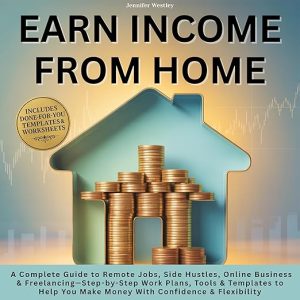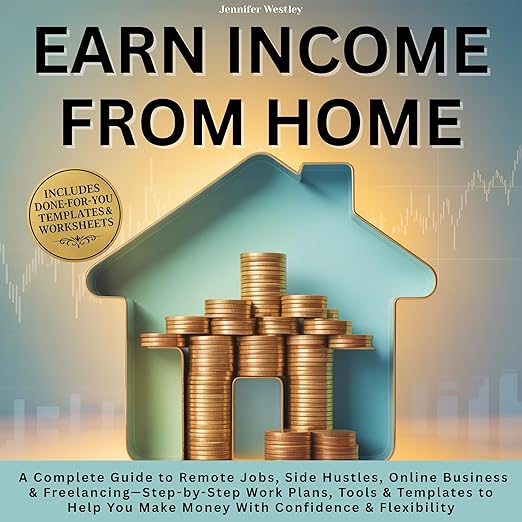
Turning a first $100 into $1,000 or more in monthly income is the concrete promise driving this audiobook, and Jennifer Westley spends six hours and forty-three minutes showing exactly how, without the vague hype that usually surrounds work-from-home advice.
This is Book One of The Earn & Thrive from Home Series, and it’s built specifically to cut through what the synopsis calls “empty promises and “easy money” traps”: remote jobs, freelance clients, and Etsy or digital-business income are all covered, alongside how to spot red flags before wasting time or money on scams.
A Companion PDF With Checklists and Planning Dashboards
What separates this from a generic hustle-culture pep talk is the companion PDF toolkit included with purchase: résumés, pitch scripts, checklists, worksheets, and planning dashboards designed to be used alongside the audio rather than as an afterthought. One reviewer, a mother building a side business, put it directly: rather than dumping a list of ideas, the book “gives clear step-by-step guidance, templates, and real-life stories that make everything feel doable.” That specificity is what separates practical guidance from motivational filler, and it’s the single biggest differentiator reviewers keep returning to.
The scam-awareness angle gets specific, practical attention rather than a single throwaway warning, which matters given how much of the remote-work advice space is genuinely full of exactly the traps this book is positioned against. A second reviewer draws that contrast directly, distinguishing it from “get rich fast” guides and praising “the real examples, clear templates, and honest advice about spotting scams.”
The book actually covers three fairly distinct paths rather than one generic work-from-home pitch: landing a flexible remote job as an employee, building a freelance client base, and launching an Etsy shop or other digital product business. Those are meaningfully different skill sets, different timelines to first income, and different risk profiles, and treating them as three real options rather than collapsing them into one strategy is part of what keeps this from reading like generic hustle-culture content. Listeners can reasonably use the book to figure out which of the three paths actually fits their situation, rather than assuming only one correct path exists. Rick Baptist’s review reinforces this multi-path breadth directly, praising how “the amount of ideas here are endless” compared to narrower advertisements he’d encountered promising a single solution.
Pellé Narrates the First Pass, the PDF Comes Second
Narrator Jessica Pellé is reading material designed to be immediately actionable, and the audiobook works best treated as a first pass through the strategy before opening the companion PDF to do the actual work: fill out a worksheet, adapt a pitch script, build a planning dashboard. The tone throughout stays encouraging without tipping into hype, a needle Westley threads by pairing every piece of advice with a concrete next action rather than leaving listeners with only motivation and no clear starting point. Treating the audio and the PDF as one integrated product, rather than audio with a bonus attachment, is the right way to approach this particular title.
At 4.8 stars across 31 ratings, the early response skews heavily toward listeners who specifically wanted structure over inspiration, which tracks with how the book is built: clear steps toward a first $100, then toward $1,000 or more a month, rather than abstract encouragement to follow your passion.
The scam-avoidance framing runs deeper than a single warning chapter: the synopsis specifically promises listeners will learn to spot red flags before committing time or money, which positions this as much as a filter for bad opportunities as a guide to good ones. That dual function matters in a space this saturated with predatory offers, since knowing what to walk away from is often just as valuable as knowing what to pursue, especially for a beginner without the experience yet to tell the difference on their own. SassyRose’s review specifically calls out the scam-avoidance material as one of the book’s standout features, valuable for a busy parent short on time to vet opportunities independently. Alex’s review draws the same contrast from a different angle, distinguishing the book’s approach from “get rich fast” guides specifically because of its honesty about how much real effort building any of the three paths actually requires.
A Strong On-Ramp, Not a Leveling-Up Resource
This is explicitly beginner-focused, per its own framing as “practical, beginner-friendly, and results-focused,” so listeners already earning steadily from freelance or remote work may find some sections cover ground they’ve already mastered. It’s a strong on-ramp, not necessarily a leveling-up resource for someone past their first year of side income.
The audio-plus-PDF structure is also a real design choice worth knowing about upfront: this is one of those guides where the most actionable material, the actual résumés and scripts, lives in the companion document rather than in narration alone, so listeners who skip the PDF are leaving real value unused.
Because this is explicitly Book One of a series, and because it covers three different income paths, employment, freelancing, and digital products, in a single six-and-a-half-hour audiobook, no single path gets the depth a dedicated freelancing guide or a dedicated Etsy-specific guide would offer on its own. Listeners who already know exactly which path they want to pursue may find some of the runtime spent on paths they don’t need. That breadth-over-depth tradeoff is a reasonable choice for a first volume meant to help listeners choose a direction, but it’s a real tradeoff to weigh if you’ve already made that choice. The companion PDF partially offsets this tradeoff, since listeners can use the worksheets to focus their own follow-up effort on whichever single path they choose after finishing the audio overview.
Naming Three Paths Instead of One Silver Bullet
Beginners exploring remote work, freelancing, or a first Etsy or digital-business venture, especially anyone juggling other responsibilities the way the reviewing mom describes, make up the core audience here, alongside anyone specifically worried about falling for work-from-home scams.
Parents and caregivers balancing income-building with other responsibilities are a specific, clearly served audience here, based directly on how closely the reviewing mother’s experience matches the book’s own stated approach. Anyone who has tried and been burned by a work-from-home opportunity before will also find the scam-literacy angle particularly reassuring on a second attempt. Listeners specifically drawn to the Etsy or digital-product path, rather than traditional freelancing or remote employment, may want to treat this as the broad orientation before seeking out more specialized resources for that specific channel. That structural honesty, naming three paths instead of pretending one silver bullet exists, is itself a form of the scam-literacy the book is trying to build in its listeners.
Freelancers already earning steady income, or anyone unwilling to actually open the companion PDF and do the exercises, will get noticeably less mileage out of this than a true beginner starting from zero.
At a Glance
- Performance: Jessica Pellé delivers immediately actionable material best paired with the companion PDF rather than audio alone.
- What it covers: Remote work and freelancing, scam avoidance, building income from $100 to $1,000 or more monthly
- Feel: Practical, encouraging, structured rather than motivational-only
- Our call: A strong beginner's guide to legitimate work-from-home income, especially for listeners who'll also use the PDF.