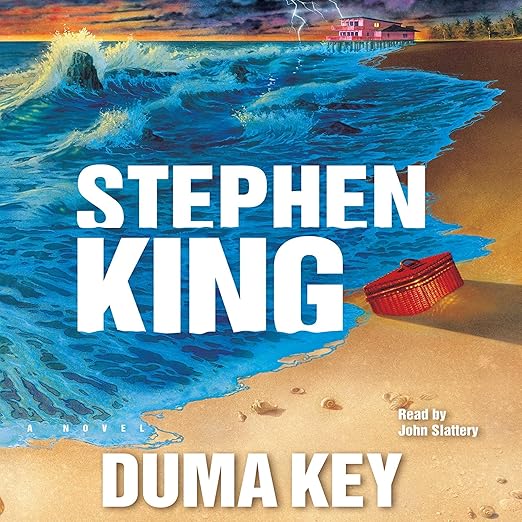
Duma Key
Audiobook & Ebook

Duma Key by Stephen King | Free Audiobook

By Stephen King

Narrated by John Slattery

🎧 21 hours 📘 Simon & Schuster Audio 📅 January 22, 2008 🌐 English
🎧 Listen Free on Audible 📖 Read on Kindle

Free 30-day trial · Cancel anytime

About This Audiobook

Winner of the 2009 Audie Award for Fiction

Master storyteller Stephen King’s classic, terrifying #1 New York Times bestseller of what happens when the barrier between our world and that of the supernatural is breached.

After a terrible construction site accident severs Edgar Freemantle’s right arm, scrambles his mind, and implodes his marriage, the wealthy Minnesota builder faces the ordeal of rehabilitation, all alone and full of rage. Renting a house on Duma Key—a stunningly beautiful and eerily undeveloped splinter off the Florida coast—Edgar slowly emerges from his prison of pain to bond with Elizabeth Eastlake, a sick, elderly woman whose roots are tangled deep in this place. And as he heals, he paints—feverishly, compulsively, his exploding talent both a wonder and a weapon. For Edgar’s creations are not just paintings, but portals for the ghosts of Elizabeth’s past…and their power cannot be controlled…

🎧 Listen Free on Audible

Free 30-day trial · Cancel anytime

Quick Take

  • Narration: John Slattery brings a damaged, masculine interiority to Edgar Freemantle that suits the slow, painful rebuilding of the character’s first act and holds through the novel’s increasingly supernatural final movement.
  • Themes: Trauma and creative rebirth, grief and the permeability of the past, art as conduit for supernatural force
  • Mood: Slow-burning dread with genuine emotional warmth in its opening third, darkening steadily as the Florida coast reveals what it holds
  • Verdict: One of King’s most underrated standalones, rewarding patient listeners with a character study that earns its horror through accumulated human feeling.

I have a particular relationship with Stephen King that I suspect many readers share: deep admiration for what he does at his best, the awareness that his best work is distributed unevenly across a very long catalog, and the occasional discovery of something sitting in that catalog overlooked while noisier titles dominated the conversation. Duma Key was exactly that discovery for me. I came to it late, on the recommendation of a friend who said simply, I think it might be his most emotionally honest book. I listened on a grey coastal weekend and it was exactly the right pairing for exactly the right conditions, the kind of alignment between content and context that you cannot engineer and can only be grateful for when it happens.

Edgar Freemantle loses his right arm in a construction site accident. The accident also scrambles his cognitive function in specific ways that emerge gradually over the following months, affecting memory and impulse control, and it ends his marriage in the slow, grinding way that catastrophic injury ends marriages when the person who comes home is not quite the person who left and neither party can fully articulate what has changed. He is a wealthy man with nowhere to redirect his rage and no framework for understanding who he is without the work and the identity the accident stripped from him. He rents a house on Duma Key, a barely developed splinter of Florida coast, and begins to paint. This is the first third of the novel, and it is King operating in a register he does not always inhabit: emotionally precise, structurally patient, and deeply attentive to the texture of a person building something from the wreckage of everything they had before.

Where Edgar’s Talent Comes From and What It Costs

The supernatural enters gradually and earns its place in the narrative. Edgar’s painting improves at a rate that exceeds human explanation. The images that come from him are not entirely his own, and the work he produces serves as a conduit for things he does not yet understand. They connect to the history of Duma Key itself and to Elizabeth Eastlake, an elderly woman whose family roots in the place run deeper and darker than the island’s quiet exterior suggests. The paintings become portals, as the synopsis describes them, for the ghosts of Elizabeth’s past, and their power proves genuinely impossible to contain once it is released into the world. King moves from character study to haunted house novel to something closer to full mythology by the final third, and the transition is handled more smoothly here than in some of his longer or more ambitious work.

John Slattery’s narration is central to why this audiobook succeeds at the level it does. Edgar is a man in his fifties, physically diminished, emotionally raw, and attempting to rebuild using the only leverage the accident left available to him. Slattery plays that register without melodrama or sentiment. His voice in the early chapters, working through Edgar’s physical therapy, his slow rediscovery of his own capacity for human connection, and his equally slow discovery of what he can do with a brush in his remaining hand, establishes a baseline of damaged authenticity that makes the later supernatural developments land with proper emotional weight. The 2009 Audie Award for Fiction was a deserved recognition of this as a genuine listening experience in itself.

Elizabeth Eastlake and the Mythology of the Key

Elizabeth is one of King’s more richly rendered supporting characters, which is saying something given how many supporting characters he has created across a very long career. Her history with the Key, what her family did there and what they brought into the world, provides the novel’s mythological backbone. The connection between Edgar’s exploding artistic talent and the supernatural properties of the island is revealed in careful layers over the course of twenty-one hours, and King is patient with the reveal in ways that will either reward or frustrate listeners depending on their tolerance for slow-burn horror that prioritizes atmosphere and character over immediate incident and action.

One reviewer who has both read and listened to this book twice preferred the reading experience, finding the story more absorbing in a format that allowed re-reading of complex passages without the linear pressure of audio. That is a legitimate preference worth naming for listeners deciding between formats. Slattery’s performance is accomplished throughout, but this is also a novel that rewards a certain quality of solitary, inward attention that some listeners find easier to sustain in print.

John Slattery and Twenty-One Hours on the Gulf Coast

At twenty-one hours, this is a significant commitment of listening time, and the narration is a central part of what makes that commitment sustainable. Slattery’s voice is already associated with a certain kind of quietly authoritative male interiority, and he brings that quality to Edgar without leaning on it as a shortcut. The early chapters, in which Edgar is learning to use his remaining arm and learning to tolerate his own company, require a narrator who can make stillness and anger coexist in the same voice without melodrama. Slattery manages this consistently across a very long runtime, which is not a small achievement and deserves to be named as such.

The Patient Listener’s King Novel

The first third rewards the investment with emotional depth that genuinely earns everything that follows it. The middle section, as Edgar’s paintings become increasingly dangerous and Elizabeth’s past comes fully into focus, sustains the momentum with the propulsive narrative architecture King has refined across decades of practice. The final act tips into the mythology completely, and one reviewer noted that King takes a few shortcuts around certain character limitations in the closing movement that a more ruthless editing pass might have caught. That is a fair critique. The resolution is less surprising than the journey that precedes it, and that imbalance is real but does not undermine what precedes it.

This audiobook belongs on the list of any serious King reader who has not yet encountered it. It is also a reasonable entry point for readers who have found King’s monster-forward work less compelling and want to see what he accomplishes when the horror is constructed around a character whose damage is entirely human before the supernatural arrives to complicate everything. Duma Key itself becomes one of the more memorable locations in his extensive catalog, and Slattery makes it feel genuinely inhabited across every one of its twenty-one hours.

Frequently Asked Questions

Is Duma Key a standalone novel or does it connect to King’s larger fictional universes?

Duma Key is completely standalone. It does not require knowledge of the Dark Tower series, Castle Rock, or any other King fictional universe. It is one of his most self-contained works and can be listened to without any prior King familiarity, though longtime readers will appreciate the craft in its broader context.

How does John Slattery’s narration hold across the full twenty-one hours?

Slattery maintains Edgar’s voice consistently and convincingly across the full runtime. The audiobook won the Audie Award for Fiction in 2009, which reflects the quality of the listening experience as a whole. Those familiar with Slattery’s other voice work will recognize a similar measured gravity applied here with particular effectiveness to this specific character.

Is Duma Key primarily horror, or does it function as literary fiction about trauma and recovery?

Both, and the balance is part of what makes it distinctive among King’s output. The opening third is closer to literary fiction about trauma, physical rehabilitation, and the construction of a new identity after catastrophic loss. The supernatural elements build gradually and take full control only in the final act. The tonal shift is deliberate and ultimately satisfying for listeners who commit to the full runtime.

How graphic is the horror content compared to King’s more extreme work like It or Pet Sematary?

Considerably less extreme than either of those titles. Duma Key builds through atmosphere, implication, and accumulated emotional dread rather than graphic imagery or scenes of explicit violence. This makes it accessible to readers who find King’s most viscerally disturbing work difficult to complete, while still delivering genuine and earned horror in its final movements.

Ready to listen?

🎧 Listen to Duma Key for free

Free 30-day trial · Cancel anytime

What Listeners Are Saying

★★★★★

Maybe my favorite King book

I have read most of King's books, and have liked more better than others. But, I think that Duma Key maybe my favorite.I have read both the paperback and listened to the audio version (twice). Both are excellent, but in this case I prefered to read the story in my…

– Laura
★★★★☆

You Gotta Believe

There is no doubt: Stephen King is one of the premier American fiction writers of our generation. And as soon as you open Duma Key, his skill becomes readily apparent. The trials of Edgar Freemantle, especially in the first third of the book, paint a picture (a painting reference… how…

– D. A. Hermann
★★★★★

Güzel

Çok güzel

– Amazon Customer
★★★★★

Love this book

Really loved this book

– Manuela
★★★★★

Klasse Buch!

Es ist sehr schwer, über dieses Buch eine Rezension zu verfassen, weil die Zusammenfassung der Handlung für einen Leser, der das Buch noch nicht kennt, eher langweilig wirken könnte.Edgar, der Hauptprotagonist, hat einen schweren Unfall, den er überlebt und sich nur langsam davon erholt. Daran zerbricht die Familie und er…

– Steve
Alexandra Reed

Written by Alexandra Reed

Founder & Literary Critic