In Brief
- Performance: Jeff Hays brings Halfdan's Viking saga to life with a voice that carries the necessary physical weight for battle sequences while remaining genuinely engaged with the character's interior conflict - a combination that historical YA fiction particularly needs.
- What it covers: Vengeance versus survival, loyalty and identity, coming-of-age through violence
- Feel: Taut and historically grounded
- Our call: Judson Roberts's second Strongbow Saga audiobook delivers Halfdan's Frankish campaign with strong historical texture and enough moral complexity to earn its place above genre average.
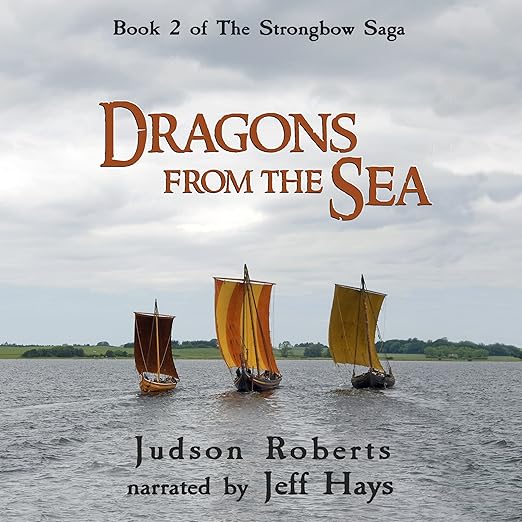
Halfdan Hroriksson carries two debts into Dragons from the Sea: the unresolved oath of vengeance for his murdered brother, and the practical reality that an oath cannot be honored by a dead man. Judson Roberts opens Book Two of the Strongbow Saga with this tension already established - the first volume has done its work, and this audiobook, narrated by Jeff Hays and running just over seven hours, moves Halfdan out of the initial crisis and into the Danish army invading Western Frankia. The logic is clear and efficient: to avenge his brother, Halfdan must first survive long enough to be worth something as a warrior, and the Frankish campaign is his school.
Roberts has constructed the Strongbow Saga with a particular kind of reader in mind - one who wants historical authenticity alongside narrative momentum. The decision to bring Halfdan into the Frankish invasion rather than continuing on a purely personal arc expands the historical scope of the series in ways that pay dividends both for story and for historical texture. The Seine raid setting gives Roberts access to the full machinery of ninth-century Viking military practice: the logistics of a large army, the hierarchy of commanders and chieftains, the specific cultures of violence and reputation that defined how Norse warriors understood their own worth. Halfdan is learning all of this in real time, and the reader learns it with him.
One reviewer, a self-described cyclist in their fifties who would not normally read books aimed at older teens, describes finding genuine satisfaction in this series - a response that speaks to Roberts's success at writing YA historical fiction that does not condescend to its audience. The violence in the book is not gratuitous but not sanitized either; it carries consequence, and Halfdan's emotional response to what he witnesses and participates in is one of the book's more interesting elements. Roberts is not writing a celebration of Viking warfare; he is writing about what it costs to become capable of it.
The hidden enemies within the Danish ranks - mentioned in the synopsis as a danger alongside the Frankish opposition - are what keep the book from being purely a historical action narrative. Halfdan is navigating two simultaneous threats: the external enemy across the river and the internal one whose identity and motives he is still trying to determine. This layering is where Roberts shows the most craft, because the interior threat requires Halfdan to develop political intelligence rather than purely martial ability. The reviewer who identifies this as a "widening" of historical fiction toward less familiar settings is responding to that double-layer: the Frankish campaign is doing historical work while the concealed antagonist is doing thriller work, and the two modes support each other.
Why Listen to Dragons from the Sea
Jeff Hays's narration is notably well-suited to Roberts's material. Historical fiction in audio requires a voice that can sell physical reality - the weight of weapons, the conditions of a river camp, the specific sound of a formation moving - while also handling the interior psychology of a young man who is in over his depth but unwilling to acknowledge it. Hays achieves both. His Halfdan has a quality of watchful uncertainty that is appropriate for a character who is simultaneously competent enough to survive and young enough that everything he's doing is still new.
At just over seven hours, Book Two is efficiently paced. Roberts does not extend scenes for atmosphere at the expense of momentum, and the result is a listening experience where the historical content feels embedded in action rather than arrayed as background. The series context means that listener investment from Book One carries forward without needing significant re-establishment, and Hays's consistent characterization across both volumes makes the transition seamless for returning listeners.
What to Watch For in Dragons from the Sea
The Frankish perspective - how the people being invaded experience and resist the Danish army - surfaces intermittently and is worth attending to. Roberts gives enough scenes from outside Halfdan's point of view to complicate the narrative without shifting the book's fundamental alliance with its protagonist. This moral texture is what prevents the Strongbow Saga from being a simple celebration of Viking heroics, and it becomes more important as the series continues.
Also worth tracking: the way Halfdan measures his own worth throughout the campaign. His need to "prove his own worth in battle" is not simply a plot requirement but a window into ninth-century Norse concepts of honor and reputation that Roberts has clearly researched carefully. Every moment of combat in the book is being calculated by Halfdan in terms of what the other warriors will say about it afterward, and that evaluative quality gives even the action sequences a social dimension that elevates them above pure choreography.
Who Should Listen to Dragons from the Sea
Readers who finished Book One of the Strongbow Saga and want to continue Halfdan's story will find this a worthy continuation. The series is targeted at older teens and young adults but has a demonstrated adult following, as the reviewer who found it satisfying in their fifties attests. New listeners to the series should start with Book One, since Halfdan's oath and the personal stakes that motivate him are established there. Historical fiction fans with an interest in Viking Age Europe and the Frankish response to Scandinavian raids will find Roberts's research satisfying without being academic.