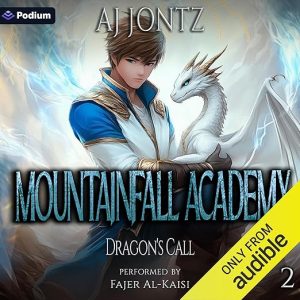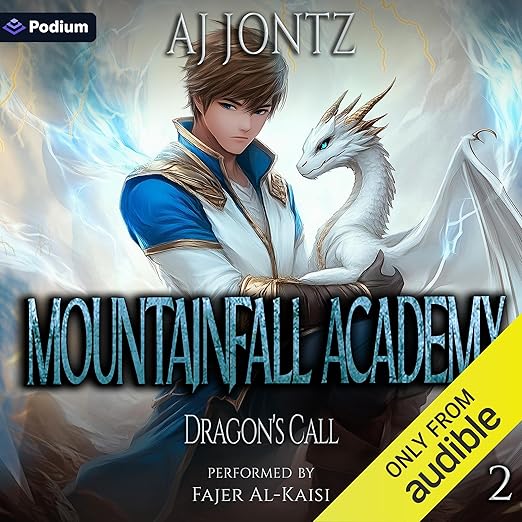
AJ Jontz's second Mountainfall Academy audiobook opens where the best sequels do: with the world already changed. Dragon's Call doesn't waste time re-establishing what made the first book work. It assumes you're invested in Aidan and his friends, then immediately raises the temperature. Fajer Al-Kaisi narrates the whole 20 hours and 36 minutes with a conversational ease that makes the academy hallways feel as immediate as the action sequences, and it's that consistency of voice that holds this ambitious expansion together.
Second-year stories in magic academy fiction live or die by what they add, not what they repeat. The first Mountainfall Academy volume introduced the world; Dragon's Call stress-tests it. Jontz shifts between multiple POVs, widens the geopolitical scope, and puts an assassin into a setting that was already under pressure. The series premise about a coming-of-age adventurers' track remains intact, but the stakes have a different texture now. These aren't just academic challenges. Someone is trying to kill people, and the academy's security framework is genuinely in question. The world Jontz has built is no longer a backdrop for coming-of-age drama; it has become a political entity with consequences.
What AJ Jontz Delivers
What stands out about Jontz's craft here is a refusal to treat her young protagonist as invincible. One reviewer specifically noted that the story expected its characters to act their age, and that's a real achievement in a genre where teenage protagonists often perform at implausible competence levels. Aidan's growing skill with sword and magic feels earned rather than granted. He struggles. His relationships are complicated by proximity and pressure. The found-family dynamic, which is central to the appeal of the whole Mountainfall series, gets deeper rather than simply warmer. When the threat of war enters the picture, it doesn't flatten the character work. It illuminates it.
Jontz has been compared to Robyn Wideman, Pedro Urvi, and DK Holmberg, and Dragon's Call clarifies why: the prose is clean, the world-building accumulates without overwhelming, and the magical beast companions function as genuine emotional anchors rather than plot devices. For audio listeners specifically, Al-Kaisi's ability to differentiate among the expanded cast makes those relationships trackable at driving speeds. You won't lose the thread of who cares about whom even when the action piles up. The narrator's management of multiple POVs across a 20-hour-plus runtime is a genuine technical achievement and should factor into the decision for listeners with long commutes or extended listening sessions.
The audiobook format serves this kind of high-fantasy series particularly well. The pacing Jontz has built into Dragon's Call, the rhythm of training sequences followed by relationship scenes followed by the sudden violence of the assassin's intrusion, translates naturally into audio. Al-Kaisi navigates those gear shifts without making the tonal variety feel choppy. Listeners who burned through the first book in a few long sessions will find the same pull here, possibly stronger because the world now has more corners worth exploring.
One listener noted they hated to finish the book and immediately needed to know when the next volume was coming. That particular reading experience, wanting more before the last chapter is done, is a real test of serial fiction. Dragon's Call passes it. The series arc is developing with intention, and that sense of direction gives the 20-hour listen shape beyond the episode at hand. Jontz is building toward something specific, and the threads left open at the end aren't dangling loose ends. They're structural, load-bearing elements of a larger architecture that rewards continued investment in the series.
Where AJ Jontz Loses Some Ground
Keep attention on how Jontz handles the multiple POVs. Earlier single-perspective fantasy often works by limiting information; the shift here to broader viewpoints is a deliberate choice to show readers the full scope of what's approaching. The war on the horizon isn't a vague background threat. Different characters have different sight lines on it, and placing those fragments together is part of the reading pleasure. Al-Kaisi manages the POV shifts cleanly, but it's worth noting that listeners who prefer a single tight perspective may need a session or two to calibrate to the wider cast.
The relationship between Aidan and his magical beast companion is also doing more narrative work than the synopsis suggests. These companion bonds in the Mountainfall series function as a kind of emotional barometer. How the bond develops in Dragon's Call says something about Aidan's interior state that the action sequences alone can't carry. It's one of the more quietly interesting aspects of Jontz's approach: she uses the fantasy elements as emotional infrastructure, not just spectacle. Listeners who came to the series primarily for the dragons and magical combat will find this volume rewards those readers too, but the emotional architecture is what makes the 20-hour runtime feel earned rather than prolonged.
Who Should Pick Up Dragon's Call
Listen if: you've completed the first Mountainfall Academy book and want to see the world deepen, you enjoy YA high fantasy that balances action with genuine character development, or you're a fan of clean fantasy that works for both teen and adult audiences. Al-Kaisi's narration is particularly strong for listeners who do extended sessions and need a narrator who sustains energy over 20-plus hours.
Skip if: you haven't read book one. Dragon's Call is not a standalone entry point. The world-building and character relationships assume prior knowledge, and dropping into the second year without context will flatten the emotional payoff of both the assassin plotline and the academy relationships. Start at the beginning of the Mountainfall Academy series, then come back to this one.
Do I need to listen to the first Mountainfall Academy audiobook before Dragon's Call?
Yes. Dragon's Call picks up directly from Aidan's first year with no recap for newcomers. The character relationships and academy dynamics that drive this volume's emotional stakes require the foundation of book one to land properly.
How does Fajer Al-Kaisi handle the expanded cast in the Dragon's Call audiobook?
Al-Kaisi differentiates between the multiple POVs and supporting characters with consistent vocal signatures throughout the 20-hour runtime. Listeners report the narration stays clear even as the cast widens in the second half.
Is Dragon's Call appropriate for younger teen listeners, or does the content skew older?
Jontz bills the Mountainfall Academy series as clean teen high fantasy suitable for kids and adults alike. Dragon's Call introduces an assassin and war-level stakes, but the content remains within the YA range without adult language or graphic violence.
Does the audiobook include any bonus content or is it a straight narration of the novel?
Based on available data, Dragon's Call is a straight narration of the novel with no bonus material. The 20-hour-and-36-minute runtime covers the full text.