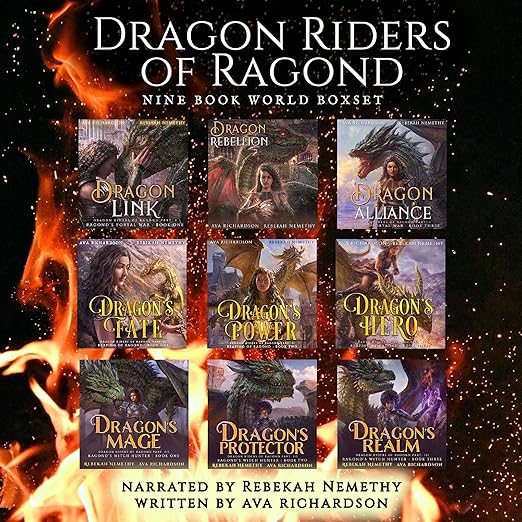
Ragond, Ava Richardson's interstitial world built beside Earth and connected to it through increasingly unstable portals, gets its full nine-novel treatment in this audiobook box set narrated by Rebekah Nemethy across ninety-five hours and forty-eight minutes. That runtime, nearly four days of continuous audio, is the first thing that needs acknowledgment, because a box set of this scale lives or dies on whether the narrator can sustain consistent character differentiation and tonal energy across three separate trilogies and three distinct young adult protagonists.
Three Trilogies, Three Different Dragon Bonds
Richardson structures the box set as three interlocking trilogies, each following a different young woman drawn into Ragond's ongoing conflict. Nova, the protagonist of the Portal War trilogy, is pulled into Ragond alongside her best friend Zephyr when the portal instability begins, and her arc is the most traditional portal fantasy of the three: ordinary world, extraordinary world, discovery of purpose and power. Kira's Reaping of Ragond trilogy moves deeper into Ragond's internal politics as she seeks a cure for a disturbing dragon sickness, with strangers from a faraway realm whose leader is hiding secrets. Yanna's Witch Hunter trilogy closes out the world's history with the highest stakes, a timeslip threatening both Earth and Ragond simultaneously.
The dragon bonding at the center of each trilogy is Richardson's primary emotional currency, and she handles it with enough variation across the three arcs that it does not feel redundant even at this length. Nova's bond is formed under urgency and has the texture of an unlikely partnership; Kira's protective relationship with the dragons she is trying to heal carries more tenderness; Yanna's dynamic reflects the Witch Hunter trilogy's higher existential stakes. The world-building accumulates satisfyingly across all three, so listeners who commit to the full set find the later trilogies richer for the foundation the earlier ones have laid.
Reviewers have noted that the series draws in readers across a wide age range. One seventy-year-old lifelong fantasy reader reports being "thoroughly drawn in and submerged in the story plots" despite the YA designation. Another praises the absence of mature content, noting that "the innocence of youth is something to be highly valued" while the characters are genuinely invested in "learning about who they are and what values they choose." Richardson earns the YA classification not by simplifying the stakes but by centering coming-of-age questions alongside the fantasy adventure.
Nemethy Anchors Nine Novels, Three Heroines
Nemethy's performance is the box set's structural backbone. Carrying three separate protagonists across nine novels, with a supporting cast that includes recurring dragon companions and expanding world-specific characters, requires a level of consistency that most audiobook productions do not demand. She maintains the distinctions between Nova, Kira, and Yanna with enough specificity that the trilogy transitions do not disorient, and her energy with the action sequences, the dragon flight, the portal confrontations, the battle sequences that accumulate across the Witch Hunter trilogy, does not flag even well into the later books.
The audio format suits this kind of epic fantasy better than it suits more introspective or literary fiction. The adventure sequences have a rhythm that translates well to audio pacing; the exposition that establishes Ragond's portal mechanics and dragon-rider traditions becomes natural context rather than world-building data dump when a skilled narrator controls the delivery. At ninety-six hours, this is a significant investment, but listeners who find their entry point in the first Nova chapters and feel the world pulling them in will find the remainder of the set delivers on that early promise.
Each Trilogy Follows the Same Arc
The box set's scope is its strength and its constraint. At nine novels, each trilogy follows a fairly predictable arc: protagonist is thrust into crisis, develops her dragon bond under pressure, faces a central antagonist whose apparent motivations conceal the real threat, and reaches a resolution that closes her personal story while leaving the world's larger history open for the next set. Richardson is skilled within this structure, but listeners who want narrative unpredictability or subverted genre expectations should calibrate accordingly. This is earnest YA portal fantasy at scale, not a revisionist take on the genre.
The transition between trilogies is the most demanding part of the listening experience. Leaving Nova's established emotional arc to begin fresh with Kira requires the listener to reset their investment, and the early chapters of the Reaping trilogy work harder to establish a new protagonist's interior life. The Witch Hunter trilogy benefits from the most accumulated context and is arguably the strongest of the three, but it requires the longest approach to reach.
Nine Novels, No Cliffhangers to Chase
Young adult dragon fantasy readers who want a complete, self-contained world in a single purchase will find the box set delivers genuine value at its scope. The nine-novel structure means no cliffhangers that require hunting down the next book; the full arc of Ragond's history from the Portal War through the Witch Hunter crisis is available in a single listening commitment. Older readers with a fondness for the YA fantasy tradition, including those who find contemporary adult fantasy too grimdark or explicit, will find Richardson's clean emotional register and genuine adventure stakes satisfying.
This is less suited to listeners who want the subversive edge of authors like Leigh Bardugo or the moral complexity of adult secondary-world fantasy. Richardson is writing cleanly and earnestly within genre conventions, not against them. At ninety-six hours, listeners who find themselves uncertain about the world by the end of the first Nova novel should take that uncertainty seriously, because the commitment only grows from there.