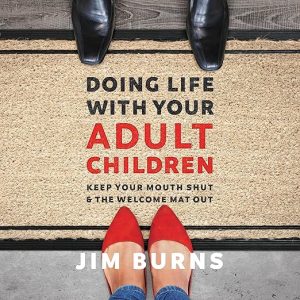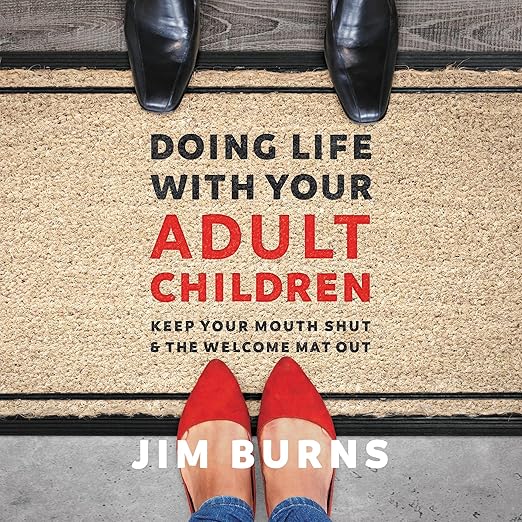
Parenting books for the toddler years fill entire shelves. Parenting books for the moment your child turns twenty-two, moves back home, makes choices you fundamentally disagree with, or stops returning your calls occupy a much smaller space. Doing Life with Your Adult Children, the audiobook by Jim Burns Ph.D, narrated by Wayne Campbell, is trying to fill that gap, and it does so with enough honesty and practical specificity that parents who pick it up mid-crisis will find it immediately useful rather than waiting for it to build to relevance. At four hours and eighteen minutes, it earns its conciseness by refusing to pad its way toward a longer runtime.
What Jim Burns Ph.D Delivers
Burns organizes the book around questions rather than principles, and that structural choice matters. Rather than presenting a theory of adult parenting and then applying it to scenarios, he leads with the actual questions parents ask: Is it okay to give advice to a grown child? What is the difference between enabling and helping? What boundaries should exist if your child moves back home? What do you do when your child doesn't seem to be maturing? Each chapter is built around one of these questions, and Burns works through it with the blunt warmth of someone who has run parenting seminars long enough to have heard every variation of the scenario.
The enabling versus helping distinction is where the book earns its most practical value. Burns doesn't offer a clean, formulaic answer, because the honest answer is that context determines the line. But he gives enough case-specific thinking that parents can work out where their own situation falls. The question of what to do when your adult child's values diverge significantly from your own is handled with more nuance than expected. Burns doesn't suggest pretending the divergence doesn't exist, and he doesn't suggest confronting it continuously. He walks a line between maintaining authentic relationship and accepting that you cannot parent the values of a person over eighteen the way you could with a ten-year-old.
Reviewer Lauren noted that she "had to read a little and then put it down because I felt like the author had been listening to my conversations." That reaction speaks to something specific about Burns's approach: he has heard enough real stories that the examples feel drawn from life rather than constructed for illustration. The faith dimension is present throughout, particularly in chapters addressing how to bring children back toward religious practice or how to maintain relationship when your child has walked away from faith. Burns writes from a Christian perspective, and that context shapes both the values framework and the language. It's neither hidden nor preachy, but it is consistent, and secular readers should know it's there.
Wayne Campbell's narration suits the material without drawing attention to itself. He reads with the measured pace of someone who understands that the listener may be in a genuinely painful situation and that rushing through practical advice is the wrong call. The audio format works particularly well for the Q&A chapter structure because you can move through the book nonlinearly, returning to the specific question that's active in your life without losing much from the surrounding chapters.
The audiobook's length is appropriate to the mission. Burns doesn't pad. He addresses each question concisely enough to be useful without collapsing the complexity. For parents who are exhausted by an ongoing situation with an adult child, a four-hour listen is achievable in a way that a dense, academic parenting text isn't. The conversational tone of the prose also translates well into spoken form. Campbell's narration doesn't have to fight against technical language or convoluted sentences. The writing was made for this format.
The chapter on grandparenting, which addresses how to remain present in the lives of grandchildren when your relationship with their parent is strained, is one of the most practically useful in the audiobook. Burns treats it with the same directness he brings to the main parent-adult child framework, and it's a topic that comparable books handle either too sentimentally or not at all. Reviewer Lexi described the content as "no-nonsense, down-to-earth" and praised Burns for writing in a way that made the content "accessible" rather than clinical or judgmental. That balance is genuinely difficult to sustain across the full range of family situations Burns addresses.
Where Jim Burns Ph.D Loses Some Ground
The faith framework shapes the book significantly enough that readers without a religious context will occasionally feel like they're reading something not entirely addressed to them. Burns is careful not to be exclusive in tone, but the assumptions about what a healthy family looks like and what "legacy" means are grounded in Christian family values in ways that secular readers will sometimes need to translate. The practical advice mostly holds regardless of faith background, but the framing occasionally doesn't.
The book also deals almost entirely with the emotional and relational dimensions of the parent-adult child transition rather than the legal or financial ones. Readers dealing with specific legal or estate planning questions around adult children will need to look elsewhere. And while Burns addresses financial enabling, he doesn't provide the kind of concrete financial boundary frameworks that books focused specifically on that topic would offer.
Who Should Pick Up Doing Life with Your Adult Children
This audiobook is well-suited for parents in the thick of the transition: the first few years after a child leaves home, returns home, or begins making autonomous choices that create relational tension. It's particularly useful for parents whose children have moved away from the family's faith tradition and who are trying to figure out how to maintain relationship without abandoning their own values. Secular parents will find practical value in the framework, though they'll need to step past the faith framing in several chapters. Parents looking for a detached, research-driven approach to adult child psychology will want a different title. This is pastoral wisdom, not behavioral science.
Common Questions
Is this audiobook useful if my adult child and I don't share a Christian faith background?
Partially. The practical frameworks around enabling, boundaries, and communication are useful regardless of faith background. The framing language and some of the prescriptive guidance is rooted in Christian family values, and secular readers will find those sections less directly applicable. The audiobook is most useful to its intended audience of faith-oriented parents.
Can I listen to this audiobook out of order, jumping to the chapters most relevant to my situation?
Yes. The Q&A chapter structure means each section is largely self-contained. You can identify the questions most relevant to your current situation and return to others as needed without losing much from the surrounding context.
Is the audiobook format better than reading the print version for this kind of parenting content?
The conversational tone of Burns's writing translates well to audio, and Wayne Campbell's warm delivery suits the subject. Many listeners dealing with difficult family situations find audio more accessible than print when they're emotionally worn down. The chapter structure also makes it easy to return to specific sections during a commute or quiet time.