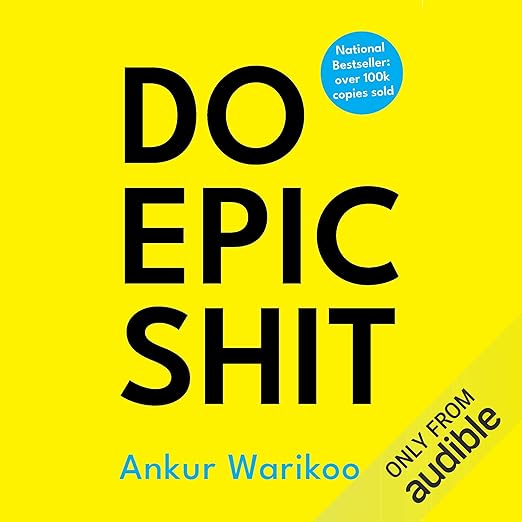
Do Epic Shit is a short audiobook, just over three hours, and that brevity is both its most honest quality and the thing that will frustrate listeners who came expecting a developed argument. Ankur Warikoo is one of India's most followed content creators, and this book reads very much like the best version of what his social media output already does: aphoristic, direct, occasionally profound, and built for people who are moving through their days and need something that can meet them there.
I listened to it in two sessions on weekday mornings, which is probably the ideal format for it. Warikoo covers a lot of ground, habits, money management, failure, self-awareness, empathy, relationships, in a structure that is more thematic mosaic than sustained argument. Each section is short enough to absorb without effort, and the better lines have the quality of something you want to write down and return to. One reviewer described reading one page a day, which is probably closer to the book's ideal deployment than listening straight through.
How Do Epic Shit Holds Up
Warikoo's background is genuinely interesting and lends the book credibility that pure motivational content often lacks. He started out wanting to be a space engineer, built and sold companies, and found his largest audience through content creation. The book reflects that trajectory, it is not the advice of someone who has only succeeded, but of someone who has failed specifically and has processed those failures into usable insight.
The range of topics is one of the book's strengths and one of its weaknesses. On the positive side, reviewers consistently note finding ideas they can apply across multiple life domains, not just professional development. The financial literacy sections, the sections on empathy, the sections on family and relationships, these give the book a breadth that narrower self-improvement titles lack. The weakness is that this breadth means nothing gets developed very far. Ideas appear, land an observation, and move on. Listeners who want sustained analysis rather than concentrated principles will be dissatisfied.
Why Do Epic Shit Works as an Audiobook
The self-narration is a real asset here. Warikoo reads with the energy of someone in conversation rather than someone reading a manuscript, and that quality, slightly informal, occasionally self-deprecating, always direct, makes the listen feel personal in a way that a third-party narrator would not achieve. When he talks about his own failures, the voice carries the weight of actual experience. The authenticity is audible.
At three hours and seventeen minutes, this is a genuinely short audiobook. It costs very little in time, and the best passages deliver insight that is disproportionate to the investment. One reviewer noted being able to resonate and agree with a good portion of the content, which is probably the book's realistic benchmark, not transformation, but recognition.
Weak Spots in Do Epic Shit
The title is indicative of the book's tone, which is confident to the point of occasionally tipping into self-assurance that outpaces the depth of the argument. Some of the aphorisms land flat, and the book's structure means there is no sustained logic connecting the insights into a coherent philosophy. Warikoo acknowledges this implicitly by calling it a book to be listened to and repeated rather than read once through, it is designed for revisitation rather than linear argument.
Listeners who are not familiar with Indian entrepreneurial culture may find some of the specific references and context slightly unfamiliar. Warikoo's audience is primarily South Asian and his examples draw on that context, which is not a problem but is worth noting for listeners who might encounter references they need to Google.
The Right Listener for Do Epic Shit
This works for listeners who want a compact, high-density motivational listen that they can absorb in short sessions and return to periodically. It is a good audiobook for commutes, morning routines, or any listening context where full sustained attention is not available. Skip it if you want a book-length argument rather than a collection of concentrated insights, the format is what it is, and listeners who need more development will feel the book cutting off just when it is getting interesting.
- Narration: Ankur Warikoo reads his own book with personal authority, his voice carries the credibility of someone who has actually lived the failures and recoveries he describes, though the delivery is more conversational than polished.
- Themes: Habit-building for long-term success, failure as curriculum, financial self-awareness
- Mood: Compact and energizing, best absorbed in short bursts rather than marathon sessions
- Verdict: A concise distillation of entrepreneurial self-improvement thinking that works best as a daily companion rather than a one-sitting read.
Questions Listeners Ask
How does Warikoo's self-narration compare to having a professional audiobook narrator?
It is more conversational and less polished than a professional narrator would deliver, but reviewers consistently find this an asset rather than a drawback. The informality suits the content, and his personal authority as the author is audible in the delivery.
Is the book better experienced all at once or in short daily sessions?
Multiple reviewers explicitly describe reading or listening in small daily increments, which seems to be the format the book is designed for. The aphoristic structure supports this approach better than a single sustained listen.