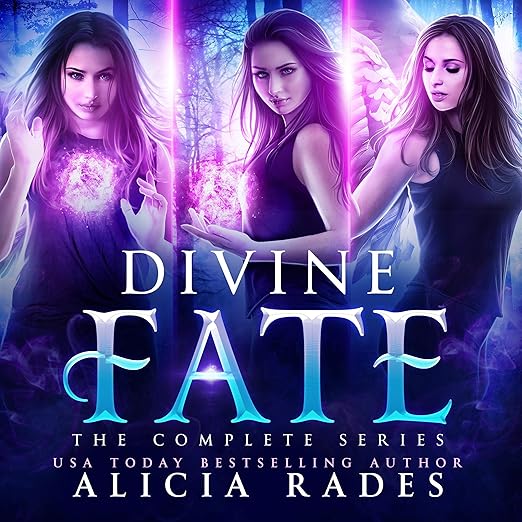
Alicia Rades built her reputation on YA fiction with emotional momentum, and the Divine Fate trilogy audiobook delivers all three volumes in a single, uninterrupted fifteen-hour listen. Ryn Tyler's arc from unwitting demon-slayer to potential savior of humanity is constructed with the logic of someone who understands why readers return to chosen-one stories: not because the destination surprises us, but because the journey illuminates something about agency and the weight of being needed. Rades is a USA Today bestselling author, and that reach is not accidental. She writes female protagonists who feel like they are discovering who they are at the same pace the reader is, which makes the chosen-one revelation land as earned rather than imposed.
The Verdict, Briefly
Rades earns genuine points for the specificity of her mythology. The Davina universe is not simply the standard celestial warfare setup. The background on how the Davina and Aedes factions came to be, their fractured history and their distinct rules of engagement, gives the world texture that most debut YA trilogies sidestep entirely in favor of action. One reviewer noted that the detailed lore around that origin story was among the trilogy's strongest features, and the assessment holds. The worldbuilding rewards close listening, not just plot-following. When Ryn arrives at the magical school for angels, it is not the school itself that carries weight but the implication of why the school exists and what it has been preparing for.
That said, the pacing is uneven across the three books. Rades has a habit of rushing through scenes that deserve to breathe, particularly in moments of emotional confrontation between Ryn and her mentor, Marek, whose troubled past is referenced more than it is unpacked. A reviewer who rated the trilogy at three-and-a-half stars flagged certain sections as feeling rushed and lacking depth, and that observation has merit. The trilogy's middle section in particular accelerates through beats that would have benefited from a slower hand. When covering three full novels in fifteen hours, compression is inevitable, but the seams show in specific places. Listeners who want emotional scenes to be given room equal to action sequences may notice this unevenness most acutely.
The stakes in this trilogy are genuinely large. Ryn does not simply have to save her new home: the fate of humanity itself rests on whether she succeeds or fails. That scale is handled with more confidence than it sometimes gets in YA fantasy, because Rades keeps the personal and the epic connected. Ryn's stakes are never purely abstract, they run through the specific people she has come to care about, which gives the world-threatening conflict a human center.
The Best Parts of Divine Fate
Natalie Naudus is a strong reason to choose the audio format for this trilogy. Her performance keeps Ryn grounded in the present tense of each scene, which matters enormously in a story where the stakes escalate quickly and the emotional register needs to shift often. Naudus handles both the lighter comedic touches in Ryn's voice and the heavier moments when Ryn confronts what her fate actually requires, without coasting on a single mode. The mentor-student dynamic between Ryn and Marek gets genuine chemistry through Naudus's choices, giving Marek's troubled past emotional weight rather than just plot function.
The bundle format also means listeners do not hit a cliffhanger and have to hunt for the next installment. That continuity matters enormously for a series structured the way this trilogy is, where character development across all three books adds up to something the individual volumes can only hint at. Ryn's transformation from a girl moving from place to place with her mom, unable to choose her own grounding, to someone literally holding the fate of humanity is best understood as a continuous arc rather than three separate reading experiences. The audiobook format respects that continuity in a way that buying books individually, and then waiting, does not.
Points to Consider
Pay attention to the supporting cast. One enthusiastic reviewer specifically highlighted the character development as excellent, and Rades does invest real energy in building a cast that feels populated rather than decorative. Ryn's relationships outside of the main mentor dynamic reveal her character more honestly than the chosen-one framework would typically allow. The chosen-one setup risks reducing everyone else to props, but Rades resists this, even if not always consistently. The people Ryn is trying to save are individuals she has formed real attachments to, and those attachments inform the choices she makes when the war against the demons reaches its most demanding moments.
The romance between Ryn and Marek is present but deliberately restrained in the early sections, which is the right call for YA fantasy that wants to be taken seriously on its plot merits. It deepens across the trilogy rather than front-loading the chemistry. Readers expecting the romance to dominate the way it might in a paranormal romance series will find this a slower burn. Listeners who want their fantasy with relationship stakes woven in but not overriding the plot arc will find the balance satisfying. The restraint in the first book pays dividends in the later volumes, where the earned emotional history between Ryn and Marek carries more weight than an early romantic payoff could have generated.
Who Should Listen to Divine Fate
YA fantasy listeners in their mid-teens and up who enjoy celestial mythology, a competent female protagonist with real stakes, and a series that actually wraps its central conflict will find the Divine Fate trilogy a dependable fifteen-hour investment. Listeners who prioritize perfectly paced prose over engaging story logic might find the uneven rhythm frustrating. This is a series-completion purchase, not a standalone sample, since listeners who have not read or heard anything in the Davina universe are starting at the beginning, which is exactly where the story intends for them to be. Adults who enjoy YA fantasy with enough substance to sustain engagement beyond the teenage demographic will find Rades delivers on that front consistently.
Frequently Asked Questions
How does Natalie Naudus handle the dual tones of action and romance in the audiobook?
Naudus keeps Ryn's voice emotionally present without overplaying either register. The action sequences feel urgent and the moments of tension between Ryn and her mentor Marek carry genuine weight. The performance is well-suited to the YA thriller-fantasy blend.
Does this audiobook wrap up the Divine Fate story completely, or does it end on a cliffhanger?
The bundle covers the complete trilogy arc, so listeners will reach a full resolution rather than a cliffhanger. That makes it a strong choice for anyone who prefers to commit to a finished story before starting.