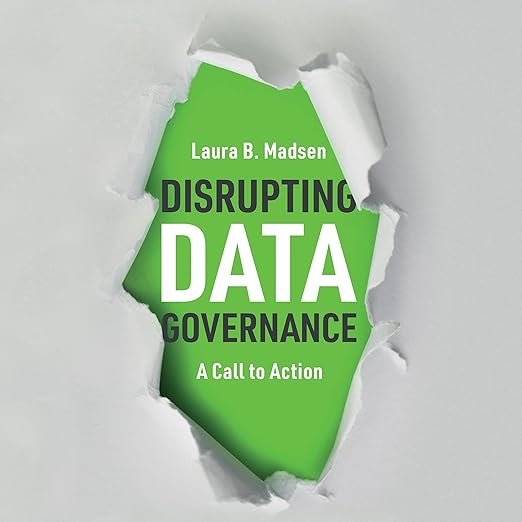
Key Details
- Performance: Tiffany Suzuki matches Laura Madsen's own casual, witty register, keeping a compliance-adjacent topic lively rather than dry.
- What it covers: modernizing data governance, moving from control to enablement, organizational change in data-driven companies
- Feel: Brisk, opinionated, and refreshingly witty for its subject
- Our call: A sharp, quick manifesto for data leaders frustrated with broken governance meetings, not a deep technical manual.
I queued up Disrupting Data Governance expecting the usual dry compliance-manual tone that this subject tends to default to, and Laura Madsen's tsunami metaphor for modern data flow disarmed that expectation within the first chapter. This audiobook runs a lean three hours and twenty-two minutes, short enough for a single commute or one focused afternoon, and Madsen uses that compressed runtime to build one sustained argument rather than pad out a reference manual: governance designed for an era of inter-office mail memos cannot possibly control the volume and speed of data moving through a modern organization today.
Suzuki's Register Matches Madsen's Casual Wit
Tiffany Suzuki narrates with real energy, matching Madsen's own casual, witty register closely enough that a topic which could easily read as dry, compliance frameworks, GDPR, organizational process, stays genuinely accessible and even entertaining across the short runtime. That register match matters more than it might sound like it should, since a mismatched, overly formal narrator could have flattened Madsen's deliberately conversational argument into something far less persuasive.
The book's central move is challenging the command-and-control governance model directly, arguing that governance should exist to support the use of data rather than restrict it by default. Madsen grounds that argument in her own decades of field experience across multiple industries, plus interviews with other best-in-field experts, which keeps the pitch from feeling like pure opinion dressed up as a manifesto.
A Lean Case That Practices What It Preaches
Suzuki's pacing choices matter specifically in the sections where Madsen shifts from diagnosis, what is currently broken, into prescription, what to actually do differently. That shift in register, from critique to constructive framework, is a common place for business audiobooks to lose momentum, and Suzuki keeps the energy consistent across both halves rather than letting the more critical opening chapters overshadow the practical back half.
The book's brevity is itself a small structural argument. A three-hour case against bloated, over-engineered governance processes that itself runs lean and gets to the point quickly practices what it preaches, in a way that a four-hundred-page tome making the identical argument would undercut through its own length.
All Models Are Wrong, Some Are Useful
One reviewer, who has worked across multiple industries as a frustrated data user, a functional owner, a business leader, and a strategic IT leader, called the book 'a pragmatic roadmap' and said flatly they wished they had it earlier in their career, since it would have given them a concrete guide for driving change from wherever they happened to sit in an organization.
Another reviewer invoked the statistician George Box's well-known line, 'All models are wrong, some are useful,' in praise of the book's grounded, practical framing of data and governance as inherently imperfect systems worth improving rather than perfecting. That reviewer specifically appreciated the book's focus on being useful over being theoretically complete, which is a fair encapsulation of Madsen's whole approach.
The tsunami metaphor that opens the book is worth close-reading on its own terms, since Madsen extends it well past a single throwaway image threaded through just the introduction. A tsunami cannot be redirected by asking it to fill out a request form and wait for committee approval, and that absurdity, stated plainly, does more persuasive work across the book's short runtime than a dense chapter of statistics on data volume growth ever could.
Madsen Names Approaches She Later Abandoned
Those outside voices are woven throughout rather than collected into one separate chapter, which keeps the book from reading as a single person's isolated opinion. Multiple independent perspectives converging on similar frustrations with legacy governance approaches lends the central argument more weight than one author's viewpoint alone could carry.
The book's framing of governance around three pillars, people-driven approaches, processes built for actual data volume rather than committee convenience, and technology now capable of automating what used to require manual review, gives listeners a genuinely usable mental model to carry away, not just a list of complaints about what currently does not work in most legacy programs still operating today.
Madsen's casual register extends to how she handles her own past mistakes and misjudgments within the governance field, naming specific approaches she once championed and later abandoned once they proved unworkable in practice. That willingness to revise her own earlier positions publicly lends the book's more forceful claims real credibility, since she is clearly not simply defending a fixed position she has never questioned.
Staying Deliberately Platform-Agnostic, No Vendors Named
That brief a runtime is genuinely short for a business title tackling organizational change, and one reviewer's honest framing captures the tradeoff well: not especially technical in nature, but a good overview with plenty of pointers toward deeper technical resources for anyone who needs them.
Listeners hoping for a full step-by-step implementation playbook, specific tooling comparisons, detailed process maps, granular rollout timelines, should recalibrate expectations. This is a persuasive case for a mindset shift and a framework for thinking differently about governance, not a granular execution manual you would follow chapter by chapter during an actual rollout.
Listeners new to data governance as a discipline, rather than practitioners already frustrated with an existing broken process, may find some of the book's energy directed at problems they have not personally experienced yet. The book argues against a specific, familiar failure mode more than it builds governance concepts up from first principles for complete newcomers to the field.
GDPR and other data literacy legislation get cited as bellwethers for the governance function's growing importance, but listeners hoping for a detailed compliance walkthrough of any specific regulation should look elsewhere; Madsen treats these as context for why governance matters more urgently now, not as the book's actual subject matter, though the framework she offers translates reasonably well across whichever specific regulatory landscape a listener's own organization happens to operate under.
The book stops short of naming specific software vendors or tools, staying deliberately platform-agnostic throughout, which keeps the strategic argument from aging as quickly as a tools-and-vendors comparison would, though it also means listeners hoping for concrete product recommendations will need to look elsewhere for that layer of specificity.
Pair This With More Technical Resources After
Data governance professionals, IT leaders, and business leaders who sit through slow, ineffective governance meetings and want real ammunition for arguing a fundamentally different approach will get the most out of this brisk, opinionated listen.
Consultants and vendors working in the data governance space will also find real professional value here, both as a persuasive framework to bring into client conversations and as a check against their own default assumptions about what governance is supposed to accomplish.
Practitioners needing granular implementation detail, specific tooling comparisons, or a step-by-step rollout plan will want to treat this as the persuasive case for change rather than the operating manual, and should plan to pair it with more technical resources afterward.
Is the Disrupting Data Governance audiobook technical enough for IT specialists?
It leans more strategic than technical, giving a solid overview and pointing toward deeper resources rather than walking through specific tooling or implementation steps in granular detail.
How long is the Disrupting Data Governance audiobook, and is that enough to cover the topic well?
It runs about three hours and twenty-two minutes. That is short for a business title, but Madsen uses the space efficiently to make one sustained argument rather than padding it out.
Who is the Disrupting Data Governance audiobook best suited for?
Data governance practitioners, IT leaders, and business leaders who sit through ineffective governance meetings and want a persuasive case for a different approach, more than beginners with no prior exposure to the field.