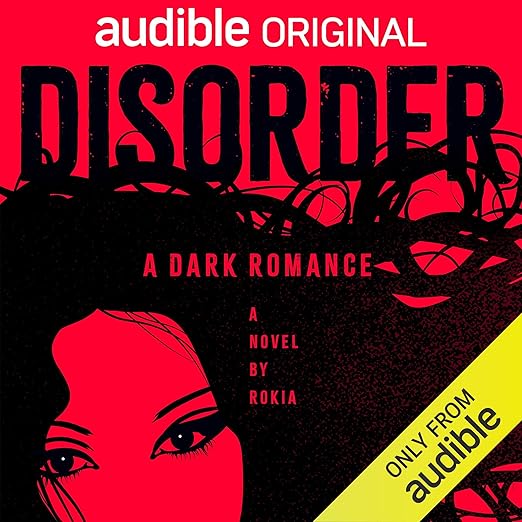
I tend to approach full-cast Audible Originals with tempered expectations. The format's potential is real, but productions that cast well-known names sometimes treat the celebrity as the primary selling point while the actual writing does the minimum necessary to justify the attention. Disorder is not that. I came to it knowing Diane Guerrero from Orange Is the New Black and William Gao from Heartstopper, and I'll admit the cast was part of the initial draw. What kept me was something I didn't expect: a genuinely dark and emotionally complex story about four young people whose various forms of suffering don't resolve neatly, told through a structure that is equal parts fairy tale and unflinching psychological portrait.
The book is by Rokia, an Italian bestselling author whose work is making its first English appearance here, translated by Beth Hickling-Moore. That context matters. This is not an English-language YA novel in the conventional American or British mode. The tone and emotional register feel distinctly different - darker in some registers, more stylized in others - and that difference is part of what makes it interesting rather than merely difficult. The four central characters, Olivia, Sia, Derek, and Edgar, are brought together by an unorthodox doctor and have in common the experiences of self-harm, anorexia, and PTSD. The premise is not subtle about the seriousness of its subject matter, and the production carries a content note covering mental illness, death, child abuse, violence, domestic violence, self-harm, suicidal thoughts, miscarriage, and substance abuse.
Our Take on Disorder
The novel's central structural conceit - that a prestigious media company called GNN sets the four protagonists increasingly demanding challenges designed to force them to confront their pasts - has a darkly satirical quality that feels intentional rather than incidental. There's something worth examining in a story where institutional forces profit from watching damaged young people perform their recovery, and Rokia seems aware of that implication even if the book doesn't press it as hard as it might. What the novel does more consistently is attend to the texture of these four characters' relationships with each other: how friendship forms under pressure, how love develops between people who are still actively hurting themselves and each other, and how wounds that seem to be healing can reopen without warning.
The fairy-tale framing, described in the synopsis as part of the book's DNA, functions as a kind of emotional permission structure. Dark romances are more tolerable when the story itself acknowledges its own stylization, and Rokia is clearly aware of the genre traditions she's working within and against simultaneously. The production at its best uses this tension productively - the full-cast narration gives each character's internal world a distinct sonic texture that reinforces the fairy-tale quality while the content keeps pulling toward something rawer.
The casting is the production's strongest element. Diane Guerrero's voice for Olivia carries a specific quality of barely-managed composure that the character requires. William Gao brings a gentleness to his character that makes certain moments of rupture genuinely startling. Freya Allan and Connor Swindells both find distinct emotional registers that don't bleed into each other, which is the constant risk when four distinct voices are competing for attention across a nearly nineteen-hour production. The length is substantial - this is a long Audible Original - and there are sections where the pacing loosens, particularly in the middle portion where the GNN challenge structure dominates. But the final movements of the story earn the investment.
Beth Hickling-Moore's translation deserves specific mention. Translating a work written in a different literary tradition for a new language audience is demanding under any circumstances, and the fact that this translation maintains the tonal distinctiveness of Rokia's Italian-language storytelling - rather than smoothing it into conventional English YA - is a significant achievement. The stylization that might initially feel unfamiliar resolves into something genuinely rewarding for listeners willing to meet the book where it is.
What to Watch For in Disorder
The content warnings listed in the synopsis are serious and should be taken seriously. This is not a gentle or comforting treatment of mental illness and recovery. The book does not end with all four characters healed, and it is honest about the ongoing, non-linear nature of recovery in ways that readers accustomed to more redemptive arcs may find difficult. The pacing is also uneven in places - the middle section, where the GNN challenges multiply, moves more slowly than either the opening or the conclusion. And because no reviews were available in the data for this title at the time of my review, I am drawing primarily on the production credits, synopsis, and the translator's note in forming these observations. Listeners with direct experience of the content areas covered should approach thoughtfully.
Who Should Listen to Disorder
This is for older teens and adults who want dark romance and psychological complexity in their YA listening, and who are not looking for uncomplicated resolutions to difficult situations. Fans of Guerrero, Gao, Allan, and Swindells who are curious about their work in audio will find the performances genuinely interesting rather than merely stunt casting. It's also a natural choice for anyone curious about Italian YA fiction finding its way into English for the first time through a format that exploits translation's best properties. Skip it if you're looking for lighter fare, if the content warnings apply to areas where you need careful management of exposure, or if you want a production that resolves its darkness before the final chapter.