The Short Version
- Narration: Daniel Henning brings warmth and emotional range to Joe Agabian's voice, capturing both the hedonistic energy of Fire Island and the grief running beneath the surface.
- Themes: LGBTQ+ community and chosen family, AIDS crisis loss and resilience, queer fantasy and magic as protection
- Mood: Joyful, bittersweet, and surprisingly tender
- Verdict: A rare audiobook that holds genuine heartbreak and disco-era joy in the same hand without letting either cancel the other out.
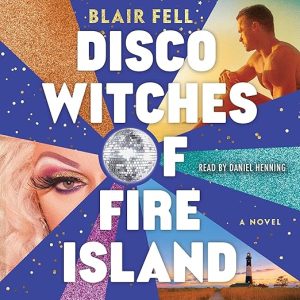
Blair Fell's Disco Witches of Fire Island arrives as one of the more distinctive audiobooks in recent queer fantasy romance: a story set in 1989 that manages to be simultaneously a sun-soaked love story and a document of catastrophic communal grief. I put it on one weekday evening thinking I'd listen to a chapter or two before switching to something lighter, and I did not put it down until well past midnight. The setting alone carries enormous weight before a single spell is cast. Fire Island Pines in 1989 was a place where gay men created something extraordinary in the face of extraordinary loss, and Fell clearly understands that historical specificity as something worth protecting in fiction.
Our Take on Disco Witches of Fire Island
Joe Agabian and his best friend Ronnie arrive on Fire Island for their first working summer, young men stepping into a community that has already lost so much and keeps losing. Joe carries his own grief, the death of a boyfriend to HIV/AIDS, and Fell doesn't soften this or use it as mere backstory texture. It sits at the center of Joe's emotional arc throughout, shaping why he wants love again even as he fears it. The fantasy conceit, that a secret disco witch coven has been protecting the island and its residents but has been decimated by the epidemic itself, is where the novel finds its most resonant metaphor. The coven's diminished power mirrors the community's real losses, and the urgency to rebuild it maps directly onto the urgency of collective survival that defined that era.
Howie and Lenny, the two older house cleaners who turn out to be surviving coven members, are among the most lovable characters I've encountered in the genre in some time. One reviewer's wish that they had their own Howie and Lenny in real life is understandable. They function as mentors, comedic relief, and emotional anchors all at once, and Fell gives them enough specificity that they never collapse into archetypes. The magic system itself, as one reviewer notes, is unusually grounded for the genre, rooted in community ritual rather than individual power, which keeps it from feeling frivolous against the historical weight of the story.
Why Listen to Disco Witches of Fire Island
Daniel Henning's narration is the right choice for this material. He gives Joe's first-person voice a quality of genuine vulnerability without making him seem passive, and he differentiates the supporting cast well enough that Howie and Lenny feel like distinct people rather than the same generous-old-man energy in two bodies. The romantic tension between Joe and the bisexual ferryman with webbed feet, a character detail that sounds ridiculous on paper and somehow works completely in context, is handled with real charm in Henning's delivery. He also navigates the tonal shifts, from comedic to grieving to genuinely frightening when the Great Darkness starts making its presence felt, with an ease that keeps the listening experience from feeling choppy.
The novel earns its description as part loathe-at-first-sight romance by committing to Joe's internal resistance with specificity rather than manufacturing drama. His complicated past, his grief, his suspicion of his own longing, creates real friction that Henning makes audible in the subtle changes in how he reads Joe's interiority. Comparisons to Red, White and Royal Blue in the marketing copy are understandable from a tonal standpoint, though Fell's novel is considerably darker in its historical grounding. A closer cousin might be something like Casey McQuiston's work refracted through the lens of Armistead Maupin's San Francisco, although the magic and the AIDS crisis give this book a texture those comparisons can only partially capture.
What to Watch For in Disco Witches of Fire Island
The mysterious hunk that Howie and Lenny identify as a potential harbinger of doom creates a genuinely intriguing ambiguity that Fell sustains longer than I expected. Whether he is threat or romance or something more complicated remains unclear well into the second half, and this uncertainty is one of the novel's more effective structural choices. The loathe-at-first-sight trope gets deployed with enough specificity that it doesn't feel like genre furniture. Joe's resistance has reasons, and those reasons connect to his history rather than to manufactured misunderstanding.
Listeners should know going in that this is not a book that pretends the AIDS crisis was anything other than devastating. The coven's dwindled numbers and the grief that permeates Fire Island are treated as the real historical horror they were, not softened for the comfort of fantasy. The book earns its joy precisely because it never looks away from what joy had to coexist with. If you approach it expecting a light queer romp with magic sprinkled on top, you may find the emotional register heavier than anticipated, though never gratuitously so. Fell handles the material with both love and honesty.
Who Should Listen to Disco Witches of Fire Island
Readers drawn to queer historical fiction with genuine emotional stakes and a willingness to hold comedy and grief together without letting either overwhelm the other will find this deeply satisfying. If you care about the history of gay community-building in America, about the Fire Island Pines in particular as a cultural site, this novel treats that history as something worth getting right. Fans of fantasy romance where the magic system reflects something real about how communities survive will find the coven mythology unusually resonant.
Listeners who want fantasy romance without significant engagement with historical tragedy, or those who need a firmly happy-go-lucky tone throughout, may find the AIDS crisis backdrop heavier than they want from the genre. This is absolutely adult content with explicit romantic scenes; it is not suitable for young listeners despite its hopeful emotional arc. But for those who want a queer love story that understands what love meant in 1989 on Fire Island, specifically and not generically, this audiobook delivers something real.