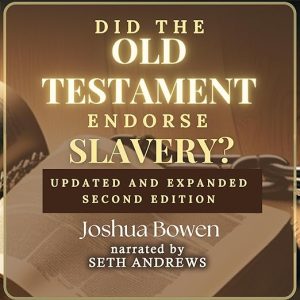
Did the Old Testament Endorse Slavery? walks into a debate that generates more heat than light on almost every platform where it appears, and Seth Andrews narrates Joshua Bowen's thoroughly revised second edition with the calm authority the material requires. This audiobook stakes out a position that will frustrate both the atheist who wants the text condemned outright and the apologist who wants it exonerated entirely: neither framing, Bowen argues, emerges from a rigorous understanding of the Hebrew Bible in its ancient Near Eastern context. That context is precisely what the book spends eight and a half hours providing, and it is genuinely more illuminating than either of the popular positions it refuses to endorse.
Andrews is the host of The Thinking Atheist podcast and is well known in secular and skeptic communities. His decision to narrate a book that ultimately argues neither side is ultimately correct in the slavery debate reflects the book's scholarly commitment to evidence over advocacy. Bowen's conclusions are clear enough: yes, the God of the Old Testament sanctioned practices that include chattel slavery, the selling of daughters into bondage, and the beating of enslaved people, and no, those practices cannot be responsibly explained away as metaphorical employment contracts or culturally neutral labor arrangements. But the path to that conclusion runs through ancient Mesopotamian law codes rather than through contemporary moral intuition, which is the book's most distinctive and most valuable contribution.
Comparing Israelite Law to Its Ancient Neighbors
The book's real scholarly contribution is what it does with the ancient Near Eastern legal codes surrounding the biblical text. Bowen is a credentialed scholar of ancient Mesopotamia, and the extended comparative analysis of how other law collections from the ancient world treated enslaved people gives the biblical laws a context that transforms their meaning for modern readers. The question is not simply "was this bad?" but rather "how did Israelite law treat enslaved people compared to Babylonian, Hittite, and Assyrian contemporaries, and what does that comparison reveal about the specific moral choices embedded in the text?" Those comparisons produce answers that are genuinely surprising and that change the moral arithmetic of the debate in ways that both common positions have been consistently unable to account for.
Seth Andrews reads this material with the same methodical fairness that characterizes the book itself. He is capable of dramatic narration when the material calls for it, but here he stays in the register of informed presentation rather than advocacy, which is precisely the right call. This is an eight-plus-hour scholarly argument, and it needs a narrator who can sustain the listener's attention through comparative law analysis without either dramatizing the conclusions before they arrive or flattening the evidence into tedious recitation. Andrews manages that balance throughout the full runtime.
Tracing Slavery's Defense From Israel to the American South
Multiple reviewers have described this as the most comprehensive resource available on its specific topic, and based on the scope of what the second edition covers, that assessment is difficult to dispute. The book addresses not only Old Testament law but traces the treatment of enslaved people through the New Testament, the early church period, and down to the antebellum American South, which gives the historical argument its full and most morally consequential context. That final section, connecting ancient Near Eastern practice to nineteenth-century American apologetics for slavery, is one of the book's most important contributions and the one that most clearly demonstrates why the contextual methodology matters beyond academic interest alone.
A reviewer with specific archival interests described the book as offering "a narrative format easily accessible to a lay audience" while also including detailed appendices with chronological comparisons, suggesting the second edition successfully serves both the general interested listener and the specialist. For the audio listener, the appendix material is less directly accessible than in print, but the main scholarly argument is fully self-contained in the listening experience and does not require the appendices to be persuasive or internally coherent.
Eight Dense Hours That Reward Sustained Attention
The second edition is substantially expanded from the first, adding three chapters and two appendices. At eight hours and twenty-five minutes, this is a serious and sustained listening commitment that requires genuine attention rather than passive background listening. The law code comparison sections are dense by design: Bowen is building a scholarly case through accumulated evidence, not summarizing it for quick absorption. Listeners looking for a rapid answer to the title's question will find one relatively early, but the book's value lies in the extended evidence marshaled in support of that answer, not in the headline conclusion alone.
The book approaches its topic from a position that takes ancient Near Eastern scholarship seriously as a discipline with its own standards of evidence and methodological debates. Listeners who arrive with strong prior commitments on either side, whether to Scripture's moral authority or to a blanket condemnation of the text, will find the book's insistence on contextual complexity uncomfortable in productive ways. The scholarship does not permit the simple conclusions that either camp publicly prefers, and Bowen is not apologetic about that methodological insistence throughout the eight-hour argument.
Best for Listeners Ready for a Lecture Series
Anyone who has been in a conversation about biblical slavery and felt the available arguments on all sides were historically thin will find this the resource they were looking for. Atheists, agnostics, and Christians willing to engage seriously with textual and historical evidence will all find material that challenges their existing understanding in clarifying rather than merely confrontational ways. Listeners who want the audio experience to double as a study resource should consider pairing it with the print edition for the appendices and comparative tables. This is not background-listening material: it rewards the sustained attention you would give a carefully prepared university lecture series on a subject that genuinely matters.
- Read by: Seth Andrews brings practiced clarity to Dr. Bowen's scholarly material, keeping eight-plus hours of dense ancient Near Eastern analysis consistently engaging without oversimplifying the evidence.
- At its heart: Biblical slavery in ancient context, comparative ancient Near Eastern law codes, Old Testament ethics
- Vibe: Rigorously analytical with the patience and texture of genuine scholarship
- Short version: The most comprehensive contextually grounded examination of biblical slavery available in audio, essential for anyone trying to move past talking points on either side of the debate.
Questions Listeners Ask
Does the Did the Old Testament Endorse Slavery audiobook take a side in the debate between atheists and Christian apologists?
Bowen argues that both the atheist 'moral monster' framing and the apologist 'just like having a job' position are historically inaccurate. The book concludes that the Old Testament did endorse slavery while insisting that understanding what that means requires deep contextual scholarship rather than contemporary moral assumptions applied to ancient texts.
How does Seth Andrews' narration fit the academic content of this audiobook?
Andrews narrates with measured clarity rather than advocacy, staying in an informed-presentation register appropriate for an eight-hour scholarly argument. Known for his work in skeptic communities, he reads the material with the same methodical fairness the book itself brings to its evidence.
Does this audiobook cover how Old Testament slavery relates to American antebellum slavery historically?
Yes. The second edition includes an entire chapter tracing the trajectory from ancient Near Eastern practice through the New Testament and early church to nineteenth-century American apologetics for slavery. This comparative history is one of the most significant additions in the expanded edition.