- Narration: Mark Sanderlin brings consistent energy to Dr. Block's Minecraft-universe storytelling, handling multiple young characters with enough vocal distinction to keep Jimmy, Claire, and Emma easily separable.
- Themes: friendship and loyalty under pressure, dimensional travel and magical ability, consequence and sacrifice
- Mood: Fast-paced and cliffhanger-dense, with the anxious energy of a long-running series approaching a turning point
- Verdict: Book 25 delivers the escalating stakes and unresolved threads that have kept this series audience engaged for years - dedicated series fans will not be disappointed.
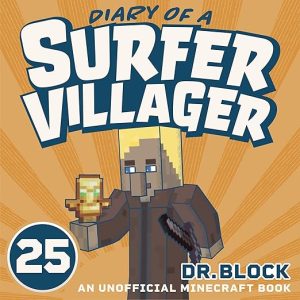
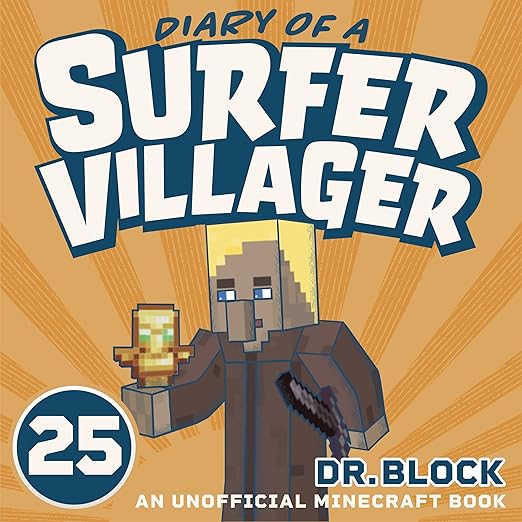
Jimmy, Claire, and Emma are stuck in Hawaii in Diary of a Surfer Villager, Book 25 - the twenty-fifth installment of Dr. Block's long-running Minecraft-inspired series, narrated by Mark Sanderlin. For listeners who have been with the Diary of a Surfer Villager audiobook series since the beginning, that premise lands with the weight of accumulated investment: Hawaii as exile, as an earthly paradise that feels like a prison. The book picks up with the same urgency that has characterized the recent volumes - unanswered questions from earlier installments crowd the opening chapters, and Dr. Block is in no hurry to resolve them before introducing new complications. This is not a starting point for the series; it is a reward for the readers who stayed.
Where This One Lands
The dramatic architecture of Diary of a Surfer Villager, Book 25 is built on five intersecting questions that run like threads through Dr. Block's twenty-five-book project. that carry over from earlier volumes: whether Claire can learn to control her interdimensional travel ability, whether Kind Hermione has responded to the messages sent to her, whether the Ender King and Princess Tina survived the events of the previous book, what lies inside Mieriale's chamber, and whether Emma can free Rupert's soul. That list of open questions is characteristic of Dr. Block's approach to long-form serial storytelling - each volume advances some threads while deepening others, and the balance of resolution and new complication is carefully managed. The Hawaii setting adds an unusual texture to this volume: the physical beauty of the location stands in direct contrast with the emotional weight of being trapped there. Mark Sanderlin, who has narrated across the series, is fully comfortable with the characters at this point. His delivery of Jimmy's voice carries the weariness and determination the character has developed over two dozen books. The young audience these books attract will find the cliffhanger construction as effective as ever - reviewers are already asking Dr. Block questions about the next book and speculating about which characters survive the consequences set in motion here.
Why Diary of a Surfer Villager, Book 25 Works as an Audiobook
At 3 hours and 26 minutes, this is a tight listen for a series entry - Dr. Block keeps the pacing brisk and does not linger on setup once the story is in motion. For children who are enthusiastic about the Minecraft universe but have not found conventional novels engaging, the diary format and the familiar game-world backdrop have always been this series' access point. The audio format is particularly well-suited to young listeners who follow the series on commutes or long car trips. Sanderlin's narration is energetic without being frenetic, and his handling of the more emotionally charged moments - Emma's situation with Rupert's soul in particular - shows range beyond the series' more action-heavy passages. The 4.9 rating across more than 850 reviews represents sustained series loyalty at a very high level, and the enthusiastic character of the reviews - readers asking about Minecon attendance, future plot directions, and specific character fates - reflects genuine investment rather than passive consumption. The dimensional travel mechanics that Dr. Block has built into Claire's arc are particularly well-developed in this volume, with clearer rules around what her ability can and cannot do. The question of Mieriale's chamber - held back across multiple preceding books - gets its most significant movement here, though Dr. Block is too careful a serial author to resolve it entirely in a single volume.
What Gives Us Pause
The disclaimer bears repeating clearly: this is not an official Minecraft product and is not approved by or associated with Mojang. Parents researching this series for younger children should know that it is fan fiction operating in a Minecraft-inspired universe rather than licensed content, which affects what you can expect in terms of continuity with official Minecraft lore and canon. The series also requires prior knowledge at book 25 - new listeners who start here will find the character relationships and ongoing plot threads difficult to orient in. Some early-chapter pacing that reviewers have noted as slower resolves as the volume builds toward its cliffhanger, which has been a consistent structural feature of the series. The diary format means the narrative is told from an intimate first-person perspective, which younger readers who enjoy that intimacy will find engaging; readers who prefer faster-moving third-person narration may find the exposition segments slower than they prefer.
Who Should Listen to Diary of a Surfer Villager, Book 25
This audiobook is written for established fans of the series - children and young adults who have followed Jimmy, Claire, and Emma through the preceding volumes and are invested in the unresolved threads. It rewards the kind of readers who leave enthusiastic reviews asking Dr. Block questions about the next installment. New listeners should start significantly earlier in the series - the world-building and character investment that make book 25 land need to be established through the earlier volumes first. Parents looking for a Minecraft-adjacent audiobook for children new to the series should start with book 1. The 3-plus-hour runtime is comfortable for a single long session or split across a few shorter ones, and Mark Sanderlin's consistent narration across the series means there is no adjustment cost for listeners who have been following along in audio form. This is exactly the volume its target audience has been waiting for.