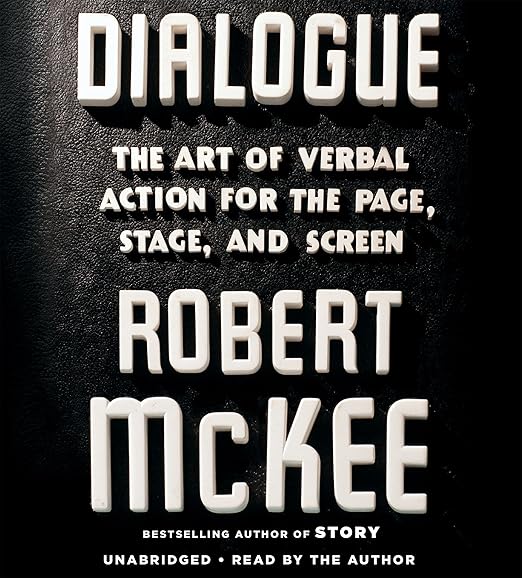
There is a review of this book that begins: I shouldn't even be writing this review because doing so only creates my competition. It is the most honest response to a craft book I have encountered in some time. The person who wrote it has read Dialogue in hardcover, on Kindle, and in audio, listens to it in their sleep, and considers the impulse to recommend it a form of professional self-sabotage they are committing anyway out of respect for McKee as an instructor. That is the kind of devotion that makes you take a book seriously before you have heard a word of it.
Dialogue is Robert McKee's follow-up to Story, his landmark guide to narrative structure that has been on every serious screenwriter's shelf since the 1990s. The list of Story alumni with Oscars is, as the synopsis notes, extensive enough to run off a page. McKee's workshop reputation is among the most formidable in the craft-instruction world, which means that Dialogue arrived carrying enormous expectation and the very specific liability of a sequel to a beloved original. It handles both with uncommon assurance.
A Closer Look at Dialogue
The core of Dialogue is McKee's insistence that what characters say is never as important as what they do not say. Subtext, the meaning operating beneath the surface words, is where the actual drama lives, and the book is organized around equipping writers to understand how subtext works technically rather than just recognizing it when they encounter it. One reviewer describes this as the thrust of the entire book, spending time on characterizations and the art of the subtext, showing how it works, what makes it effective, and providing the tools to generate it. That summary is accurate and also undersells how granular the instruction gets.
McKee deconstructs specific scenes from sources ranging from Macbeth to Breaking Bad to illustrate his principles at work. The scene analysis sections are where the audiobook format does something the print version cannot: the scene examples are read by professional voice actors rather than by McKee himself, giving them a performed quality that makes the textual analysis feel more grounded in actual dramatic experience. One reviewer described this as making the audio version the ideal entry point to the material, and I would agree. Hearing the scenes read and then hearing McKee analyze them is a different experience from reading both on the page, and the difference favors the audio.
McKee distinguishes between dialogue as it functions across three different forms: prose fiction, theater, and cinema. The distinctions are not arbitrary. What a character can say without breaking fictional reality differs significantly between a novel, where the reader is constructing the world internally, and a film, where an actor must deliver the line in a physical space that the camera will capture without mercy. The platform-specific instruction is one of the book's more valuable contributions, because most dialogue craft guidance treats the forms as interchangeable in ways that produce advice that is right for one medium and wrong for another.
The deep dive into the roots of English language and how a character's specific word choices reveal their psychology, class, education, and emotional state is a section that multiple reviewers flag as particularly generative. McKee approaches dialogue etymology not as trivia but as a working tool for writers who want their characters to sound specifically themselves rather than generically articulate. This is the kind of instruction that is easy to describe and difficult to execute, and the book is at its best in the sequences where McKee shows rather than just tells. The examination of even the word choice between Latinate and Anglo-Saxon vocabularies in character speech is the kind of granular detail that separates Dialogue from most craft books on the subject.
Things to Know Before Starting Dialogue
McKee narrates the bulk of the material himself, and the voice carries the workshop instructor's combination of authority, impatience with muddled thinking, and genuine excitement about the craft. One reviewer described the experience as a great master class lecture rather than a book in the conventional sense, and that framing captures something important. McKee in audio has the quality of a seminar leader who is accustomed to holding a room, and the material benefits from that presence in ways that pure prose instruction does not always deliver.
The ten-plus-hour runtime is not light, and the instruction is dense enough that passive listening will not produce the same results as engaged attention. Multiple reviewers describe returning to sections multiple times over months and years, finding different layers on each pass. One writer described reading it three times and plans to read it at least three more, learning and relearning each time. This is a book that functions as a long-term resource rather than a one-time listen, and the audio format supports that use particularly well given how easily specific sections can be navigated and revisited.
Who Robert McKee Is Writing For
Dialogue does not require prior familiarity with Story to function, though readers who know McKee's structural frameworks from the earlier book will find the dialogue principles extending naturally from that foundation. One reviewer describes Dialogue as more relevant than Story on a daily basis, more useful as a practical working tool for writers who are actively in projects. Whether you agree depends on what kinds of problems your writing currently faces, but the claim reflects a real difference in the texture of the instruction: Story is architectural, Dialogue is sentence-level. Both scales matter, and McKee is formidable at both.
For the writer who is serious about their craft and willing to treat this as a working text rather than a single listen, Dialogue delivers something rare: instruction that improves on re-encounter. The scene analyses do not exhaust themselves the first time through. The principles return differently when you have applied them and encountered their limits. The ten hours are, as McKee's workshop alumni consistently attest, an investment that compounds over time.
Do you need to have read Story before tackling Dialogue?
No prior familiarity with Story is required. Dialogue stands on its own as a guide to craft. Readers who know McKee's structural principles from Story will find Dialogue extending that foundation, but newcomers can start here without feeling lost.
How does the audiobook use voice actors for the scene examples, and does that work?
McKee narrates the analytical content himself while professional voice actors perform the scene excerpts he uses as illustrations. Reviewers consistently describe this as one of the audio edition's advantages over print, giving the scene analysis a more performative and visceral quality.
Is Dialogue more useful for screenwriters or prose fiction writers?
McKee explicitly addresses dialogue across prose, stage, and screen, with platform-specific instruction for each. The material is most densely populated with film and television examples, reflecting McKee's primary audience, but the principles and the instruction are substantive for fiction writers as well.
Is the subtext discussion in Dialogue applicable to genres like thriller or romance, or is it primarily aimed at literary and dramatic writing?
Subtext operates in every genre where characters speak to each other, and McKee's analysis draws from a wide range of sources. The principles apply to genre fiction as directly as to literary drama, even if McKee's canonical examples tend toward film and theater.