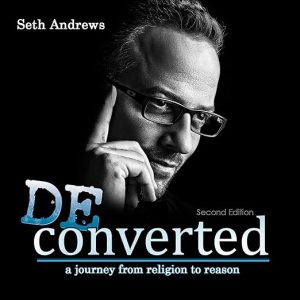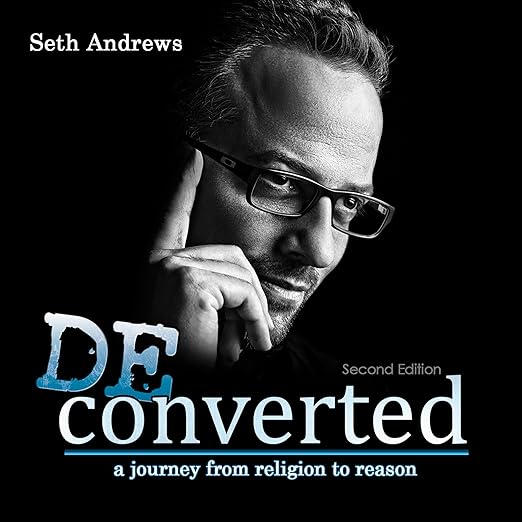
I came to Deconverted already familiar with Seth Andrews' podcast work, which meant I arrived with certain expectations that the audiobook both confirmed and complicated in interesting and occasionally surprising ways. The Thinking Atheist's origin story is something Andrews has addressed in various forms across his public work over the years, but the memoir format gives him room for a level of personal granularity that a podcast episode or live talk cannot accommodate within its time constraints. What I did not expect was how much the book's emotional texture would differ from the confident rationalism of his broadcasting persona. The Seth Andrews of Deconverted is less certain, more conflicted, and significantly more interesting as a subject of extended narrative than any thumbnail sketch of his public identity and work would suggest to someone approaching the memoir without that context.
The book covers Andrews' journey from a deeply embedded career in Christian media, he spent years working in religious broadcasting as a producer and on-air personality, to his eventual and deeply disruptive departure from the faith that organized that career and the community around it. What makes this narrative arc distinctive is the extraordinary specificity of Andrews' professional context. This is not a story about someone raised casually religious who drifts away from faith in early adulthood as many contemporaries do. It is a story about someone whose entire professional infrastructure, social world, and daily sense of purpose were structured around a belief system that he began to find internally inconsistent, and who spent years trying to paper over the cracks before finally acknowledging that the structure itself was what needed to change.
Andrews' Entire Career Was Built on Belief
Andrews spends considerable time in the memoir establishing what he had at stake, and that groundwork is absolutely essential to understanding the emotional weight of everything that follows. His career in Christian broadcasting was not incidental to his identity in the way that many people's jobs are peripheral to their sense of self. It was the center of his professional identity, his social network, his daily rhythm, and his sense of purpose and contribution. The colleagues, the friendships, the creative work, all of it was organized around a set of beliefs he was actively in the process of losing. The memoir is honest about the way that cost shaped his behavior during the transition: the years of compartmentalization between his private doubts and his public role, the professional obligations he continued to fulfill while privately experiencing the dissolution of the faith that had given them their meaning, and the eventual psychological impossibility of sustaining that gap.
Generosity for the Believers He Left Behind
One of the more impressive qualities of Deconverted is its sustained, genuine generosity toward the people Andrews hurt by leaving the community and the career. He does not portray the believers in his life as fools, as victims of psychological manipulation, or as enemies of intellectual freedom. His family members, his former professional colleagues, and the broader community that shaped him over decades are rendered with real affection even in the sections that document the most painful ruptures in those relationships. This generosity does not feel strategic or politically careful in the way that some public atheist memoirs are generous toward believers for tactical reasons. It feels like the hard-won result of someone who has spent serious years thinking about the difference between a belief framework being wrong and the people who hold that framework sincerely being bad or foolish.
Andrews' Restrained Self-Narration Reports, Doesn't Perform
Andrews' self-narration is clearly the right choice for this particular material and this specific memoir. His professional broadcasting background gives him a technical facility with the microphone that most author-narrators simply do not have, and his delivery in the memoir's most emotionally difficult sections is notably restrained in exactly the right way. He does not perform the grief of losing his faith or the relief of finally acknowledging what had been true for years; he reports both, and that reportorial quality paradoxically makes the emotional content more powerful and more present than a more theatrical delivery would. The audiobook format also suits the memoir's fundamentally conversational register, which reads as if Andrews is telling you his story directly in a quiet room rather than having constructed it carefully for publication. That intimacy is the audiobook format doing exactly what it should with this material.
Honoring What Was Left, Not the Departure
Deconverted is most valuable for listeners who have some personal stake in the questions it addresses, whether through their own religious history, their current faith, the loss of it, or their relationships with people who are navigating those transitions. It is not an apologetics text for atheism written to convert the undecided or to validate those who already share Andrews' conclusions. What it offers instead is something considerably rarer in this genre: an honest, specific, and emotionally intelligent account of what it actually costs in human terms to leave a belief system that has organized the entirety of your adult life, told by someone who paid that full cost and is still reckoning with the ledger years later. The memoir rewards listeners who bring genuine curiosity about the internal experience of faith and its dissolution rather than those seeking confirmation of a position already firmly held. Andrews has managed something genuinely rare in the memoir genre: a book about leaving that is more interested in honoring what was left than in justifying the departure, and that generosity of spirit is what makes it worth reading for people on all sides of the questions it addresses.