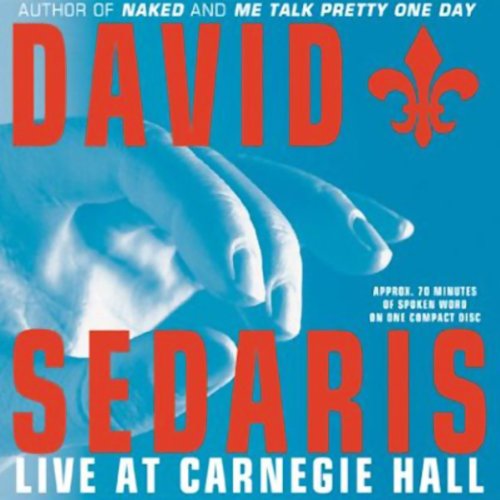
- Read by: Sedaris performs his own new material live at Carnegie Hall, so the timing is negotiated with an audience rather than fixed in a studio.
- At its heart: Family as comic material, absurd premises in domestic settings, the work of testing prose aloud.
- Vibe: Dry, mischievous, gleefully undignified.
- Short version: Superb for anybody who already knows the essays, and a misleading place for a newcomer to begin.
One hour and thirteen minutes, recorded live in front of a sold-out Carnegie Hall in 2002 and released as an audiobook the following year. That is the entire proposition. No studio, no retakes, no essays adapted for the page: David Sedaris trying new stories out on a room, with the laughter left in and a question-and-answer session at the end that the description never gets around to mentioning.
One Hour, Thirteen Minutes, Tested Live at Carnegie Hall
David Sedaris works his material out on tour before it reaches print, and the description says so plainly: the reading tours exist to get the rhythm and phrasing right first. That single fact is what makes this recording worth its price. You are not hearing a performance of finished prose. You are hearing the laboratory stage, sentences being tested against a live audience to find out which ones actually land.
Carnegie Hall lends the evening a formality that Sedaris obviously enjoys undercutting. The room was built for orchestras, the material is domestic and absurd, and the collision does a great deal of the comic work. Prestige venues make his particular brand of family humiliation funnier rather than smaller, and you can hear him playing the gap between the setting and the subject matter throughout.
A December 2010 account walks through the opening piece: how his family regards him and his little notebook, what their lives might look like adapted into a film, the death of a dog, all folded into one story. That response credits him with the writing and with the telling as separate accomplishments, which is the right distinction. The prose would work on paper. The pauses only work here.
Deadpan Delivery and a Live Room's Laughter
Deadpan is the technical term, and a five-star response from April 2008 names it exactly: the pleasure of hearing that amusing, almost deadpan style as the stories are told, and then the question-and-answer session with the audience at the end of the performance. That second detail appears nowhere in the description and is one of the better reasons to choose this over any studio reading of comparable material.
Laughter from the room functions as a second instrument. You can hear where a crowd goes first, which lines catch them off guard, and which pauses are being held an extra beat because the response has already arrived. Comedy recorded live carries information a booth cannot supply. It also carries the opposite risk, that a reference from 2002 draws a laugh you will not be able to share.
A Parrot, a Rubber Hand, and a Bishop of Turkey
Three stories are named in the description and they establish the register precisely: a parrot that mimics an ice maker, a couple arguing over a rubber hand, and a Santa Claus moonlighting from a job as bishop of Turkey. Absurd premises, domestic settings, no punchlines in the stand-up sense. If you have only met Sedaris on the page, the shape is familiar and the tempo is not.
Timing is the thing a live recording preserves and a printed essay loses. On paper the sentence lands because of where the clause breaks. In a room it lands because of the half second of silence before the final word, and the choice of exactly how long to hold it. Hearing those decisions made in front of a full house is instructive for anybody who writes and simply funny for everybody else.
A Listing Shelved Under LGBTQ+ and Parenting
Buyers cannot work any of this out from the title. The entry reads David Sedaris, the author's name and nothing more, with no indication that what is on offer is a seventy-three minute live set from one night in 2002 rather than a collection of his books or a bundle of essays. Somebody looking for an introduction could reasonably expect several hundred pages of material and receive a single evening.
Shelving is the other oddity here. The listing files this under LGBTQ+ and tags it for parenting and families, neither of which is wrong about Sedaris as a writer and both of which sit strangely on a live comedy set. Nothing in the description positions the material that way, so a listener arriving on the strength of those labels is working from a description of the author rather than of this recording.
Compact discs run through the entire response pool, which tells you how old the reception is. A five-star account from June 2013 describes laughing out loud alone in the car while traveling and warns that this is adult humor rather than something to put on for children. The enthusiasm has proved durable, the vocabulary belongs to another decade, and none of it was written about a modern download.
Better as a Second Helping Than a First
Newcomers are named as part of the target audience in the description, and I would still start elsewhere. A single evening of new material tested in front of a crowd is a wonderful second helping and a very thin first course. One buyer writing in December 2013 came to Sedaris through the Moth radio program before ever opening a book, which is the other classic route in and a more generous one.
Parents should note the obvious. This is adult comedy performed for a ticketed audience, and the family tag on the listing should not be read as a signal about who it suits. Anyone who dislikes live recordings, with an audience present throughout and applause around the edges, will also be happier with a studio reading, since half of what makes this valuable is the room.
Live comedy from 2002 could easily have curdled by now, and the surprise is that it has not. Family embarrassment does not expire, the delivery is unhurried, and the audience does a share of the work. Take it as a supplement to the books rather than as an entry point, and go in knowing exactly what you have bought, because the listing itself will not tell you.
Good to Know
What exactly is on this David Sedaris audiobook?
One live reading, captured at Carnegie Hall in 2002 and published the year after. Sedaris uses tour dates to test new stories before they go into print, so the pieces here are deliberately unfinished. The description names three of them, and the register runs from talking birds to moonlighting bishops.
How does a live recording differ from a studio audiobook?
You hear the audience, which changes everything. Timing is adjusted in real time, laughter overlaps the lines, and the performer can play with a pause because a room is responding to it. The trade-off is dated references and the occasional laugh you cannot join, since the evening belongs to a specific night in 2002.
Is the audiobook suitable for family listening?
No, whatever the parenting tag on the listing suggests. The set was performed for a ticketed evening audience, and the humor runs to lovers, religion and family cruelty. Older teenagers who already read Sedaris will be fine with it. Younger listeners are not who any of this material was written for.