Before You Press Play
- Narrator: Ross Berkeley Simpson's decades of series familiarity make the comic timing feel effortless.
- Subjects: Minecraft-inspired adventure, fan-driven Q&A tradition, silly running jokes
- Tone: Playful, silly, unmistakably kid-focused
- Bottom line: A comfortable, low-commitment listen for existing series fans; new listeners should start at book one.
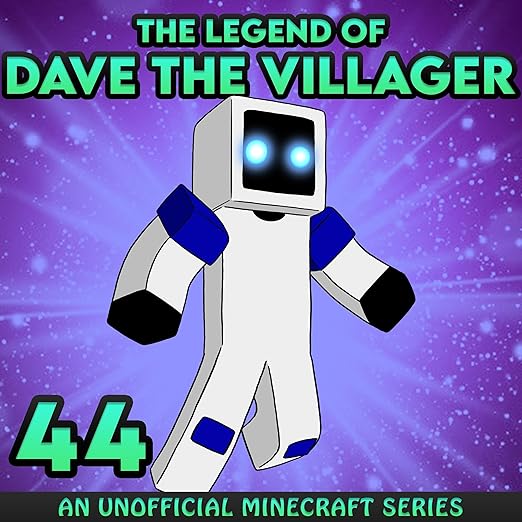
Fan questions get answered directly inside Dave the Villager 44's own pages, part of a running Q&A tradition where earlier readers' submissions show up folded into the story itself, and that structural choice is as much a part of this audiobook's appeal as its actual Minecraft-inspired plot. Ross Berkeley Simpson narrates the return to Laboratory 303, now under the control of the ominous Robot King, as installment number forty-four in a series that has clearly built something closer to an ongoing relationship with its young audience than a typical chapter-book run.
A Closer Look at Dave the Villager 44
The plot itself is compact by design: Dave and his friends head back into Laboratory 303, the setting from earlier books in The Legend of Dave the Villager, to confront the Robot King who has taken it over. This is explicitly an unofficial, fan-made expansion of Minecraft's world rather than a licensed Mojang product, a disclaimer the book states plainly upfront, and that unofficial status is precisely what gives the series room to build its own mythology, characters, and running jokes well beyond anything the actual game ever depicted.
Mousie1876's review captures what keeps readers this deep into a forty-four-book run coming back: being included in the book's own reader Q&A section really made her day, and the review's own rating breakdown, action ten out of ten, humor eight out of ten, romance seven out of ten, treats the book almost like a running scorecard across the whole series rather than a one-off judgment. That kind of engaged, almost participatory fandom is unusual for a series this deep into its run and speaks to genuine sustained quality rather than momentum alone.
KRTMan's review opens by addressing the book's narrator persona directly as human bean, a deliberate malapropism for human being that has apparently become one of the series' recurring bits, greeting readers in-character rather than breaking into a straightforward author's note. That small running joke says a lot about the series' whole relationship with its audience: playful, a little silly, willing to bend the fourth wall regularly enough that longtime readers have their own shared vocabulary with the books by this point.
The Robot King antagonist and Laboratory 303 setting both return from earlier installments rather than being introduced fresh here, which is itself a small structural signal: this volume functions as a direct continuation of a specific earlier plot thread rather than a fully self-contained standalone adventure, closer to a two-parter's back half than an isolated episode.
Ross Berkeley Simpson has narrated this series across dozens of installments now, and that accumulated familiarity shows in how efficiently the comic timing lands. Jokes built around Minecraft mechanics and running character bits, Carl's specific brand of humor gets a direct callout from Mousie1876's review, deliver with the ease of someone who has fully settled into this world rather than someone reading unfamiliar material cold. The fourth-wall-breaking asides that recur throughout the series work specifically because Simpson has made the fictional world feel solid enough to break the wall of in the first place.
For a middle-grade audience, that consistency matters more than it might in adult fiction: kids returning to a long-running series want the familiar voice they already associate with these characters, not a rotating cast of narrators across installments. At just over two hours, this is also a genuinely low-commitment entry point for a parent testing whether their child will connect with the format, short enough to finish in a single sitting.
KRTMan's review goes further than simple praise, actively pitching a new character idea and a specific piglin card-game concept for a future book, the kind of unsolicited creative pitch that only happens when readers feel genuinely heard by a series. Whether or not those specific suggestions make it into a future volume, that level of fan investment says something real about the relationship this series has built over its considerable run.
Things to Know Before Starting Dave the Villager 44
This is unmistakably a deep series entry, book forty-four, and while each individual adventure is reasonably self-contained, returning characters, ongoing plot threads about the Robot King and Laboratory 303, and running jokes accumulated over dozens of prior installments will land better for existing fans than for someone parachuting in cold. Rud's review even flags what reads as a continuity question, about when a specific in-game material was discovered relative to the lab's shutdown, the kind of detail only a genuinely invested long-term reader would catch and care about.
Parents should also know this is explicitly not an official Minecraft product, a distinction the book states directly rather than hides, so listeners expecting Mojang-sanctioned content should adjust expectations accordingly. The humor here leans broad and silly, closer to a Minecraft-flavored sketch comedy than a serious adventure narrative, which is exactly what its young audience wants but worth knowing if you are selecting this for a child who prefers more grounded stories.
Unofficial Minecraft-inspired children's fiction is now a genuinely large publishing category in its own right, populated by many competing series chasing the same built-in audience of young Minecraft players. What separates a series that survives to a forty-fourth installment from the many that don't tends to come down to exactly the kind of sustained reader relationship this book demonstrates, direct engagement with fan questions, consistent narration, running jokes that reward loyalty, rather than any single dramatic plot twist.
Who Dave Villager Is Writing For
This is built for kids already following The Legend of Dave the Villager, particularly the Minecraft-obsessed readers who enjoy the series' specific blend of silly humor and light adventure stakes. Simpson's consistent narration across the whole run makes this a comfortable pick for a family already deep into the series looking for the next installment without needing to re-explain who anyone is.
It's also worth noting the series now publishes under the fuller banner The Legend of Dave the Villager, a slightly expanded title from the earlier, simpler Dave the Villager name many longtime fans will still associate with the franchise. That rebrand does not change anything about continuity or numbering, book forty-four picks up exactly where forty-three left off, but it is a useful detail if you are trying to track down the full backlist under two slightly different series names.
Skip this one, or at least start elsewhere, if this would be a first exposure to the series for your child, since forty-three prior books' worth of running jokes and characters are assumed rather than reintroduced. New listeners will get more out of starting from book one and building up the same fondness for this world that clearly keeps Simpson's longtime audience coming back.
Common Questions
Do I need to listen to the previous 43 books to follow this audiobook?
Yes, effectively. Returning characters, ongoing plot threads, and running jokes built up across the earlier installments are assumed rather than reintroduced here.
Is this audiobook an official Minecraft product?
No, the book states directly that it is not an official Minecraft product and has no association with Mojang; it's an independent, fan-made expansion of that world.