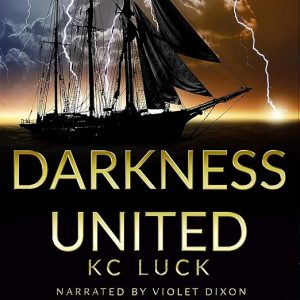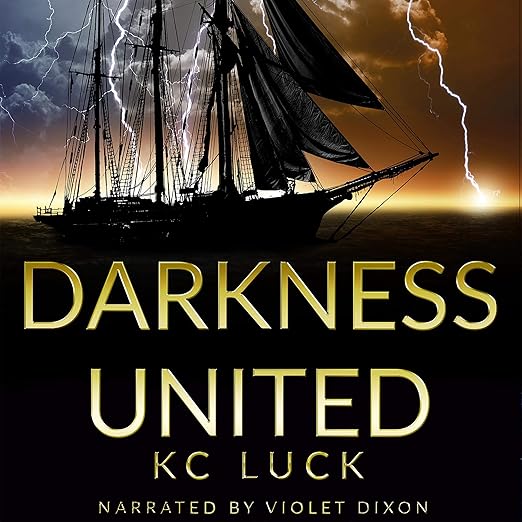
I came to Darkness United having already been briefed on the series by a reader friend who described it in the kind of shorthand that tells you everything you need to know: apocalyptic solar storm, group of women building a life together, lesbian relationships at the center rather than the margins, Violet Dixon narrating. She sent me a voice memo that was basically eight minutes of enthusiastic plot summary and two minutes of telling me to stop asking questions and just listen. She was right about the stop-asking-questions part.
KC Luck's third and final volume in The Darkness Trilogy picks up where Darkness Remains left off. The catastrophic solar storm that eliminated electrical power has already happened. Taylor, Jackie, Lexi, and Anna, along with Sam, Laura, and their network of found-family friends, have already survived two waves of crisis. Darkness United is about what survival looks like when the immediate emergency has passed and the harder work of building something durable begins, while new threats arrive to test whether what they have built can hold.
The novel is operating at the intersection of apocalyptic fiction and sapphic romance, and KC Luck handles both without sacrificing one to the other. The world-building is functional rather than elaborate: Luck is not interested in the mechanics of the solar storm or in geopolitical speculation about a society without power. She is interested in the community her characters are building in Astoria and on Lexi's family farm, and in what threatens it. The threats in this final volume include a militarizing Fort Aberdeen declaring martial law and expanding its presence into civilian territory, which gives the novel its external conflict engine while the romantic and relational threads provide its emotional center.
One reviewer described this as an apocalyptic thriller and lesbian romance combined, noting that the initial journey of the core quartet was so compelling that the series earned its place on the permanent re-read list. Another called it a page-turning conclusion with everything: pandemic chaos, brutal attack, family forged by circumstances, sacrifice, adventure, finding love in the darkest of times. Those descriptions are accurate, and they reflect what KC Luck is consistently delivering across three volumes: a genre hybrid that does not treat the romance as decoration on the survival story or the survival story as backdrop for the romance.
What Stands Out
Violet Dixon's narration is one of the production's consistent strengths across the trilogy. With a cast of primary characters who are all women and who are closely bonded, the challenge for any narrator is distinguishing voices without resorting to caricature. Dixon manages this by finding specific emotional registers for each character: Taylor's leadership voice sounds different from Jackie's, Lexi's domestic confidence sounds different from Anna's, Sam's pragmatism has its own frequency. The distinctions are subtle enough to feel natural rather than performed.
The romantic scenes, which are present and explicit in tone if not in graphic detail, are handled by Dixon with the same matter-of-fact warmth that characterizes the series overall. Luck's approach to the sapphic content is neither apologetic nor fetishizing: these are loving relationships between adult women who have survived something enormous together, and Dixon reads them with that understanding.
Weak Spots in Darkness United
Darkness United is explicitly marketed as a conclusion to The Darkness Trilogy, but some listeners have noted that it does not tie off every thread. The fates of secondary characters, particularly what happens to Alice and what becomes of the relationship between Meg and Grace after they return to sea, are left unresolved in ways that one reviewer found frustrating. Another felt more at peace with that openness, reading it as a realistic acknowledgment that not every story ends tidily.
This is worth knowing before you invest nine hours in the final volume. The core quartet's arcs are resolved. The central conflict with Fort Aberdeen reaches a conclusion. But KC Luck has written a conclusion that trusts its readers to be satisfied with the main threads without demanding every secondary strand be tied. For some listeners that will feel like a limitation; for others it will feel like honesty about how community stories actually end.
Best Suited For
Listeners who have already read or listened to Darkness Falls and Darkness Remains should finish the trilogy here; Darkness United delivers the emotional payoff the series has been building toward. The publisher's note that it can function as a stand-alone is technically true but practically optimistic: the relationships that give this volume its emotional weight are built across three books, and coming in cold means trusting that weight without having earned it.
For listeners specifically seeking sapphic post-apocalyptic fiction with romantic content at its center, KC Luck's trilogy is one of the more consistent series in the genre. Darkness United is the right ending for it.
Questions Listeners Ask
Can Darkness United be listened to without reading the first two books in the trilogy?
The publisher markets it as a possible stand-alone, but most listeners will find the emotional stakes considerably reduced without the relationship history built across Darkness Falls and Darkness Remains. The plot is followable; the emotional investment is not transferable without the earlier books.
Does Violet Dixon's narration handle the large ensemble of female characters distinctly?
Yes. Dixon finds specific emotional registers for the core characters that allow listeners to track who is speaking without relying on tags. The distinctions are achieved through subtle tonal and pacing differences rather than exaggerated vocal differentiation.
Is the Fort Aberdeen military plotline resolved by the end of Darkness United?
The core conflict with Fort Aberdeen and its expansion is resolved within the novel. Some secondary character threads, particularly around supporting characters introduced in later books, are left with more ambiguity, which has divided reader responses.