
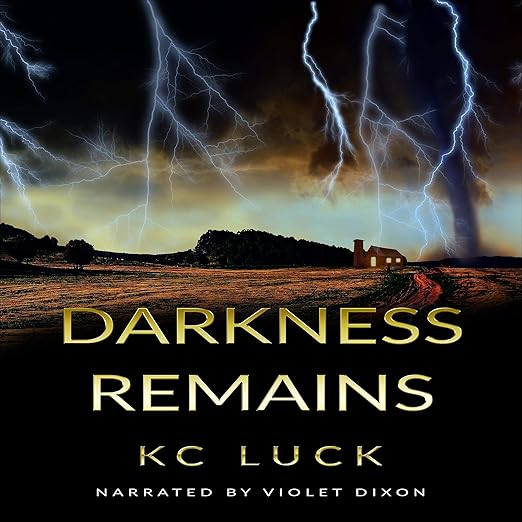
I came to Darkness Remains without having read Darkness Falls, the first book in KC Luck's series, and I want to be honest about the consequences of that choice for how I experienced this review. The book rewards prior investment in its characters in ways that made it a somewhat different and more effortful experience for me than it would have been for a returning reader. I spent the first hour or so catching up on relationship histories and community dynamics rather than simply following an established emotional throughline, which probably cost me some resonance in scenes that would have hit harder if the attachments were already in place. This is worth knowing before you start.
That said, Luck writes with enough care for her characters that I was invested in all four protagonists by the midpoint, which says something real about what she's doing. The world she's built around a solar storm blackout and its aftermath in Astoria, Oregon has the specificity that distinguishes committed post-apocalyptic fiction from the kind that's using collapse as aesthetic backdrop without thinking through its implications.
A Closer Look at Darkness Remains
The structure is a quartet: Laura Kennedy, adrift after part of Astoria burns in the aftermath of the global blackout; Sam Quinn, a veterinary student on horseback heading northwest with the instinct that somewhere safe exists if she rides far enough; Taylor Barnes, an Army veteran pulled into unwanted community leadership she never sought; and Jackie Scott, a former CEO learning what identity means when all the infrastructure she built her self-image around has disappeared. The Laura-Sam romance is new to this installment, and it develops more slowly than the Taylor-Jackie relationship, which carries over from the first book and receives, by multiple reviewers' accounts, the more emotionally satisfying arc because it has more history to resolve.
Luck's choice to stage her queer romance against a solar apocalypse rather than a zombie one is small but tonally significant. The threat in this world is scarcity, fear, and human cruelty rather than undead horror, which keeps the register warmer than the genre typically allows. The danger is real and the violence is present, but the book's center of gravity is always the relationships and the community rather than the threat landscape. That's a deliberate tonal choice that distinguishes Darkness Remains from a lot of post-apocalyptic fiction, which tends to let the horror crowd out the humanity in the name of realism.
What Makes Darkness Remains Worth Hearing
What Luck does consistently well is render the texture of post-blackout life: what it means practically for food distribution, for security, for the social contracts that hold communities together when the infrastructure that enforces them disappears. Astoria, Oregon is rendered specifically enough that the community fighting to maintain order feels like a place with a history rather than a genre backdrop assembled from standard parts. Taylor's reluctant leadership role is credible rather than convenient, because Luck has thought through what skills an Army veteran actually brings to civilian emergency management and what the limits of those skills are.
The darker side of human nature under pressure is not absent. Luck includes the exploitation and opportunism that would attend any real societal collapse, and the book's antagonists have enough specific motivation to feel like more than narrative obstacles. One reviewer described the book's achievement as showing how an author can bring light, love, hope, and humanity into a story of life after apocalypse, and that's the balance Luck is trying to strike. The light is more persuasive because the dark is acknowledged rather than wished away. This is a book that believes in human goodness without pretending that catastrophe reveals only the best in people.
Things to Know Before Starting Darkness Remains
Keeping four female protagonists vocally distinct across nine-plus hours of parallel narrative is a genuine technical challenge, and Dixon handles it with consistent and unobtrusive skill. Her differentiation between the four women is not theatrical but sufficient: Laura's uncertainty sounds different from Taylor's controlled competence, Jackie's adjustment to a radically reduced world sounds different from Sam's open searching. In a genre that sometimes reduces its characters to their function in the plot, it matters that Dixon gives each woman a specific quality of voice that reinforces their individuality on the page rather than flattening them into types.
The narration is particularly effective in the romantic scenes, where Dixon finds an intimacy without breathiness that keeps the emotional register genuine rather than performed. Post-apocalyptic romance is not the easiest thing to sell through audio without tipping either into excessive sentiment or into the kind of tonal flatness that makes the affection feel abstract. Dixon finds a middle position that serves the material well across a range of tonal demands, from tense community confrontations to quieter scenes of connection between characters who are still figuring out what they mean to each other.
Who KC Luck Is Writing For
Darkness Remains works best for listeners who have read or listened to Darkness Falls and want to continue with these characters. As a standalone it functions, but it functions harder when you bring the prior emotional investment to it. The queer romance here is handled with genuine respect for its characters as fully realized people rather than as genre representatives fulfilling a diversity mandate, and the book's stubborn insistence on community, love, and collective action as survival mechanisms rather than luxuries gives it a distinctive quality in a post-apocalyptic field that often mistakes relentlessness for honesty.
Those looking for primarily action-driven post-apocalyptic fiction may find the relationship emphasis heavier than they want. Those looking for a queer love story with enough speculative scaffolding to keep the stakes elevated and enough community texture to make the world feel real will find exactly what they're looking for, provided they start at book one.
Frequently Asked Questions
Is Darkness Remains accessible as a standalone, or is reading Darkness Falls first essential?
Luck provides enough context that a newcomer can follow the plot, but the emotional payoff in the Taylor-Jackie storyline depends significantly on prior investment from the first book. Starting with Darkness Falls is strongly recommended for the fullest and most emotionally resonant experience.
How central is the lesbian romance versus the post-apocalyptic survival plot?
The romance is the book's center of gravity; the survival scenario is the frame rather than the subject. Readers coming primarily for action-driven post-apocalyptic tension may find the balance tips further toward relationship development than they expect.
Does the Sam-Laura storyline reach satisfying resolution in this book, or does it carry over to a third volume?
The Sam-Laura arc is, by several reviewers' accounts, the book's weaker thread, partly because the two characters don't meet until well into the narrative. It reaches a partial resolution but leaves clear room for the series to continue, which it does in subsequent volumes.







