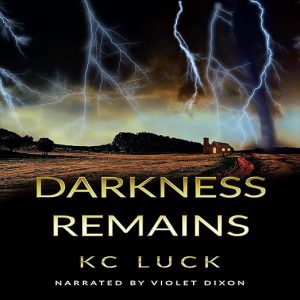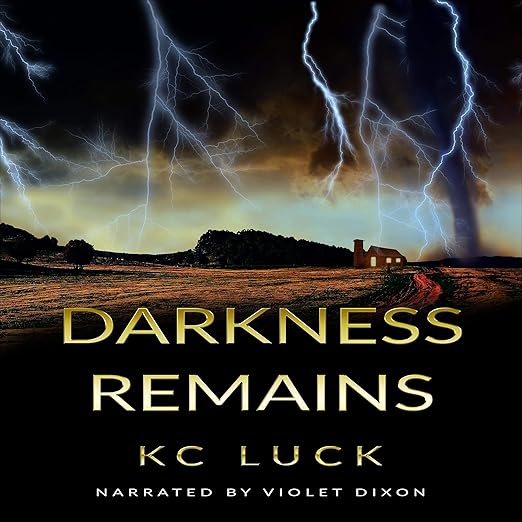
I came to Darkness Falls already primed by the first book in KC Luck's series. I had spent a weekend with the original story and found myself unexpectedly absorbed by the world she built in the aftermath of a solar storm that kills the grid. So when I returned to Astoria, Oregon, for this second installment, it felt less like starting a new audiobook and more like checking in on people I had been thinking about. That is a specific kind of reading pleasure, and Luck earns it.
The setup is a continuation of the world established in the first novel, a landscape where the power has gone out everywhere and is not coming back. Laura Kennedy lost her home when part of Astoria burned. Sam Quinn, a veterinary student who rode northwest on her horse when everything went dark, arrives in the area after an accident. Taylor Barnes, the reluctant leader, is trying to keep the community together for the sake of Jackie, the former CEO she loves. This is a book with multiple simultaneous romantic storylines, and managing that without losing any thread is harder than it looks. This free audiobook is available through Audible membership and Luck's pacing makes nearly nine and a half hours feel earned.
What Luck does well is maintain emotional specificity across different pairings. Taylor and Jackie get the most page time here, which is appropriate given how well developed they were in the first book. Their arc reaches a genuinely satisfying resolution that feels earned rather than rushed. The newer pairing of Sam and Laura has a slower build, Sam does not even encounter Laura until the final third of the book, which one reviewer correctly identified as a structural issue. Their connection feels compressed relative to the older couples, and you can sense Luck prioritizing resolution for characters listeners already know over full development of the new relationship. That said, the weakness of that one thread does not diminish the overall quality of what this book delivers. One reviewer described it as a story that shows us the bad and the good and even greatness in others, and I think that is accurate.
The community-building elements are some of the most interesting material here. How do people organize, who takes power, who resists it, and what does safety cost when resources are genuinely scarce? These are not small questions, and Luck takes them seriously even in a genre that does not always demand it. The bullies who get their comeuppance, as one reviewer put it, are not cartoon villains but recognizable types who emerge naturally from crisis conditions.
What KC Luck Gets Right
The post-apocalyptic setting is not decorative. The solar storm and its consequences create specific pressures that drive the romantic relationships in ways that feel plausible rather than contrived. Characters have to decide whether to trust quickly because there is no time for lengthy courtship when the structure of ordinary life has dissolved. The vulnerability that crisis strips people down to is exactly the vulnerability that makes intimacy possible, and Luck understands this dynamic at a structural level, not just as a plot device.
The darker undercurrents of the world, the opportunists who emerge when law and order break down, the violence that certain men turn to immediately, the particular danger that falls on women in a world without institutional protection, are handled without being gratuitous. One reviewer noted the difficulty of portraying the light shining in during the darkest times. That is the book's central emotional challenge, and mostly Luck meets it. The moments of warmth and connection land harder because they arrive inside genuine threat, not beside it.
Where KC Luck Loses Some Ground
Violet Dixon's narration is one of the book's genuine assets. With four main characters plus a supporting cast, there is real work involved in keeping listeners oriented, and Dixon does it without resorting to exaggerated differentiation. Her Laura is softer, her Taylor more measured, her Sam a bit younger in energy. The emotional scenes, and there are several that carry real weight, are handled without melodrama. She seems to understand that the material works best when delivered with restraint rather than performance.
For readers already in this series, the second book delivers what you came back for: the couples you invested in, tested by new circumstances and brought to resolution, with the addition of a new relationship that sets up future installments. For newcomers, the prior context is genuinely necessary. Start with the first Darkness Series book. The emotional payoffs here depend entirely on knowing these characters before the solar storm changed everything.
Who Should Pick Up Darkness Falls
Listen to this if you enjoyed the first Darkness Series installment, or if you are looking for sapphic romance in a post-apocalyptic setting with genuine emotional investment and competent worldbuilding. Listen if multiple-POV romance does not put you off, and if you find that crisis scenarios produce richer emotional stakes than conventional contemporary settings. Skip it if you have not read the first book, since the relationships and context here depend heavily on what came before. Also skip if you want equal development across all romantic pairings, since Sam and Laura get noticeably less runway than Taylor and Jackie. This is a second installment in the truest sense: it rewards loyalty without being entirely self-contained.
How explicit is the romance content in this audiobook?
The romance is present and emotionally central but not graphically explicit. The focus is on emotional connection, attraction, and the development of trust under pressure. Readers who found the first book's level of romantic content appropriate will find this installment consistent in tone.
Does Violet Dixon's narration work with so many different female lead characters to distinguish?
Yes, quite well. Dixon develops distinct vocal signatures for the main characters without resorting to caricature, and she navigates the emotional weight of the book's more intense scenes with restraint. Listeners who struggled with multi-narrator ensemble casts in other audiobooks should find her approach manageable.