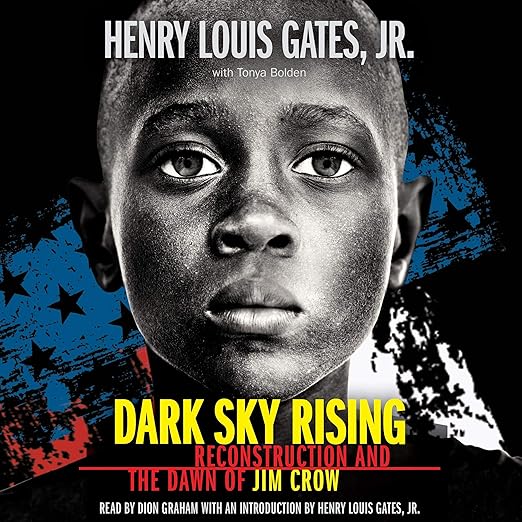
Reconstruction is one of the most significant and most systematically distorted chapters in American history. Henry Louis Gates Jr. has built a considerable part of his scholarly career on restoring the accurate record of this period, and Dark Sky Rising: Reconstruction and the Dawn of Jim Crow, published under the Scholastic Focus imprint, is his attempt to deliver that corrected history to the audience that most needs it: young people who will encounter the distorted version in popular culture, in political argument, and in many textbooks before they encounter the real one. Dion Graham narrates across just over three hours, and together they produce an audiobook that functions for its intended YA audience without condescending to the adults who will listen alongside the young people in their lives.
Gates is a Harvard historian and a skilled writer for general audiences, and the Scholastic Focus format does not diminish either quality. The book is concise in the sense that it covers what it needs to without redundancy, not in the sense that it simplifies or omits the difficult material. The half-century from the Civil War's end to Birth of a Nation in 1915 is tracked with real historical precision, and the people Gates names, both the architects of Reconstruction's promise and the architects of its destruction, are treated as specific human actors rather than as symbols of historical forces.
A Pipeline Back Into Forced Labor
The book's central argument is that Reconstruction was a genuine democratic experiment, not simply a period of chaos imposed by outside forces on a reluctant South. Black men voted, held office, built institutions, and participated in a national project from which they had previously been excluded by law and by violence. Gates describes these achievements with the same specificity he brings to the experiment's dismantling: names, dates, legislative acts, court decisions, and the terror campaigns that accelerated what legal mechanisms could not accomplish quickly enough for those who wanted the prewar racial hierarchy restored.
The real-life accounts Gates foregrounds make the history legible and human in ways that survey approaches often cannot achieve. Specific individuals appear with enough context to be understood as people rather than as historical placeholders. Dion Graham's narration honors this: he does not blur individual testimonies into background texture but gives them the weight they carry in Gates's text. Reviewer Hutch described the book as relating "history that is hidden from younger generations" and expressed regret at not having had it in an American history class decades earlier. That response points to the book's central justification.
The Black codes that Southern states enacted almost immediately after the Civil War represent one of the book's most clarifying passages. Gates shows the speed and deliberateness with which the apparatus of control was rebuilt in slavery's formal absence. The Thirteenth Amendment abolished slavery except as criminal punishment, and the Black codes exploited that exception precisely, criminalizing minor offenses such as vagrancy to create a pipeline back into forced labor. This history appears in some contemporary discussions of mass incarceration, but Gates locates it in its post-war origin with a directness that many accounts avoid.
Graham's Narration Suits Group and Individual Study
The audio format serves this book particularly well for classroom and educational use. Graham's narration is clear enough for group listening and well-paced enough for individual study, and the three-hour runtime means the entire work can be covered within a school week's worth of assigned listening. For teachers of American history, the audiobook offers an authoritative, accessible account of Reconstruction that is calibrated for the attention spans and prior knowledge of young adult audiences without softening the historical record.
For adult listeners who received a thin or distorted public school treatment of Reconstruction, which is a common experience across many American school systems, this book functions as an efficient and authoritative correction. Gates does not assume prior knowledge of the period but also does not oversimplify. The balance between accessibility and intellectual honesty is the hallmark of good historical writing for young audiences, and Gates achieves it consistently across the text.
Griffith's Film Was Screened at the White House
The sections on Black political participation during Reconstruction carry a different emotional register from the passages about the experiment's destruction. Gates writes about the legislators, educators, and community builders who operated under constant threat with genuine admiration, and those names, which do not appear in most popular accounts of American political history, deserve the recognition the book gives them.
The book's endpoint, D.W. Griffith's Birth of a Nation in 1915, is a deliberately chosen conclusion rather than an arbitrary one. Griffith's film crystallized the Lost Cause mythology that had been building throughout the Jim Crow decades into a form that reached millions of viewers and was screened at the White House. Gates uses this as the endpoint to show how cultural production and political history intersected in the consolidation of a false historical narrative that shaped American racial memory for generations. Understanding that intersection is part of what makes this history relevant beyond its period.
The Bibliography Points to Eric Foner's Reconstruction
The Scholastic Focus imprint targets middle school and high school readers, and the audiobook works well for that audience with adult guidance for younger listeners. Some passages describing racial violence and the terror used to dismantle Reconstruction require contextual conversation in younger listening settings. For adults, particularly those who received incomplete formal education on this period, the book is an efficient and credible correction. Educators using this in curriculum should note that Gates's bibliography points outward to Eric Foner's Reconstruction and other scholarly texts for listeners who want greater depth after the three-hour introduction.
Before You Listen
Is Dark Sky Rising appropriate for middle school listeners, or is the subject matter better suited to high school and older?
Gates writes for the Scholastic Focus young adult series with age-appropriate gravity rather than sanitization. High school and mature middle school students are the target audience. Some passages describing racial violence and the terror used to dismantle Reconstruction are serious and require contextual conversation with younger listeners. Adults should listen alongside children rather than assigning it without preparation.
Does the Dark Sky Rising audiobook serve as a complete introduction to Reconstruction, or does it assume prior historical knowledge?
It functions as a complete introduction. Gates establishes the post-Civil War context before tracing Reconstruction's arc, and no prior knowledge of the period is assumed. The three-hour runtime produces a survey rather than a deep dive, but it covers the essential political, legislative, and human history clearly and without gaps that would leave a new listener confused.
How does Dion Graham's narration handle the personal testimonies and historical accounts Gates includes in the text?
Graham gives individual testimonies meaningful weight rather than blending them into surrounding historical prose. His pacing distinguishes between Gates's analytical voice and the personal accounts, which helps listeners, particularly younger ones, track when they are hearing historical argument versus specific human experience.
Does the audiobook cover the full Jim Crow era, or does it end with Reconstruction's collapse?
Gates frames the book as spanning roughly the half-century from the Civil War's end to Birth of a Nation in 1915. It follows Reconstruction through its collapse and traces the establishment of Jim Crow as a systematic replacement for slavery's legal apparatus. The coverage ends before the 20th-century Civil Rights movement, focusing specifically on the period of democratic promise and its undoing.