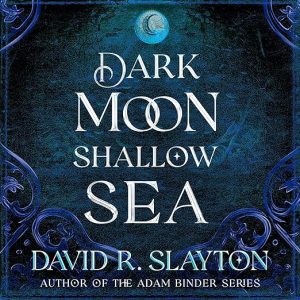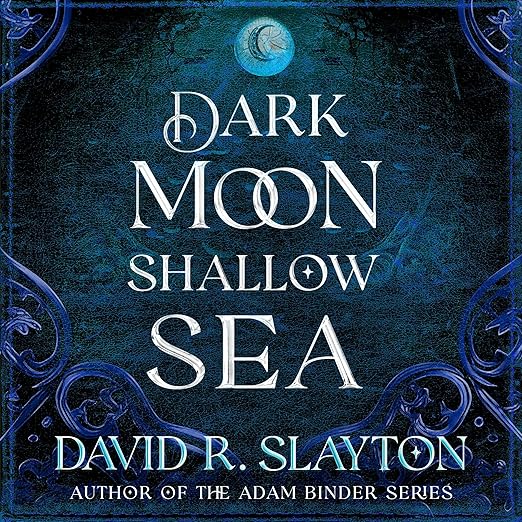
A goddess is dead before the story starts. Phoebe, who held the moon, has been cut down by Hyperion's knights of the sun, everyone who followed her is now a heretic, and the immediate practical consequence is that nobody ferries the dead anywhere any more. They stay. They get hungry. Eleven and a half hours of audiobook follow from that single act of theological vandalism, and David R. Slayton spends them on two young men who have no idea they are standing at the center of the wreckage.
A Closer Look at Dark Moon, Shallow Sea
The structure is a two-hander and the two halves are deliberately mismatched. Raef is a thief, a child of the night living in shadows and on scraps, who breaks into the Temple of Hyperion after an ornate box because the score is too good to leave alone. Seth is a knight of that same sun god, except the fire of Hyperion brings him only pain, which he has decided he deserves as penance for origins he cannot remember. One is sent to recover the contents of the box the other went after. Both end up crossing the sea and coming back changed.
The publisher pitches this as divine betrayal, ghosts and self-discovery, and points listeners toward the Dark Souls games and Brandon Sanderson's Mistborn. That is an odd pairing until you hear the book, at which point it makes sense: the bleakness and the hostile theology come from one side of the comparison, and the promise of scale and a fully built mythology comes from the other. What Slayton adds to both is a dying world explicitly divided by the greed of the people running it, which gives the mythology a political floor.
What Makes Dark Moon, Shallow Sea Worth Hearing
The five-star reviews converge on craft. Darren Lipman opens one of them with "I loved this book. The writing was strong, and I enjoyed the alternating viewpoints", then singles out the setting as "rich with interesting details and backstory". D J is more excitable, titling the review "This odyssey will keep you reading until late into the night!" and describing a story line that is "dark but not scary, full of twists and turns". The two things they name are the two the book does best: the alternating structure and the atmosphere.
The romance is handled with more restraint than the setup suggests. Lipman notes only that "The romantic elements were nicely written", and that is the sole mention of romance anywhere in the review pool. This is filed as queer fiction and the two point-of-view characters are both men whose destinies converge, but nobody who read it came away describing a love story. Listeners who came for a romance with a fantasy backdrop should note how little space it takes up in the reception here; listeners who usually find romance subplots intrusive in epic fantasy have rather less to worry about than the shelving suggests.
For audio specifically, the mythology is an asset. Invented pantheons are hard to read on a page, where a reader's eye skids off unfamiliar names and half-absorbs them, and far easier to take in aloud, where Hyperion and Phoebe and their competing orders arrive as sounds attached to consequences. The prologue-shaped premise, a murdered moon goddess and a world of unferried dead, also has the cadence of something meant to be spoken. Eleven and a half hours is a serious commitment, but the register rewards the format.
One more thing the setting does quietly. A theocracy that has just executed a god and outlawed everyone who followed her gives the world a politics rather than a backdrop, which is where the copy's promise of "a dying world divided by the greed of those in power" stops being a tagline and starts being a plot mechanism. Worth listening for, because it is the point at which the mythology has to carry an argument instead of decorating one.
Things to Know Before Starting Dark Moon, Shallow Sea
The onboarding is the weak point and the four-star review names it precisely. Vykyll writes "I did actually enjoy this, after getting through some hurdles" and then locates them: "It almost felt like we should know who some of the Gods were, what the situation was." The information does arrive, but late, and Vykyll argues most of it could have landed halfway through with the book flowing better for it. Expect a genuinely disorienting opening stretch where names, orders and divine politics are used before they are explained.
Lipman raises a different complaint: "A few plot points felt like they came out of nowhere with little real cause", and that review is cut off just as the balancing clause begins, so how much weight the complaint carried stays unknown. Taken with Vykyll's point, the pattern is a book that withholds and then delivers in bursts. Some listeners find that propulsive. Others will spend the first two hours suspecting they missed a prequel. Two content notes belong here as well: shades that feed on the blood of the living, and a protagonist who has decided he deserves his own suffering.
Michael David Axtell has the reading, and what the text demands is clear enough from the structure. The viewpoints alternate between Raef and Seth, and a listener needs to know within a sentence which world they have re-entered, the thief's or the knight's. On top of that sits a heavy invented vocabulary of gods, orders and place names that has to stay consistent throughout. My own test on a book like this is whether I can still tell the two men apart with my eyes shut in traffic, which is less obvious than it sounds when both men are young and in trouble.
Who David R. Slayton Is Writing For
Epic fantasy listeners who like their theology broken and their worlds already collapsing will find a great deal here, particularly anyone who wants a pantheon that behaves like a government. It suits readers of Slayton's earlier work as well: one reviewer arrived from The Adam Binder stories and rates this considerably higher. Anyone looking for queer fantasy where the relationship is woven through the plot instead of bolted onto it should also take a look, as should listeners who want a first book that behaves like a first book, with a world clearly built to be continued.
Push past the first two hours before deciding, because the opening deliberately withholds the context that makes everything legible, and a listener who bails at the confusion will never see the payoff two reviewers describe. Avoid it if you need your fantasy explained as it goes, if bleak settings wear you down, or if a series opener at eleven and a half hours reads as a commitment rather than an invitation. The average of 4.6 across two hundred and eighty-one ratings suggests most listeners who stayed were glad they did.