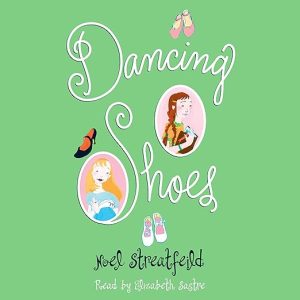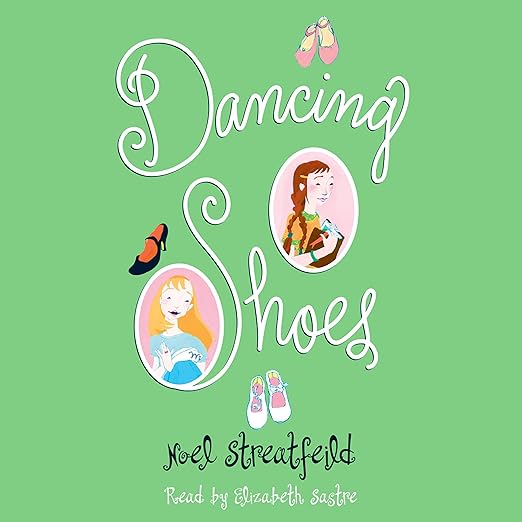
Rachel stands backstage in a ruffled costume she hates, watching her adopted sister Hilary get praised for talent Rachel doesn't have and doesn't want, and that image, an unwilling performer trapped in a role built for someone else, is the emotional engine of Dancing Shoes from its earliest chapters. After losing their mother, Rachel and Hilary move to London to live with their aunt Cora Wintle, who runs a dance troupe called Wintle's Little Wonders and immediately sees Hilary as her next star, a genuine threat to Cora's own daughter Dulcie. Noel Streatfeild wrote this as part of her loosely connected Shoe Books, alongside Ballet Shoes, Skating Shoes, and Theater Shoes, and this audiobook edition, narrated by Elizabeth Sastre, gives the decades-old story a clean, unfussy reading that doesn't try to modernize what was always a fairly quiet, character-driven story about two sisters figuring out where they each belong.
Rachel's Real Talent Turns Out to Be Acting
What makes this hold up past its original mid-century setting is how clearly Streatfeild separates the two sisters' arcs instead of treating Rachel as simply the less-talented one standing in Hilary's shadow. Hilary is bright and eager to please, genuinely gifted at dance but also genuinely just a kid who wants to have fun rather than carry the weight of Cora's ambitions for her. Rachel is the more interesting listen precisely because her arc isn't about becoming good at dancing, it's about discovering she has a completely different talent, acting, that nobody in her family thought to look for because they were all fixated on the one skill Cora valued. That reversal, a story ostensibly about a dance troupe that turns out to be about a girl who was never meant to be a dancer at all, gives the book more shape than the orphan-joins-a-performing-school premise suggests on its own.
Reviewers keep returning to how well the book holds up for repeat listening and gifting. One reviewer, writing anonymously, described making tee shirts around the book's theme, noting, “I'm making tee shirts to go along with the theme of the book so the person being gifted can wear it as they read the book just for fun,” which says something about how the Shoe Books function almost as a small tradition passed between generations of readers rather than just individual titles. Kate Shaw's review makes that generational pull explicit too, describing this copy as a replacement for one “read to pieces,” since “paperbacked books for children are not, for some reason, made to last a lifetime,” and adding that she has “loved Ms. Streatfield's books since I first encountered Ballet Shoes when I was 10 years old.”
Cora Wintle herself is worth a closer look than the “strict aunt” shorthand suggests, since Streatfeild resists making her a simple villain even as she pushes Rachel into a role that clearly doesn't fit. Her ambition for the troupe, and her barely concealed favoritism toward her own daughter Dulcie over her nieces, comes from a recognizable, very human insecurity rather than cartoonish cruelty, which is part of why the book holds up: even the adult obstacle in Rachel and Hilary's path has an interior logic a listener can follow, rather than existing purely to be overcome.
Sastre Finds Rachel's Voice in Quiet Restraint
Elizabeth Sastre's narration is the reason I'd recommend the audiobook specifically over just handing a child the print edition. She differentiates Rachel's guarded, observant quality from Hilary's brighter, more extroverted energy through cadence and restraint rather than exaggerated character voices, which keeps the sisters distinct without ever tipping into caricature, a real risk with a book built around two contrasting personalities performing on stage. She's noticeably more comfortable in Rachel's quieter, more internal passages than in Hilary's more performative scenes, which actually suits the book's own sympathies, since Streatfeild is clearly more interested in Rachel's interior life than in Hilary's stage triumphs. Sastre also handles Streatfeild's slightly old-fashioned, mid-century sentence rhythms cleanly, never rushing them into something that sounds artificially modern.
At five hours and thirty minutes, this sits at a genuinely comfortable length for the age range it's aimed at, long enough to sustain real character development across Rachel and Hilary's diverging paths, short enough that a family could realistically finish it across a handful of car rides or evenings without losing the thread between sessions. Kind Bean's review notes the book follows “a similar formula compared to Streatfeild's other books,” which is accurate and, I'd argue, part of the appeal rather than a knock against it: familiarity with the formula, an orphaned or displaced child, a new domestic situation, a hidden talent waiting to be discovered, is exactly what makes these easy recommendations for kids who've already worked through Ballet Shoes or Theater Shoes and want more of the same world.
Grief Comes Before Dance in This Shoe Book
It's worth being clear that Dancing Shoes belongs to Streatfeild's loosely connected Shoe Books rather than a strict numbered sequence; the book's own description points listeners toward Ballet Shoes, Skating Shoes, and Theater Shoes without insisting on a particular reading order, and this one stands on its own without requiring the others as setup. Parents expecting a straightforward theatrical-triumph story should also know the emotional center is really about grief and displacement first, dance and performance second; the loss of the girls' mother sits underneath every chapter even when the surface plot is about rehearsals and recitals.
The mid-century British setting and vocabulary, talent troupes, dance mistresses, a fairly rigid class-consciousness around Cora's ambitions for her daughter, will occasionally need a quick explanation for younger American listeners unfamiliar with the period, though nothing here is dense enough to actually stall a listen the way genuinely archaic language sometimes does in older children's books. At a 4.8 rating from 460 listeners, this is about as close to unanimous approval as children's audiobooks get, which tracks with how consistently reviewers describe returning to Streatfeild's books across multiple childhoods, their own and then their kids'.
Two Clearly Different Siblings Share One Listen
This is a strong pick for kids around eight to twelve who already prefer character-driven stories over pure adventure plots, for anyone raised on the Shoe Books looking for a well-narrated way to revisit them, and for a parent hunting for a story about sibling dynamics that doesn't resolve into a tidy, uncomplicated friendship by the last chapter. It also travels well for a family road trip, since each chapter closes at a natural pausing point.
It also works well as a shared listen for two siblings with clearly different temperaments, since Rachel and Hilary's contrast, one guarded and internal, one bright and eager to please, gives two different kinds of kids a character to specifically recognize themselves in, rather than a single default protagonist everyone is expected to identify with equally.
Young listeners craving constant action or a fast-moving plot might drift during the quieter domestic chapters, since Streatfeild's pacing favors small, accumulating detail over dramatic set pieces. It's also not the best entry point if a child specifically wants a book centered on dance itself, given how much of Dancing Shoes is actually about Rachel discovering she doesn't want to dance at all.
Do I need to listen to Ballet Shoes or Theater Shoes before this audiobook?
No. Dancing Shoes and Streatfeild's other Shoe Books are companion novels sharing a general milieu rather than a strict numbered sequence, so this one stands on its own without requiring the others as setup.
Is this audiobook mainly about dancing, or is there more to it?
The dance-troupe setting is really a backdrop: the emotional core is about grief and displacement after losing a parent, and Rachel's arc is specifically about discovering a talent, acting, that has nothing to do with dance at all.
Is this audiobook appropriate for kids who aren't interested in ballet specifically?
Yes. The dance setting really functions as a backdrop for a story about sibling dynamics and finding your own talent, so kids without any particular interest in dance can still connect with Rachel and Hilary's family situation.