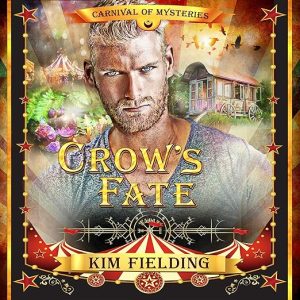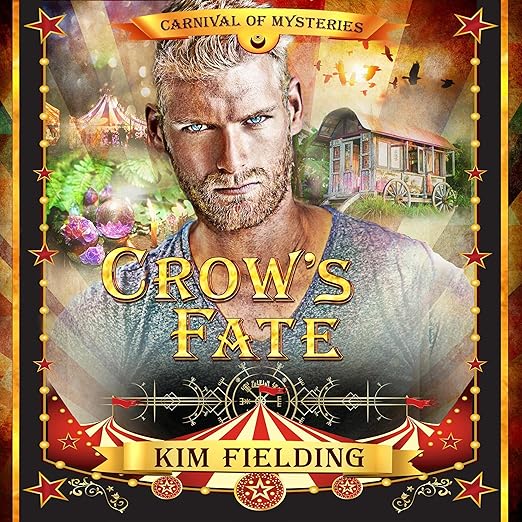
Fielding's contribution to a multi-author shared world turns out to be the least generic thing in it, which is the opposite of how these projects usually go. Crow's Fate runs eleven hours and twenty-two minutes as an audiobook, Joel Leslie carries the narrator credit, and Kim Fielding both wrote and published it. One reviewer, Wintermask, admits to being surprised at finding Fielding's name attached to a shared-world series at all, then concludes that the rest of the series now "has big shoes to fill with this as the opener."
A Closer Look at Crow's Fate
The premise is a prophecy story told with unusual patience. Crow Rapp expects to grow corn in rural Illinois for the rest of his life, the way the grandparents who raised him did. A visit to a traveling carnival produces two things instead: a handsome stranger named Simeon Bell, and a prophecy of a horrifying future. When that future arrives, Crow runs, and the book's central discovery is that distance accomplishes nothing.
What lifts it above the setup is the decade the novel is willing to spend. Simeon returns ten years later, and the question changes shape: not how to outrun a fate, but whether fighting it directly might beat another decade of fleeing. The book's own summary frames the stakes as an argument about free will, which is a heavier proposition than most romantic fantasy attempts and the reason the book needs its full length.
The shared-world frame is lighter than the series branding suggests. Every entry in the Carnival of Mysteries includes at least one visit to Errante Ame's carnival, a multiverse traveling show that changes to suit whatever world it lands on, and each book otherwise stands alone. The series field on this listing carries a name and no number, which is accurate rather than sloppy: a multi-author shared world has no reading order to impose.
What Makes Crow's Fate Worth Hearing
MetalMom's five-star review names the archetype precisely and explains why it works here. "I'm partial to a hero who carries the weight of the world on his shoulders, who fears he will be the downfall of all he holds dear, and who believes he is undeserving of love," the review begins, then places Crow squarely in that mold and calls Simeon "the perfect shiny foil to this self-destructive path." That pairing, a man convinced he is a danger to everyone and a man who refuses to accept it, is the engine of the whole book.
The novel is also more slippery than its jacket copy. "No matter what you think it is going into it, it's not what you think it is. It's more," MetalMom writes, and JKers, giving four stars, confirms the same thing from the other direction by describing a book far more serious than expected. Going in without a fixed idea of the genre is the right approach.
Joel Leslie holds the narrator credit, and this text sets an unusually explicit casting requirement. The book's own description states its contents plainly: an Illinois farmboy, a roustabout from London, and realizations about the power of love. Two leads separated by an ocean of accent, kept distinct across eleven hours and across a decade of story time in which both men change, is a specific production demand rather than a general one, and it is the thing to listen for in the opening chapters.
Where Kim Fielding Loses Some Ground
The opening is slow, and the two reviewers who say so arrive at it from opposite verdicts, which makes the agreement worth taking seriously. Carole M Stokes, at five stars, writes that "The beginning is a bit of a slow build, but build it does!" JKers, at four, puts it less forgivingly: "It took me a while to warm up to this book." Both eventually landed well, with Stokes describing "a steady increasing of depth and action throughout the story" and JKers naming the last few chapters as the turning point.
Tonal expectation is the related trap. JKers went in anticipating "something a bit more light-hearted" and got a serious start instead, noting that Crow's life is genuinely bleak in the early going. A carnival setting and a romance label both suggest lightness that the first act does not deliver. Anyone who needs early comfort from a love story should know that the comfort arrives late here, by design.
On the evidence attached to this listing, nobody has assessed the recording. The most telling detail sits in the title of D J's five-star review, which is simply a page number: the review is built around a passage the reviewer located at page 124, which is a thing only a printed edition has. All five written reviews cluster within three months of the July 2023 release, and three of the five reach for the vocabulary of reading rather than listening, so the audio edition is being bought on the strength of the novel.
One structural note for romance readers. The book asks its central relationship to survive a ten-year separation in the middle, which means the emotional momentum built in the first act has to be rebuilt in the second. Stokes calls the payoff "a rousing, exciting finish," but the architecture puts a genuine gap where most romances put escalation, and readers who want continuous forward pressure should factor that in.
Who Kim Fielding Is Writing For
Readers who like their queer romance braided into actual fantasy plotting, rather than decorated with it, are the core audience. The prophecy structure, the mythic register the description promises, and the argument about free will give the book more to do than the relationship alone. D J credits Fielding with telling a story that entertains while making the reader think about the characters, which is a fair account of the balance.
Skip it if you want a light carnival romp, since the early chapters are heavier than the packaging suggests. Anyone who dislikes a slow first act should weigh the fact that both a four-star and a five-star reviewer flagged the same thing. And listeners looking for a linear series to work through will find the Carnival of Mysteries is a shared world rather than a sequence, so nothing here builds on anything else.
Where the novel earns its length is in refusing the easy version of its own premise. A prophecy story that let its hero simply outrun the prophecy would be over in three hours. Making him stop, turn around, and argue with it is what fills the remaining eight, and on the evidence of a review pool whose only reservation concerns the opening, with nobody disputing where it ends up, the argument holds.
Key Details
- Read by: Joel Leslie faces a text that names its own casting problem, an Illinois farm boy opposite a London roustabout, held apart across a decade of story time.
- At its heart: Prophecy and free will, found family, self-worth, a decade-long separation, magical realism at a traveling carnival
- Vibe: Melancholy early, warm and mythic by the end
- Short version: A patient, unusually serious queer fantasy romance that repays the slow first act, provided you know it is coming.
Do I need to read other Carnival of Mysteries books before this audiobook?
No. The series is a multi-author shared world in which each book stands alone, linked only by at least one visit to Errante Ame's traveling carnival. The listing's series field carries a name without a number for exactly that reason. One reviewer treats this title as the opener, but nothing requires prior reading.
Is the slow opening a serious problem?
Two reviewers flag it from opposite verdicts, which suggests it is real rather than a matter of taste. A four-star reviewer took a while to warm up; a five-star reviewer calls it a slow build that does eventually build. Both describe the last stretch as the payoff, so patience is the requirement.
How explicit or light is the romance?
Lighter in tone than most carnival-set romances promise, and considerably more serious in the early chapters. One reviewer expected something more light-hearted and found a bleak opening instead. The central relationship is a devoted pairing between a self-doubting hero and the man who refuses to accept his self-assessment.
Does anyone comment on Joel Leslie's narration of this audiobook?
No. All five written reviews describe the novel, and one is built entirely around a passage the reviewer locates by page number, which only a printed edition provides. The text does set a clear casting demand, though, since the two leads are an Illinois farm boy and a roustabout from London.