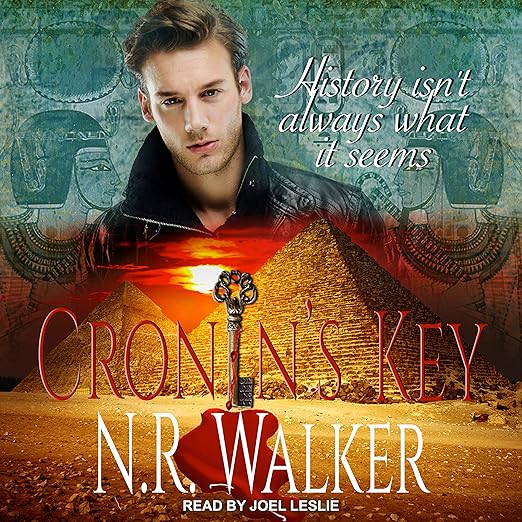
Alec MacAidan's relationship with weird is well established before the first page of Cronin's Key. The NYPD detective with a photographic memory has survived too many inexplicable near-death experiences to pretend the world operates on purely rational terms. What he is not prepared for is the man who crumbles to dust in front of him after delivering a cryptic message, because that particular variety of weird lands outside even Alec's expanded category of explainable. N.R. Walker's audiobook opens with a police procedural hook and pivots quickly into something considerably stranger and more emotionally ambitious.
Cronin has spent a thousand years waiting. He was told his fated one would be a man wielding a shield, which he interpreted as a warrior. He did not expect a police badge. He certainly did not expect the fated one to be human, which presents obvious complications when one party to the fated bond is immortal and the other is very much not. That gap between expectation and reality is where Joel Leslie, narrating the audiobook across nearly eleven hours, does some of his best work: in the comedy of the collision between Cronin's millennium of anticipation and Alec's extremely contemporary skepticism about everything.
The audiobook's narrative structure moves through three distinct modes. The opening third is a detective thriller: Alec chasing a suspect, encountering something he cannot explain, being pulled into a world he did not know existed. The middle section is the romance in its primary negotiation phase: two very different men with very unequal amounts of information about their situation trying to figure out what being fated to each other actually means in practical terms. The final third pivots to Egyptian mythology, with ancient curses, vampire covens fleeing from turmoil, and a figure with an unprecedented talent for death setting up a confrontation that takes the story to a genuinely unexpected scale.
That pivot to Egypt is the book's boldest narrative move. Reviewer V. Rundell describes Alec as learning "that history isn't always what it seems" when he encounters the firsthand truth about ancient pharaohs and Egyptian gods. Walker is doing something more ambitious than the standard paranormal romance here: building out a mythology that connects vampire politics to the deep history of human civilization in ways that have genuine internal logic. Whether that mythology satisfies depends partly on how much you want the romance foregrounded versus the world-building, but the ambition is evident and mostly well-executed.
Why Listen to Cronin's Key
Joel Leslie's narration is the audiobook's structural center. He has to make Alec's transition from detective skeptic to someone willingly operating inside a supernatural framework feel earned rather than convenient, and he does it through consistent attention to how Alec's voice changes as his understanding changes. The cop cadences of the early chapters soften as the world expands, but the fundamental directness and dry humor remain constant. Alec never becomes someone else. He becomes a fuller version of himself with access to more of the world than he previously knew existed.
Reviewer Leah describes initial hesitation about the vampire premise after what she characterizes as an influx of weak vampire romances in other media, and then being entirely won over by what this book actually does with the premise. That arc of reluctance to investment is common among readers who come to paranormal romance with fatigue about genre conventions. Walker earns the premise by taking it seriously as mythology rather than merely as a vehicle for supernatural aesthetics.
What to Watch For in Cronin's Key
The fated mate dynamic, which is central to the premise, is one of the more contested conventions in paranormal romance. Walker is aware of the potential problems: a bond that is predetermined raises obvious questions about free will and consent, and Cronin's thousand years of waiting means he arrives into the relationship with a certainty about its nature that Alec does not share. How the book handles the asymmetry of that dynamic, and whether Alec's eventual investment in the relationship feels chosen rather than merely destined, is worth paying attention to as you listen.
Reviewer Louden Sproul identifies the love story as the book's strongest element and is more ambivalent about the action-adventure framework, finding the structure of ancient curse and foreign finale somewhat familiar. That observation is accurate for genre-experienced readers. The action sequences are competent rather than revelatory. Where Walker distinguishes herself is in the interpersonal dynamics and in the specific texture she gives Cronin and his world. The thousand-year weight of waiting that Cronin carries is rendered with enough gravity that the romance feels like it has consequences beyond the immediate.
The first book in the Cronin's Key series ends in a place that is satisfying as a standalone experience while clearly establishing a world with more story in it. The Egyptian mythology introduced in the final section opens up possibilities that the sequel develops, and listeners who find that expansion exciting rather than overwhelming will want to continue directly.
Who Should Listen to Cronin's Key
This audiobook is for fans of M/M paranormal romance who want vampire mythology taken seriously rather than used decoratively, and for readers who enjoy genre hybrids that combine detective fiction with supernatural romance. Joel Leslie's narration is an asset regardless of prior familiarity with the subgenre, and the Egyptian mythology angle distinguishes this series from the standard vampire romance landscape.
Listeners who approach paranormal romance primarily for the romance and find mythology-building distracting may find the book's back third less engaging than the central relationship. Those who want the world-building to pay off in scale and ambition will find the Egyptian turn the most interesting thing the book does. The balance is weighted toward character and romance but tips meaningfully toward mythology by the conclusion, which is worth knowing before you commit your eleven hours.