The Short Version
- Performance: One credited name for a two-hander whose entire premise is rival voices working rival microphones.
- What it covers: Enemies to lovers, professional rivalry, forced collaboration, true crime podcasting as a romantic setting.
- Feel: Quick, flirtatious and comic, with the banter carrying most of the weight.
- Our call: Under three hours very well spent, provided you want a short story rather than a novel.
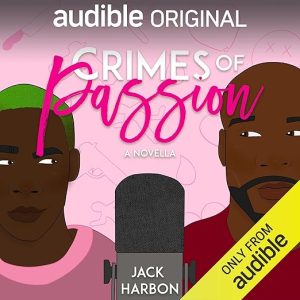
Rival true crime podcasters, shoved into one studio by a late fan's request, is the premise this audiobook runs on, and it takes two hours and forty-one minutes to deliver it. Emery Thompson cannot stand Calvin Chamberlain. Calvin cannot stand losing. The collaboration neither of them wants goes out over their microphones and the numbers climb, which is a neat way of forcing two people who talk for a living to finally talk to each other.
The Review
More than one listener here describes hearing several voices. One writes about the audiobook readers and the production making everything better, in the plural; another credits the narrators, again plural, with doing an amazing job. The narrator line names exactly one person, Kevin Free, and no second performer turns up anywhere in the credits. Something about this recording gave two separate listeners the impression of a cast, and the listing offers a buyer no way to check whether they were hearing one performer or two.
Kevin Free is therefore either doing a great deal of characterization single-handed, or the production credits are incomplete. Both explanations are interesting and the page settles neither. What can be said without guessing is that the reading made an impression strong enough that listeners reached for the language of performance rather than of reading, which on a two-hander built from dueling podcast hosts is exactly the outcome the material needs.
Whether a second performer exists matters practically, not just as bookkeeping. A listener who finishes this and wants more from the voice they enjoyed has one searchable name to work from, and if the impression of a duet came from a second uncredited artist, that artist is unfindable from this page. Queer romance in audio lives on performer loyalty, and incomplete credits break the chain that loyalty travels along.
Why Listen to Crimes of Passion
Premise does most of the heavy lifting, and it is a smart one. Setting a romance inside podcasting means the characters' profession is talking, so the banter that carries a comic romance is also the work they are doing on the page. Their rivalry has a scoreboard built in, since sponsors and audience numbers are public, and the copy uses it: one show bleeding sponsors while the other gains them is a status gap you can hear. Harbon also picks the sharper of the two possible jealousies: the historical crime host is losing to a pop-culture upstart, which stings in a way that losing to a peer never would, and it gives the eventual collaboration a genuine cost for one of them.
Comedy of this kind depends entirely on delivery, and the listening responses suggest it lands. A listener who expected a light diversion to have on while working describes ending up with something adorable and laugh-out-loud that they now own and expect to replay, which is a decent proxy for rereadability in a form where nobody rereads anything. That is a stronger endorsement than a star count, because it is a statement about behavior.
Chemistry between the leads gets handled through their microphones rather than around them, which suits audio better than most romance setups do. When the copy promises the pair crackle over the air and their numbers skyrocket as a result, the professional and romantic arcs share a single measuring stick. Short romances usually struggle to make the attraction feel earned; giving the couple a public audience that reacts to them does a lot of that work quickly.
The Caveats
Brevity is the real constraint, and one listener names it precisely, calling the pacing too quick and wishing the story had been more fleshed out while still reporting a good time overall. That is the honest trade. Under three hours buys you setup, collision, resolution and very little breathing room, so anybody who wants the slow accumulation of a full-length romance will feel the compression, particularly in the final stretch. The same compression is what makes the thing repeatable, of course, and short romance readers tend to trade depth for exactly that.
Provenance is unusually clear here, which is worth noting because it so often is not. One response opens by reproducing a three-part grade, overall, performance and story, the format used by listening platforms rather than by book retailers. That tells you the column includes people who actually listened rather than people who read a print edition and left their thoughts on the audio page, and it makes the enthusiasm considerably more relevant. The same entry singles out the invented podcast names, one of them a pun on perception and death, as a highlight of the whole thing.
Heat level is the one thing the copy asserts without specifying. The description sells the story as funny and sexy and closes on a question about giving in to the heat of passion, but nothing on the record indicates how explicit the result actually is, and no content note appears in any field. Buyers of short queer romance tend to want that settled before purchase, and this listing leaves it entirely to the sample. Running time makes the gamble small, which is the only mitigation on offer.
The Right Listener for Crimes of Passion
Romance listeners who like their enemies loud and their runtimes short should take this immediately. Queer romantic comedy at this length is not overserved, the banter is the point rather than the filler, and the podcasting frame gives it a specificity most short romances lack. True crime listeners get an extra layer, since the story teases the genre it borrows from without sneering at the people who love it.
Novel-length expectations are the thing to leave at the door. Anyone wanting a slow burn, an extended third-act separation, or a fully built world around the couple should choose something four times the size, because this cannot deliver those at this length and does not pretend to. Listeners who dislike a story resolving quickly after its central conflict lands will find the last stretch abrupt.
Charm carries it, in the end, and charm is the hardest thing to fake in a short recording. My reservation is entirely with the credits rather than the story: two listeners heard a cast, the page names one performer, and neither the publisher line nor any other field clears that up. Take the two and a half hours anyway, then go looking for the voice, and expect that search to run into a wall.