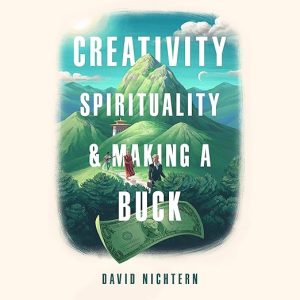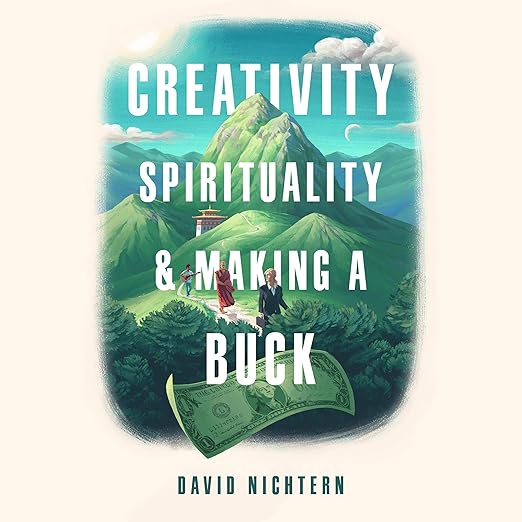
I was skeptical of the title. Books that try to hold creativity and spirituality in one hand while gesturing at financial survival in the other tend to fumble all three. David Nichtern does not fumble any of them, partly because he has been living at exactly that intersection for decades and partly because his writing has the specific confidence of someone who has thought hard about these questions rather than someone packaging received wisdom in a new cover.
Nichtern is a four-time Emmy-winning composer who has worked with Paul Simon, Stevie Wonder, Jerry Garcia, and Lana Del Rey. He is also a senior Buddhist teacher in the Tibetan tradition. The book proceeds from the premise that separating these three domains, creativity, spiritual practice, and livelihood, is itself part of the problem. He uses his own life as the primary case study without it becoming memoir, which requires a kind of discipline that not all author-narrators achieve. He narrates the audiobook himself, and at five hours and fifty minutes, the listen has exactly the right length for the density of what he is covering.
Heaven Livelihood Versus Earth Livelihood
The distinction Nichtern draws between what he calls heaven livelihood and earth livelihood is the conceptual center of the book and the idea that most reviewers circle back to. Heaven livelihood is work that comes from genuine calling, from the part of yourself that does not need external justification. Earth livelihood is the work you do to pay the bills. Most people operate in the tension between these two, and Nichtern's argument is that they are not necessarily opposed but need to be honestly reckoned with rather than collapsed into each other. One reviewer who came from a sustained Artist's Way practice found that Nichtern's framework addressed something Cameron did not: the specific ethics and mechanics of actually running a business as a creative person. That is a fair characterization of the gap Nichtern fills.
David Nichtern Narrates the Meditation Appendix Himself
Author narration can be a liability when the author reads mechanically or has not spent much time thinking about pacing and emphasis. Nichtern avoids both failure modes. He reads with the cadence of a teacher in a room rather than a performer in a studio, which suits the material perfectly. The meditation instructions in the appendix, which one reviewer describes as excellent and worth the book alone, benefit especially from his delivery: the mindfulness exercises, awareness practices, and loving-kindness instructions are read with the unhurried quality that makes them actually usable while listening. The companion PDF workbook adds an active layer that the audiobook format can accommodate if you are willing to pause and write, which Nichtern himself encourages.
A Meditation Manual, Philosophy Text, and Business Primer
This is genuinely multiple books in one, as one reviewer accurately describes it: a meditation manual, a creative philosophy text, and a practical business primer. The business sections are the most variable in quality. Nichtern's advice on protecting intellectual property, understanding basic contracts, and thinking about revenue streams is sensible but not particularly deep. It is the advice of a practitioner who has navigated these things over decades rather than a business theorist who has mapped them systematically. Listeners who want sophisticated entrepreneurial strategy will find this section adequately useful rather than revelatory. The strength of the book is in the integration thesis and in the meditation practices, not in the mechanics of business planning. The workbook exercises, which Nichtern advises printing out and completing seriously, are where the practical application lives.
Best for Creatives Torn Between Art and Income
Creatives who have tried to separate their artistic identity from their financial survival and found the separation exhausting will find Nichtern's integrative framework genuinely useful. Buddhist practitioners who also run creative businesses will find this unusually attuned to their specific situation. Listeners who have worked with The Artist's Way and want something that takes the question of livelihood more seriously than Cameron does will find the comparison useful. Those who want a deep business strategy text should look elsewhere: this is a philosophy of creative life with business application rather than a business manual with creative inspiration.
Before You Press Play
- Read by: David Nichtern narrates his own book with the easy authority of someone who has taught this material for decades, making the meditation instructions feel genuinely personal rather than prescriptive.
- At its heart: The integration of creative practice, spiritual discipline, and sustainable livelihood; the ethics of commerce
- Vibe: Warm, funny, and practically grounded
- Short version: One of the more honest books about making a living as a creative person, better for its unwillingness to separate the spiritual from the financial.