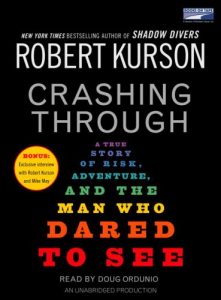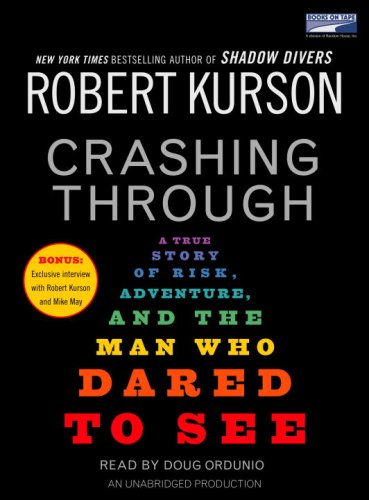
Blinded at three years old, Mike May spent the next four decades building a life that never waited for sight to return: setting downhill speed-skiing world records, working for the CIA, becoming a successful inventor and entrepreneur and family man, all without ever particularly yearning for vision he could not remember having. Robert Kurson, the author of the acclaimed Shadow Divers, turns that life into the setup for this audiobook's real subject: the true story of a 1999 chance encounter that raised the possibility of an experimental stem cell transplant that might actually restore May's sight.
The questions Kurson lets May sit with are the real spine of the book, and they are stranger than they first sound. Would music still sound the same? Would sex feel different? Would he even recognize his own face in a mirror? Would his marriage survive a version of him who could suddenly see his wife rather than know her only through years of accumulated non-visual intimacy? Fewer than twenty people worldwide had gained vision after a lifetime of blindness before May's case, and Kurson does not soften how badly several of those cases had gone.
Restored Sight as a Genuine Unknown
Doug Ordunio proves a reliable, competent narrator for exactly the dual demands this book places on him: adventure pacing for May's pre-surgery life, downhill skiing runs and CIA fieldwork, and a genuinely different register for the neuroscience of vision that dominates the book's second half. He handles that shift in speed without drawing attention to the seams, which matters for a book that keeps moving between adrenaline and clinical explanation without much warning.
What elevates Crashing Through above a standard inspirational disability narrative is exactly that neuroscience framing. Kurson does not treat restored sight as an unambiguous happy ending waiting to happen; he treats it as a genuine unknown, backed by a small, mostly discouraging body of real case history, which makes the book considerably more philosophically unsettling than the genre's usual triumph arc. A 4.4-star average across nearly six hundred ratings suggests listeners respond to that honesty rather than resent it.
The Specific Skills That Made Him Effective
The CIA chapter of May's pre-surgery life gets treated with the same matter-of-fact confidence as everything else Kurson covers. A blind man working in intelligence sounds almost like a premise from fiction, and the book resists turning it into either an inspirational stunt or an implausible curiosity, instead grounding it in the specific skills, acute hearing, memory, spatial reasoning, that made May genuinely effective at the job rather than merely tolerated in it.
The marriage question in particular gets handled with real emotional specificity rather than treated as an abstract worry tacked on for drama. It becomes one of the book's most quietly affecting threads precisely because Kurson refuses to resolve it early, letting a listener sit with the same genuine uncertainty May's own wife must have felt as the surgery date approached.
Split-Second Trust at Genuinely Dangerous Speed
The comparison to Shadow Divers is a genuinely useful one for anyone trying to decide whether this book is for them: the same instinct for turning a true, meticulously reported story into something that reads with a novel's forward pull, applied here to ophthalmology and neuroscience instead of shipwreck diving. Listeners who found that earlier book's blend of adventure and hard research compelling will recognize Kurson's method immediately.
May's life before the surgery gets equal narrative weight to the medical drama itself, and that balance matters: by the time the operation actually happens, a listener has spent enough time inside May's fully realized, successful blind life that the question of whether restored sight is even worth the risk lands as genuinely open, not a foregone conclusion the book is simply building toward.
The downhill speed-skiing record gets similarly grounded treatment: competitive blind skiing relies on a sighted guide skiing just ahead, calling out terrain and turns in real time, and Kurson's description of that partnership, split-second trust between two people at genuinely dangerous speed, becomes its own quiet argument for how thoroughly May had already built a full, fast, unafraid life before any surgeon ever entered the picture.
Handled Clearly by Ordunio, but Still Technical
Some of what happens in the operating room and its aftermath is described in enough clinical, honest detail that squeamish listeners may need to brace for it, particularly given how directly Kurson engages with the small number of prior cases where restored sight went badly wrong. This is not a book that looks away from risk to preserve an uplifting tone.
Because the book spends real time on the neuroscience of how a brain that has never processed visual input might or might not learn to interpret it, listeners expecting a purely biographical, emotionally driven memoir should know upfront that a meaningful portion of the runtime is dedicated to genuinely technical explanation, handled clearly by Ordunio but technical nonetheless.
Deep, Patient Interviewing Behind Every Scene
Kurson's reporting style throughout leans on extensive direct access, detailed scene reconstruction that suggests deep, patient interviewing rather than secondhand research, and listeners who appreciate that specific brand of immersive narrative journalism, built from years of access rather than a single interview, will recognize the same rigor that made Shadow Divers land as more than just an adventure story.
The book's structure itself, extensive pre-surgery biography before the medical narrative even begins in earnest, means listeners eager to reach the operation itself may find the opening hours feel like a delay. That patience is rewarded once the medical story starts, but it is worth knowing upfront that Kurson takes his time getting there rather than rushing toward the central event.
A Refusal to Flatten Real People Into Shapes
Readers of Shadow Divers, or anyone who enjoys true stories that combine genuine adventure with real scientific stakes, are the clearest audience, and the ten-hour runtime moves briskly enough that the science never bogs down the human story it is in service of.
Kurson's other narrative nonfiction, built around ordinary people making extraordinary, high-stakes decisions under real uncertainty, gives this title a reliable home for listeners who already trust his particular brand of deeply reported, novelistic nonfiction, even before knowing anything about Mike May's specific story going in. The throughline across his books is less a fixed subject than a fixed method: total access, patient reconstruction, and a refusal to flatten real people into simple inspirational shapes.
Squeamish listeners uneasy with detailed medical description, or anyone wanting a simple, uncomplicated triumph narrative rather than a genuinely uncertain outcome, should brace themselves or adjust expectations before starting. Everyone else drawn to a true story willing to sit with real ambiguity about what regaining a lost sense actually costs will find this among the stronger entries in the genre.
Frequently Asked Questions
Does this audiobook end with Mike May regaining his sight successfully, or is the outcome more complicated?
Without spoiling specifics, Kurson treats the outcome as genuinely uncertain throughout, grounding that uncertainty in a small, largely discouraging history of prior cases rather than guaranteeing a clean triumph.
How does this audiobook compare to Robert Kurson's earlier book Shadow Divers?
It shares the same narrative approach, meticulously reported true events told with novelistic pacing, applied here to blindness and experimental medicine instead of shipwreck diving.