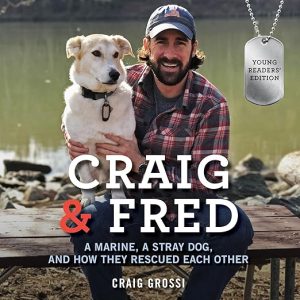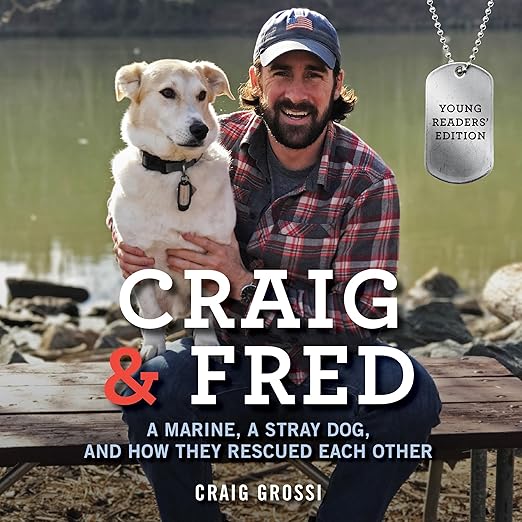
Adaptations for younger readers usually lose something, and the thing they lose most often is the adult's willingness to sit inside discomfort. Craig Grossi's account of finding a stray dog in the Sangin District of Afghanistan had every reason to arrive here sanded down into a pet story. It does not. This audiobook keeps the deployment, the danger and the slow business of coming home, and it lets an eight-year-old walk through all three without being lied to. Grossi reads it himself, which matters more than any other production decision attached to the release.
A Small Breach of Protocol Becomes Fred
The setup is deceptively simple. Grossi was sent with an elite Marine team to one of the most dangerous postings of the war and expected exactly what he got: harsh conditions and Taliban fighters. What he did not expect was a filthy stray covered in bugs, with what the copy calls "a big goofy head and little legs", carrying himself through a bomb-ridden district with complete confidence. Marines are not supposed to approach strays. Grossi offered food and a pat anyway, and the dog wagged his tail. Everything that follows comes out of that one small breach of protocol.
The second half is the part that lifts this above the genre. Fred comes home, and Grossi does not, at least not immediately, because acclimating to civilian life is its own campaign and the dog turns out to be load-bearing in it. One reviewer, mamaof6, read the book aloud to four children between eight and eleven and describes it as "an excellent, captivating, gentle-enough introduction to the military, war, and the aftermath of healing that needs to take place in those who serve our country". Her sentence breaks off mid-thought after that, but the phrase she reaches for is the right one. This is a book about aftermath as much as about a rescue.
Enthusiastic About the Text, Silent on the Recording
Self-narration is doing real work here. The voice describing that district belongs to the person who was standing in it, and no casting decision could substitute for that. It is worth being precise about what the listing can and cannot tell you, though: all three attached reviews describe reading the book, one aloud to a family, one as a chapter book a boy carried around for four days, one as a summer reading assignment shared with a son. They are enthusiastic about the text and completely silent on the recording. So the case for the author's voice is structural rather than something the review pool has tested for you.
The read-aloud argument is the practical one. At five hours and twenty-two minutes this is roughly a week of bedtimes or one long drive, and the parent who would otherwise be doing the reading gets to listen alongside the child instead. Given that mamaof6's use case was literally reading it out loud to four children at once, an audio edition solves a problem that family already had.
Then, of course, the dog. Fred is a genuine character rather than a device, and the stubborn positivity the copy credits him with is the emotional engine of both halves. Sara, who read the adult version first and loved it, bought this edition for her eight-year-old son and reports that it was "the first chapter book that he would NOT put down", travelling everywhere with the family for four days. That is a specific, checkable claim about how a reluctant reader responded, and it is more useful than any general recommendation.
The Young Readers' Framing Will Feel Managed
The first thing to be clear about is that this is an adaptation. Sara's review makes the two-edition situation explicit, and she is the right guide: adults who want the full texture should buy the grown-up memoir. If you are listening for yourself rather than with a child, the young readers' framing will feel managed, and you will notice the places where the harder material has been eased rather than removed.
The war content is gentle, but it is still war. Sangin, bombs, Taliban fighters, and the healing that comes afterward are all on the page. The age band the reviews actually establish is eight to eleven, which comes from families who used it rather than from a publisher's guidance, and a sensitive six-year-old is not the target. Preview it if you are unsure, particularly the sections dealing with what deployment leaves behind.
Finally, the recording itself is untested by the commentary on this listing. Three hundred and thirty-one ratings averaging 4.8 is a strong pool, but those ratings attach to the story, and the written reviews all describe print. If you care about how a first-time author-narrator paces a chapter book, or about pronunciation of Afghan place names, spend two minutes on a sample before committing. That is not a warning so much as a reasonable precaution given what the evidence here actually covers.
The Same Virginia Schools Craig Once Attended
This is squarely aimed at families with children roughly eight to eleven, at classrooms running summer reading, at military households looking for something a child can share, and at anyone who has ever brought home an animal that turned out to be the one doing the rescuing. The reach can be surprisingly specific: shopper7 listened with a son who had been assigned the book, and found a double connection, since her son attends "the same schools that Craig did here in Virginia" and her son-in-law deployed to the same regions of Afghanistan as a dog handler.
I would hand this to a nine-year-old who has started asking what a deployment actually is, and to the adult who does not quite know how to answer. Give it a pass if you want the adult memoir's full range, if your household is not ready for the war frame at all, or if you are hoping for a light animal story with the difficult parts taken out, because the difficult parts are exactly what this edition keeps.
Common Questions
How does this audiobook differ from the adult version of Craig and Fred?
It retells the same story for a middle-grade audience, shorter and with the roughest material eased rather than cut. One reviewer read the adult book first, loved it, then bought this edition for her eight-year-old. Expect the deployment, the rescue and the homecoming, told at a length a chapter-book reader can carry alone.
What age range does this audiobook actually suit?
The reviews establish eight to eleven, including a family who went through it together and a boy assigned it for summer reading. Younger children may want a parent nearby for the combat material. Older middle-graders will find it short rather than simple at five hours and twenty-two minutes.
Does Craig Grossi narrate the book himself?
Yes. He is credited as both author and narrator, so the man who found Fred in Sangin is the one telling you about it. None of the three attached reviews comment on the recording itself, so the quality of the delivery is something a sample will settle faster than the ratings will.
Is the war content too intense for a young listener?
One reviewer who read it aloud to four children between eight and eleven calls it a gentle-enough introduction to the military and to the healing that follows service. It does not pretend Sangin was safe. Preview it yourself if your child is under eight or sensitive to combat settings.