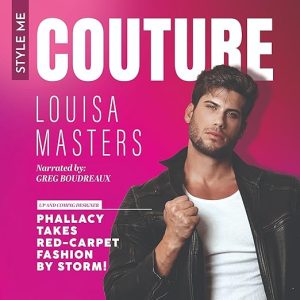
Two men who do not use words meet in a room where everything depends on talking. Phil, co-owner of a rising label, goes nonverbal when his baseline stress climbs. Griff Pevensy, the celebrity stylist standing between him and the awards gown that could change his business, is an ex-Marine who, in the book's own phrasing, 'prefers to communicate in grunts'. That collision is the design of the whole novel, and it makes Couture a stranger and more interesting audiobook than a fashion-world romance usually is.
Phil and Griff Share One Language Problem
Louisa Masters has built a romance where the central obstacle is not a secret, a rival or a misunderstanding about someone's intentions. The obstacle is language itself, distributed across both leads in opposite forms. One cannot speak when it matters most; the other will not speak more than he has to. Putting those two people in a professional negotiation where a silent meeting reads as disinterest is a genuinely clever piece of construction, and it earns the plot the emotional stakes that a story about awards-season dressmaking would otherwise have to manufacture. The arrangement also makes the love interest the professional obstacle, since the copy calls him 'gatekeeper Griff' outright. That is a harder balance to hold than a rival or an ex, because every romantic advance doubles as a business one.
Four of this listing's five reviews single out the same thing, which is unusual consistency. Ana Silva writes that the handling of Phil's anxiety and selective mutism was 'respectful and insightful'. Another reviewer calls the mental health representation 'so well researched it showed how Phil suffered, how he hated being put in that position but how well his found family helped'. Maude Allen describes watching Griff make Phil feel safe. Laurel simply says the representation was 'so interesting and well-written'. When four readers independently name the same element, that element is the book.
Which reframes the trope that romance readers complain about most. Two of the reviewers use the word miscommunication about the opening, and a third describes the first meeting as a mixed bag of understandings and misunderstandings. Ordinarily that is a contrivance, a problem two adults could solve in one honest conversation. Here the silence has a cause, stated plainly in the setup: a mostly wordless meeting plus a design that is not the stylist's taste. That distinction matters more to me than it may sound, because the trope arrives motivated rather than imposed, and one reviewer who says outright that miscommunication usually annoys them still came away satisfied.
Greg Boudreaux Paces Silence Where Print Uses Space
Greg Boudreaux holds the narrator credit, and this book hands a reader a problem most romances never pose. The story is told in first person by a man whose defining trait is that he stops producing speech under pressure, which means the recording has to convey a character's interior fluency alongside his external silence, repeatedly, without a page break to mark the difference. Print does that with white space and paragraphing. Audio has to do it with pacing. My honest curiosity about this edition sits entirely in how the silent scenes are handled, because they are the ones the plot turns on.
The world around the couple is doing more work than it gets credit for. A label named Phallacy tells you the register before anything else does, half joke and half provocation, exactly the kind of name a young house picks to get noticed. Around that sit Griff's princess of a dog, a designer's best friend and business partner, and a group of friends the setup describes as codependent, whom Laurel praises for being sassy and fun as well as protective. Romance lives or dies on whether the supporting cast feels like a life rather than a set.
On heat, the reviews are helpfully direct. Ashley C reports that once the initial misunderstanding clears and the two start talking properly, it is 'no holds barred', describing them as 'fast and steamy and beautiful together'. Seven hours is a comfortable length for a contemporary romance, long enough to earn a relationship and short enough to finish across a weekend. As the opening volume of the Style Me series, it carries the extra job of making you want the next one, and Laurel's closing line suggests it managed that.
Most Reviews Here Predate This March Recording
The mutism is the engine, not a detail, and that cuts both ways. Readers who came for fashion, glamour and a red-carpet payoff will get those things wrapped around a sustained portrait of what acute anxiety actually costs the person carrying it. The book is warm and it resolves happily, but the difficulty is not decorative. Anyone using romance as pure escape should know the weight is genuinely there.
Miscommunication remains miscommunication, however well motivated. If the beat where two people fail to say the obvious thing makes you close a book regardless of the reason, the opening will still test you, since the whole first act depends on a meeting going wrong for want of words. The reviews suggest the resolution is quick and the payoff worth it. Reader tolerance for that specific structure varies more than almost any other preference in the genre.
Adjust expectations for a self-published series opener. The publisher name on this listing is the author's own, the recording arrived in March 2026, and four of the five reviews were posted before that date, describing the text rather than this edition. An average of 4.6 from 266 ratings is a healthy signal about the writing. Anyone curious about the performance itself should play a sample first.
Grumpy and Anxious Leads Pair Well Here
Contemporary male-male romance readers who like their leads competent at work and clumsy in feeling are the obvious fit, and so is anyone actively seeking disability and mental health representation handled with care rather than as a plot device. The fashion setting is a real draw too, since the industry detail is specific enough to be interesting without turning into a procedural. Readers who enjoy a grumpy, monosyllabic love interest paired with a more anxious partner will find that dynamic given an unusually literal treatment.
Low-angst comfort with no clinical weight is the wrong expectation here, since the anxiety is written as painful rather than quirky. Readers who need romance plots free of any misunderstanding at all should also stay away, as should anyone who prefers a closed-door heat level, given how directly the reviews describe the physical side. And listeners who want a finished, self-contained world should note this opens a series, with the friend group already positioned for books of their own.
Good to Know
How does the audiobook handle a first-person lead who goes nonverbal?
That is the central question of this edition. Phil tells his own story while losing access to speech under stress, so the recording has to keep his interior voice fluent while his external one disappears. Print marks that shift with layout. Audio has to manage it through pacing, which is worth sampling for.
How explicit does Couture get?
Openly so, once the couple stops misfiring. One reviewer reports the pair becoming explicitly physical with nothing held back after the professional obstacle between them clears. Expect on-page intimacy rather than a fade to black, arriving mostly in the back half, alongside a relationship the same reviewer describes in warm rather than clinical terms.
Is this audiobook a bad choice for readers who hate the miscommunication trope?
Less than you would expect. The failure to communicate has a stated cause rather than being the usual contrivance, and a reviewer who admits to hating the device generally reports being won over by this one. If any version of that beat ruins a book for you, the first act will still be a hurdle.