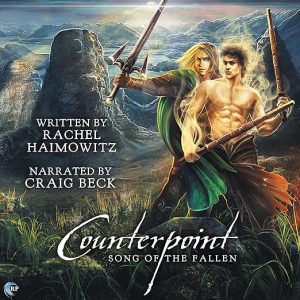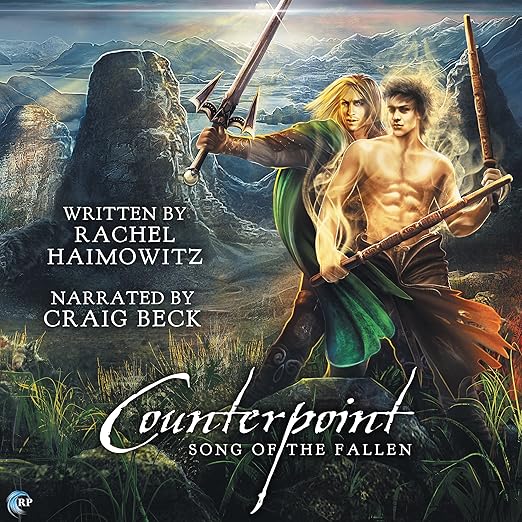
An elf kneels in chains before a human prince, and the audiobook built on that image runs close to twelve hours. Ayden has spent his life on two emotions, love for his sister and hatred of everything human, and he is captured in battle and enslaved into the service of Freyrik Farr. Freyrik rules a midlands the publisher's copy calls rotting with decadence and despair, in a war that has ground both peoples toward extinction. Rachel Haimowitz puts the two of them in a room and lets the pressure do the rest.
The Verdict, Briefly
Haimowitz has written a slow political fantasy with a love story running through its center, which is a different animal from a romance with a fantasy backdrop. Lexi, whose notice is the fullest on the page, calls it a stunning fantasy romance and then supplies the more useful description: the love story is "a slow, angsty burn", offered there as a recommendation rather than as a warning. That phrase is the honest summary of the pacing. Lexi also reaches for Marion Zimmer Bradley and Tolkien as comparisons, which is ambitious and still points in roughly the right direction. Nothing here moves quickly, and the obstacle between the two men is not a misunderstanding but ownership, prejudice and the political survival of two species.
Marv N came to the book as only a second gay-themed purchase, with no prior knowledge of the author, and the resulting notice is about the worldbuilding rather than the couple: the mix of medieval texture and fantasy invention was convincing enough to half suggest an alternate version of Earth's own past. That is a specific and unglamorous compliment, and it tells you the setting is doing real work rather than sitting behind the leads as scenery. Fantasy romance that can hold a reader who came for neither the fantasy nor the romance has usually built something solid underneath.
Structurally the book earns its title. Two peoples, two perspectives, two claims on the same shrinking territory, and a romance that is also a negotiation between species. Haimowitz keeps the counterweights balanced for most of the runtime, which is harder than it sounds when one man legally owns the other, and the moments where the book tilts are the moments it is most alive.
What Makes Counterpoint Worth Hearing
Politics are the reason to stay past the first few hours. Freyrik is described as teetering on a dagger's edge between duty and high treason, and that language is not decorative: every private decision about Ayden is also a public decision about a kingdom losing a war. Elfkind, meanwhile, watches from a distance and waits for nature to run its course on humanity. The romance and the war turn out to be one plot, which is rarer in this subgenre than you might expect.
Annabelle points at something interesting for a listener, noting that the chapters avoid first person while confining themselves to one character's thoughts at a time, so you get a tight alternating close third rather than a pair of competing I-voices. On the page that is a typographic convention you absorb without noticing. Heard aloud, the handoff between heads has to be carried by the writing and by a single credited reader, and the chapter architecture is clean enough that it works.
Its score is more informative than most, and worth pausing on. An average of 4.1 across 218 ratings is not a curated number and not a number a small enthusiastic circle can produce, and the visible pool sets a one-star abandonment beside three five-star notices and a four-star. A book provoking both reactions is usually doing something specific rather than something safe, and here the specific thing is pace plus premise, which readers either commit to or walk away from within a couple of hours.
Points to Consider
An ending is the one thing this book does not supply, and William Schatzabel states that plainly: the story has everything except an ending, and it continues in a second volume. This is book one of Song of the Fallen. That notice is candid about the objection being a personal preference formed by growing up on weekly serials, but the information stands regardless. Budget for a sequel before you start, or wait until you are willing to.
Read the one-star notice in full before you buy. Sofia Boquist describes only a second abandoned book ever, dropped at the halfway mark, and calls the story boring and slow going. Set that against the deliberate pace its admirers praise and you have the same property of the book described from opposite sides. Whether twelve hours of deliberate pace reads as luxurious or interminable is the single question you need to answer about yourself.
Chronology complicates the score badly. This recording is dated September 2016, while four of the five notices were filed between January 2011 and January 2013, and the fifth in 2023. None of them mentions the recording. So the 4.1 average and everything written beneath it grades Haimowitz's prose, and Craig Beck's reading remains publicly ungraded. If performance is what you are trying to assess, this page will not help you and a sample will. That is a common enough situation with a book whose print life began years before anyone recorded it, and it is worth recognizing rather than assuming the score covers everything.
Finally, be clear about the premise you are buying. The book opens with a prisoner of war held as property by the man he comes to love, and it treats that imbalance as its central problem rather than as a costume. The handling is serious and the narrative knows what it is doing, but this is not a light enemies-to-lovers setup and it never becomes one.
The Right Listener for Counterpoint
Commit to it if you want fantasy romance where the world has consequences, if slow burn means slow to you rather than three chapters, and if you can accept a first volume that stops rather than concludes. Readers who like being submerged in older, statelier fantasy will find the prose congenial, and the political material rewards the patience it demands.
Leave it if you need a self-contained story, if a slavery premise inside a romance is a line for you, or if you want heat arriving early. Twelve hours is a long time to spend waiting for two people to admit something, and this book takes most of them. Nothing about it is in a hurry, and that is either the appeal or the deal-breaker.
Questions Listeners Ask
Does the Counterpoint audiobook have a complete ending?
No. One reviewer says flatly that everything is here except an ending and that the story carries on into a second volume. This is the first book of Song of the Fallen, and both the romance and the war are left open. Plan on continuing, or wait until you are ready to.
Do any reviews describe the audiobook narration?
Not one of them. Four notices were filed between 2011 and 2013, years before this September 2016 recording existed, and the fifth stays silent on the subject. The 4.1 average therefore grades the writing rather than the performance, so judge Craig Beck's work from a sample.
Is the slavery premise treated seriously?
Yes. The book builds its politics around the imbalance between a captive elf and the prince who owns him rather than using it as flavor, and the consequences persist rather than dissolving once the attraction starts. Readers who find that setup difficult will not find it softened later.